October 9, 2026 · Moeed
333 Angel Number Meaning: Career, Twin Flames & Signs
Many people notice the same digits on a receipt, a license plate, or a clock face. A repeating pattern such…
 Moeed
Read more
Moeed
Read more

Moeed
Moeed is the Content Head…
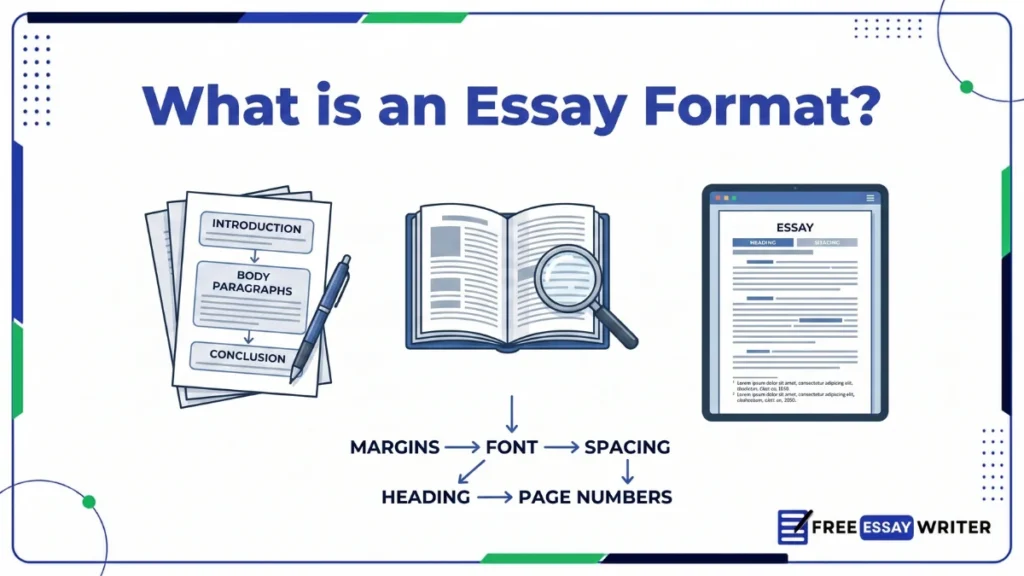
Essay format and structure are the two most important parts in writing an essay. A strong essay format not only helps you present your ideas effectively, but also makes your writing professional. In this article, you will learn how to format an essay using different formats, along with the essay structure that you will need to follow in your academic writing assignments or timed exams.
Free templates included: You’ll find ready-to-use MLA, APA, and Chicago templates later in this guide. There’s no need to set anything up, just download a template and start writing.
Essay format refers to the rules and structure used to organize and present an essay. It covers both the way an essay is structured and the formatting requirements used to present information, cite sources, and document references. While most essays follow a basic structure of an introduction, body paragraphs, and conclusion, the specific formatting requirements can vary depending on the required citation style.
Each style has its own rules for elements such as page layout, headings, in-text citations, footnotes, and reference or bibliography pages. Following the required essay format helps ensure that your work is organized, consistent, and properly credits the sources you use.
There are four most common types of essay formats used in high school assignments, college essays, and research papers. Below is an overview of the most common formats.
| Feature | MLA | APA | Chicago | Harvard |
|---|---|---|---|---|
| Font | 12-pt Times New Roman | 12-pt Times New Roman, 11-pt Calibri, 11-pt Arial, or 11-pt Georgia | 12-pt Times New Roman | Varies by institution |
| Spacing | Double-spaced | Double-spaced | Double-spaced (single-spaced for block quotes, footnotes, bibliography) | Double-spaced |
| Margins | 1 inch, all sides | 1 inch, all sides | 1 inch, all sides | 1 inch, all sides |
| Indentation | 0.5″ first-line indent | 0.5″ first-line indent | 0.5″ first-line indent | 0.5″ first-line indent |
| Commonly used for | Humanities and English literature | Social sciences, education, psychology | History, humanities, and various academic fields | Various university subjects and disciplines |
| In-text citation | Author and page number | Author and year | Footnotes/endnotes or author-date | Author and year |
| Example citation | Basic: (Smith 24) No author: (“Title” 12) 3+ authors: (Smith et al. 114) | Basic: (Smith, 2022) Direct quote: (Smith, 2022, p. 45) 3+ authors: (Smith et al., 2021) | NB: superscript¹, footnote: 1. Smith, Title (City: Publisher, 2022), 45. Author-Date: (Smith 2022, 45) | Basic: (Smith, 2024) Direct quote: (Smith, 2024, p. 45) 3+ authors: (Smith et al., 2024) |
| Main source page | Works Cited | References | Bibliography or References | Reference List |
| Source ordering | Alphabetical order | Alphabetical order | Alphabetical order | Alphabetical order |
| Separate title page | Usually unnecessary for standard papers | Depends on student or professional requirements | Often used, depending on requirements | Depends on institutional guidelines |
| Page number placement | Top-right, paired with last name | Top-right, number alone | Top-right, number alone | Varies by institutional requirements |
| Main distinguishing feature | Author-page citation system | Author-date citation system | Flexible notes-and-bibliography or author-date system | Institution-specific author-date system, no single official manual |
An essay generally has two aspects: format and structure. A format refers to the specific reference or citation style and the formatting a document follows. On the other hand, a clear structure shows how your content is organized in a logical and coherent order.
Most essays typically follow the same basic structure of introduction, body paragraphs, and the conclusion. The section below will explain how an essay is structured.
The title is basically the topic of your essay. This is the part that comes at the top. The exact formatting depends on what your essay prompt requires. In addition, a strong title is concise, reflects your thesis or main argument, and avoids being lengthy.
The introduction is the opening section of an essay that introduces necessary background information and context about your topic. This is the part that establishes the main point of your essay.
The most important part of an introduction is a hook. A hook is the first line of the essay that grabs a reader’s attention. It can begin with a fact, statistic, example, question, or a statement.
Additionally, how your essay begins matters for leaving a lasting impression on your readers. Therefore, it should be compelling enough to prompt a reader to follow through.
Note: The introduction of an essay typically makes up about 10-20% of the total word count. These figures are general guidelines, and there is no fixed word count you have to follow for each section. The exact length of all the sections of an essay depends on the instructions given in the prompt and the topic complexity.
A thesis statement is the core argument that will be argued in the later sections of your essay. It usually appears near the end of the introduction. Additionally, it is one to two lines long and gives readers an idea of why you are writing an essay on a specific topic.
The body of your essay is the most critical part of your entire content. This section is written to prove your thesis statement with relevant facts, examples, statistics, or logical reasoning. Body paragraphs typically have no limit.
They can either be a single paragraph, two paragraphs, or even five paragraphs for longer word counts. Each new paragraph begins with a topic sentence (single idea) which you then prove with relevant content (facts, examples, stats, logic, and reasoning).
Additionally, you must use transition words (moreover, therefore, and, so, etc.) to create a logical connection from one paragraph to the other. This helps in keeping your content coherent and easy to follow.
Note: Body paragraphs make up about 60-80% of the total word count. This section needs to contain all the relevant information about your topic. So, be mindful of your introduction and conclusion’s word count.
Pro tip: As a benchmark, a standard double-spaced academic page is usually 275 words. It helps you estimate the number of pages your body paragraphs will span.
An essay’s conclusion summarizes the entire essay in a single paragraph. It should briefly discuss your topic sentences and then support your thesis statement at the end to show how you proved the core argument of your essay.
Furthermore, how you end your essay matters a lot. A strong ending should leave a lasting impression on your readers, prompting them to discuss your point of view.
A strong conclusion avoids:
Note: The conclusion of an essay typically makes up about 10-15% of the total word count.
These five elements form the basic structure for most of the essays. Combined with the correct format (MLA, APA, or Chicago), this gives your essay a polished and professional look.
Although each formatting style has its own formatting requirements, most academic essays still follow standard formatting rules. Knowing how to format essays correctly starts with understanding the standard formatting guidelines most essays follow, which are explained below.
Set one-inch margins on all four sides of every page. This is the standard across MLA, APA, and Chicago styles.
Use a readable font style and size for your essay writing assignments. Times New Roman font with 12-point font size is the most widely used convention across all three styles. However, APA offers more flexibility with conventions like 11-point Calibri, 11-point Arial, or 11-point Georgia.
Use double line spacing for the entire body text, including between paragraphs. Don’t add extra space before or after a paragraph, as double spacing provides enough separation.
Indent the first line of every body paragraph by 0.5 inches from the left margin. Use the tab key or your word processor’s paragraph settings rather than manually pressing the space bar, which can create inconsistent spacing.
Usually, page numbers go to the top right of every page, though exact formatting may vary according to your prompt’s instructions. In MLA and Chicago styles, the page number is usually paired with your last name. On the other hand, APA typically places only a page number, unless your assignment requires a running head.
Most essays left-align the text rather than fully justified alignment. Justified text often creates uneven spacing between words, which can hurt readability and look unprofessional. As a result, most standard essays require left-alignment.
Note: These are standard formatting guidelines used in most of the essays. Always check your assignment instructions first; if your instructor specifies a different font, spacing, or margin requirement, follow their guidance over the standard style-guide rules.
MLA (short for Modern Language Association) is one of the most common styles in subjects like Humanities, English composition courses, literature, languages, and cultural studies. Its most recent conventions come from the MLA Handbook, 9th Edition, published in April 2021 by the Modern Language Association.
Note: If you find the formatting in a Word document extremely complex and time-consuming, we have a free downloadable template you can use, where you will just have to write your essay. Download the MLA essay format, where you can simply copy-paste your entire essay without worrying about finding those formatting options.
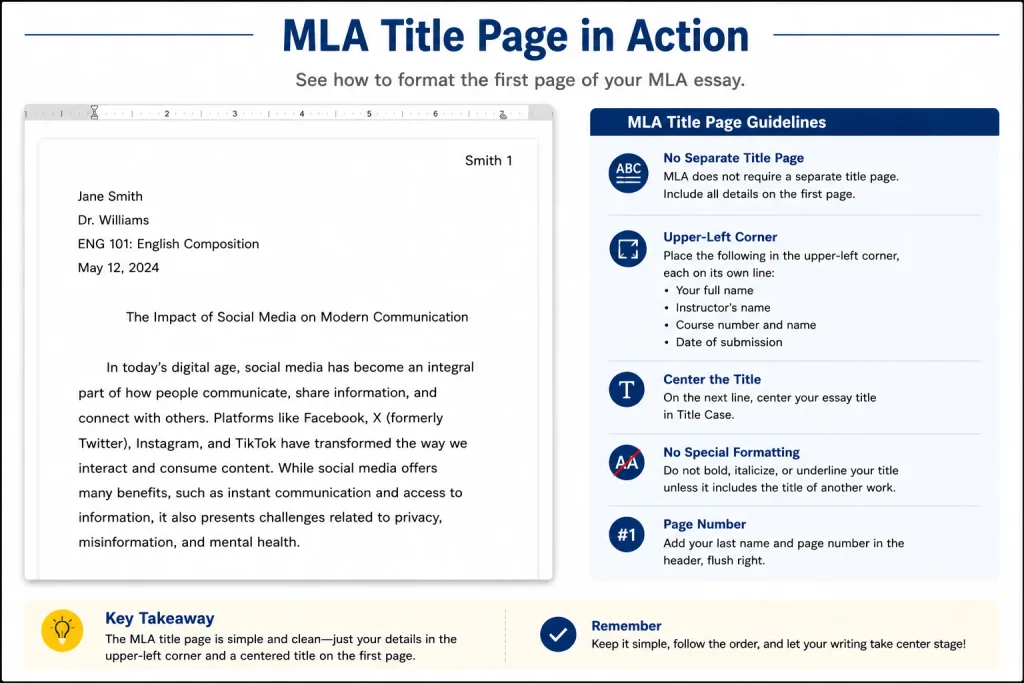
A separate title page is not required in MLA style. Instead, place the following in the upper-left corner of the first page, each on its own line:
In the next line, center your essay title in title case. Do not bold, italicize, or underline your own title unless it includes the title of another work.
Note: If your instructor specifically requests a separate title page (common for group projects or longer papers), follow their exact instructions rather than the standard MLA layout.
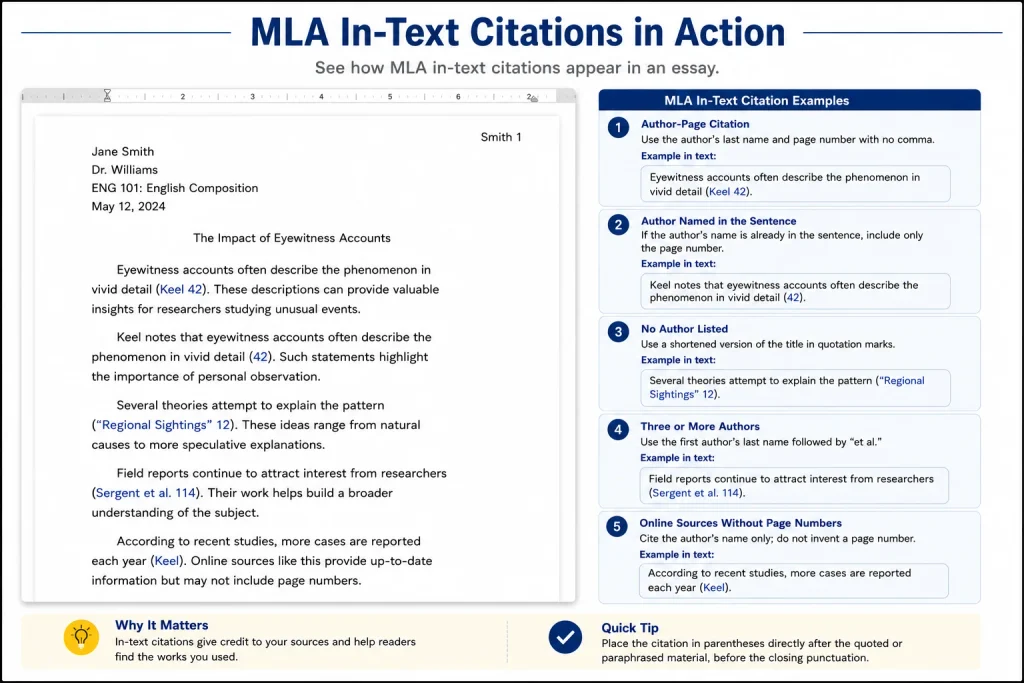
MLA essay format uses an author-page citation system, with no comma between the name and the page number. Place the citation in parentheses directly after the quoted or paraphrased material, before the closing punctuation:
Example:
Eyewitness accounts often describe the phenomenon in vivid detail (Keel 42).
If you’ve already named the author in your sentence, include only the page number in parentheses:
Example:
Keel notes that eyewitness accounts often describe the phenomenon in vivid detail (42).
If a source has no listed author, use a shortened version of the title instead:
Example:
Several theories attempt to explain the pattern (“Regional Sightings” 12).
If a source has three or more authors, name only the first author followed by “et al.”:
Example:
Field reports continue to attract interest from researchers (Sergent et al. 114).
For online sources without page numbers, cite the author’s name alone; never estimate or invent a page number.
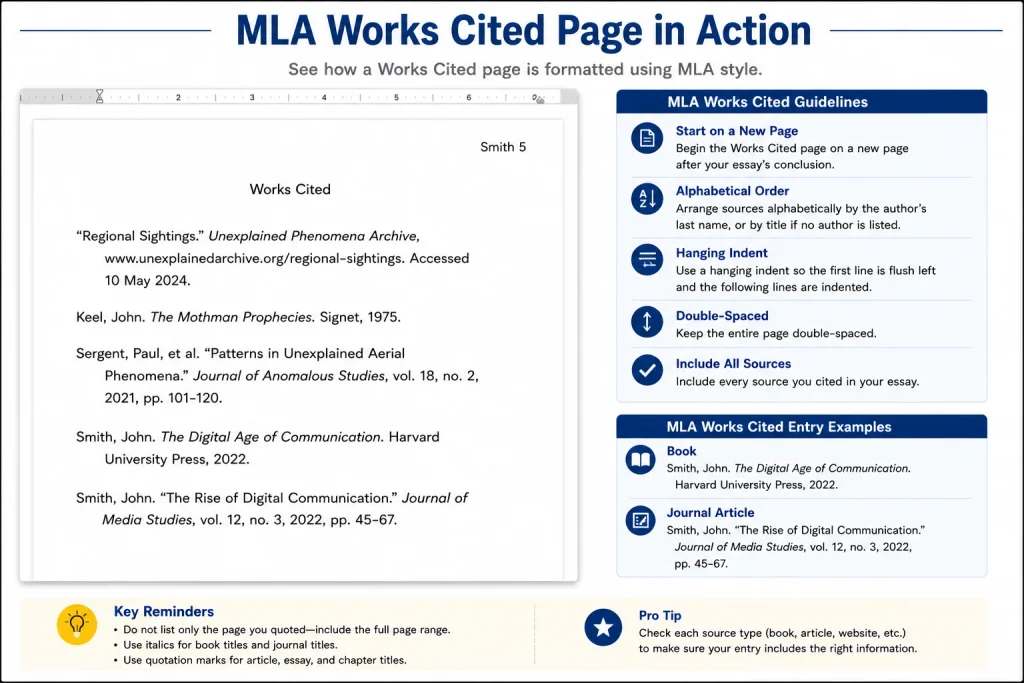
Start the Works Cited page on a new page after your essay’s conclusion. Keep these points in mind:
Example Works Cited Entry:
Smith, John. The Digital Age of Communication. Harvard University Press, 2022.
Example Works Cited Entry (Journal Article):
Smith, John. “The Rise of Digital Communication.” Journal of Media Studies, vol. 12, no. 3, 2022, pp. 45-67.
Note: If you’re citing part of a larger work, such as a journal article, book chapter, or essay in an anthology, include the complete page range in the Works Cited entry. Don’t list only the specific page you quoted in your essay. Also, MLA focuses more on the author and the work itself than on when it was published. This approach fits the literature and humanities, where an older source can still be highly relevant and valuable.
APA format follows the rules of the American Psychological Association for presenting and documenting academic work. It commonly appears in:
Its recent guidelines come from the APA Publication Manual, 7th edition, published by the American Psychological Association in October 2019.
Note: If you find the formatting in a Word document extremely complex and time-consuming, we have a free downloadable template you can use, where you will just have to write your essay. Download the APA essay format, where you can simply copy-paste your entire essay without worrying about finding those formatting options.
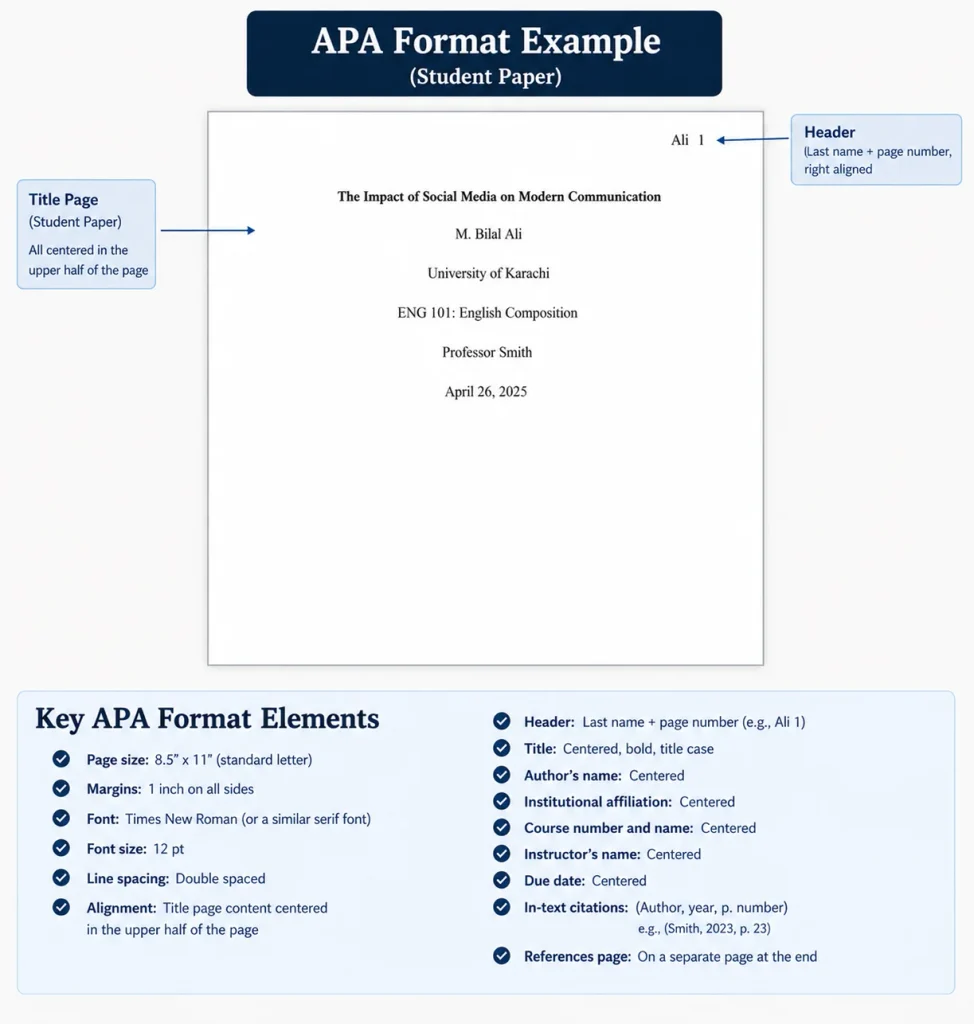
APA essay format provides different title-page requirements for student and professional papers. A student title page generally includes the paper title, author’s name, institutional affiliation, course number and name, name of the teacher or professor, and due date.
Professional papers use additional author and publication information, while page numbering remains part of the page header. Additionally, keep everything centered in the upper half of the page.
An abstract provides a concise overview of the paper’s purpose, main points, and findings. Student assignments do not always require an abstract, so check the instructor’s instructions before adding one. When required, place the abstract on its own page following the title page and before the main text.
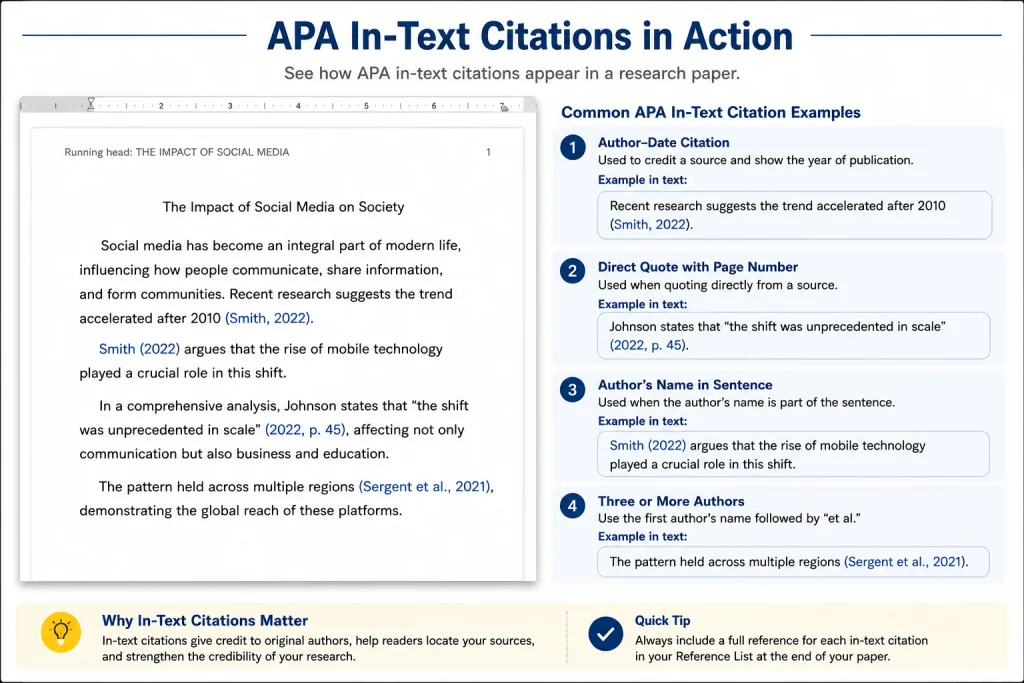
APA style uses an author-date system to show readers where your information comes from. In most cases, include the author’s last name and the publication year in parentheses, separated by a comma:
Example:
Recent research suggests the trend accelerated after 2010 (Smith, 2022).
When you’re using a direct quote, include the page number after the year so readers can easily find the exact passage:
Example:
Smith notes that “the shift was unprecedented in scale” (2022, p. 45).
If you mention the author’s name naturally in your sentence, you don’t need to repeat it in the parentheses. Just add the publication year:
Example:
Smith (2022) argues that the trend accelerated after 2010.
For sources written by three or more authors, APA style simplifies the citation by using the first author’s last name followed by “et al.”:
Example:
The pattern held across multiple regions (Sergent et al., 2021).
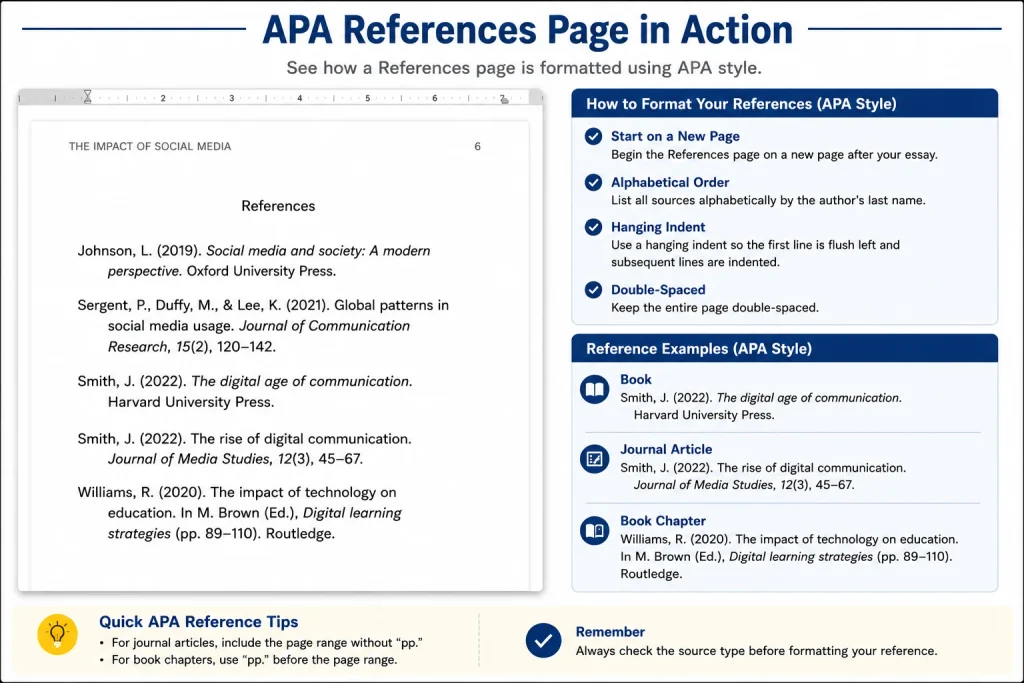
Start the References page on a new page after your essay. Keep these basic formatting rules in mind:
Example Reference Entry:
Smith, J. (2022). The digital age of communication. Harvard University Press.
Example Reference Entry (Journal Article):
Smith, J. (2022). The rise of digital communication. Journal of Media Studies, 12(3), 45–67.
Note: APA emphasizes the publication year because research in the social sciences can become outdated. Including the year helps readers understand how current the source and its findings are.
APA essay format provides five heading levels that help organize sections and subsections throughout longer academic papers. Each level follows specific formatting conventions, allowing readers to distinguish major sections from smaller subdivisions. Therefore, use heading levels consistently and select them according to the hierarchy of your paper.
Chicago style is widely used in history, the humanities, and the fine arts. It is based on The Chicago Manual of Style, 17th edition (University of Chicago Press, 2017). For student papers, though, you’ll usually come across Turabian, 9th edition, which is a simpler, student-friendly version of Chicago style created by Kate L. Turabian. The full Chicago Manual of Style is mainly designed for professional publishing.
Keep in mind that the 18th edition of the Chicago Manual was recently released, but Turabian has not yet been updated to reflect those changes. Unless your instructor tells you to use a different edition, stick with the 17th edition / Turabian 9th edition guidelines.
Chicago gives you two different citation systems to choose from. Pick the one that fits your assignment and use it consistently throughout your paper; don’t mix the two.
Note: If you find the formatting in a Word document extremely complex and time-consuming, we have a free downloadable template you can use, where you will just have to write your essay. Download the Chicago essay format, where you can simply copy-paste your entire essay without worrying about finding those formatting options.
Chicago generally follows the same basic formatting rules covered earlier:
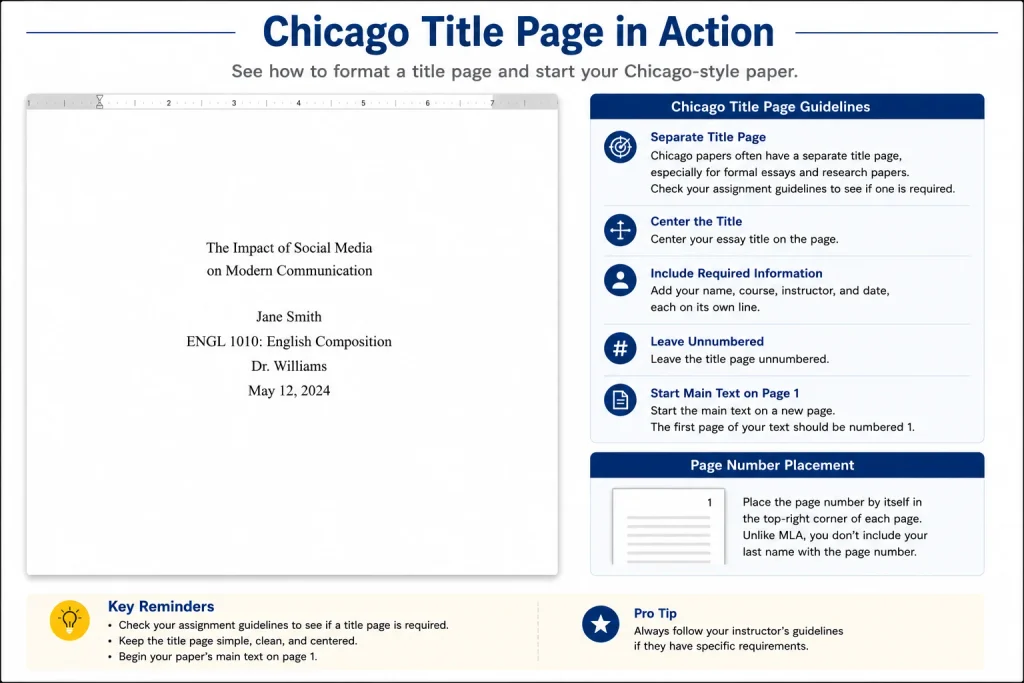
Chicago papers often have a separate title page, especially for formal essays and research papers. Check your assignment guidelines to see if one is required.
If you need a title page:
Page Numbers: Put the page number by itself in the top-right corner of each page. Unlike MLA, you don’t include your last name with the page number.
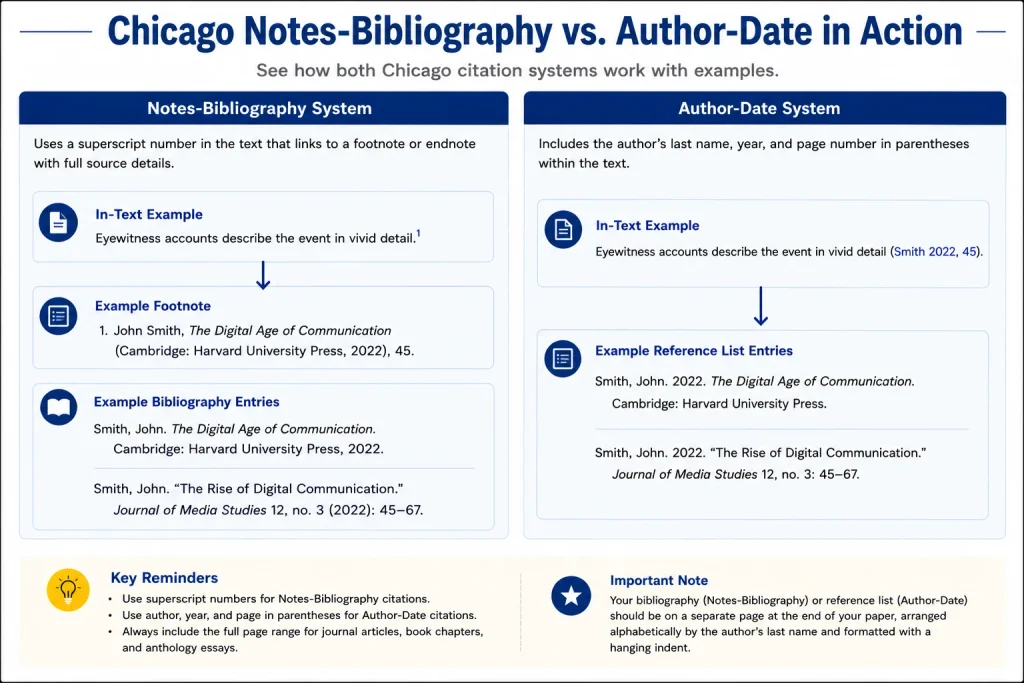
The Notes-Bibliography system uses a superscript number after the information you’re citing. That number connects to a footnote or endnote with the source details:
Eyewitness accounts describe the event in vivid detail.¹
Footnote Example:
- John Smith, The Digital Age of Communication (Cambridge: Harvard University Press, 2022), 45.
Example Bibliography Entry:
Smith, John. The Digital Age of Communication. Cambridge: Harvard University Press, 2022.
Example Bibliography Entry (Journal Article):
Smith, John. “The Rise of Digital Communication.” Journal of Media Studies 12, no. 3 (2022): 45-67.
The Author-Date system is more straightforward: include the author’s last name and publication year in parentheses within the text:
Eyewitness accounts describe the event in vivid detail (Smith 2022, 45).
Example Reference List Entry:
Smith, John. 2022. The Digital Age of Communication. Cambridge: Harvard University Press.
Example Reference List Entry (Journal Article):
Smith, John. 2022. “The Rise of Digital Communication.” Journal of Media Studies 12, no. 3: 45-67.
Note: Whichever Chicago system you use, remember to include the full page range for journal articles, book chapters, and anthology essays. Don’t list only the page you quoted. Your bibliography or reference list should be on a separate page at the end of the paper, arranged alphabetically by the author’s last name and formatted with a hanging indent.
Not every essay follows the same structure. The best essay format often depends on your topic, purpose, and how you need to present your ideas. These specialized structures can make it easier to organize more complex arguments and guide your reader through your points.
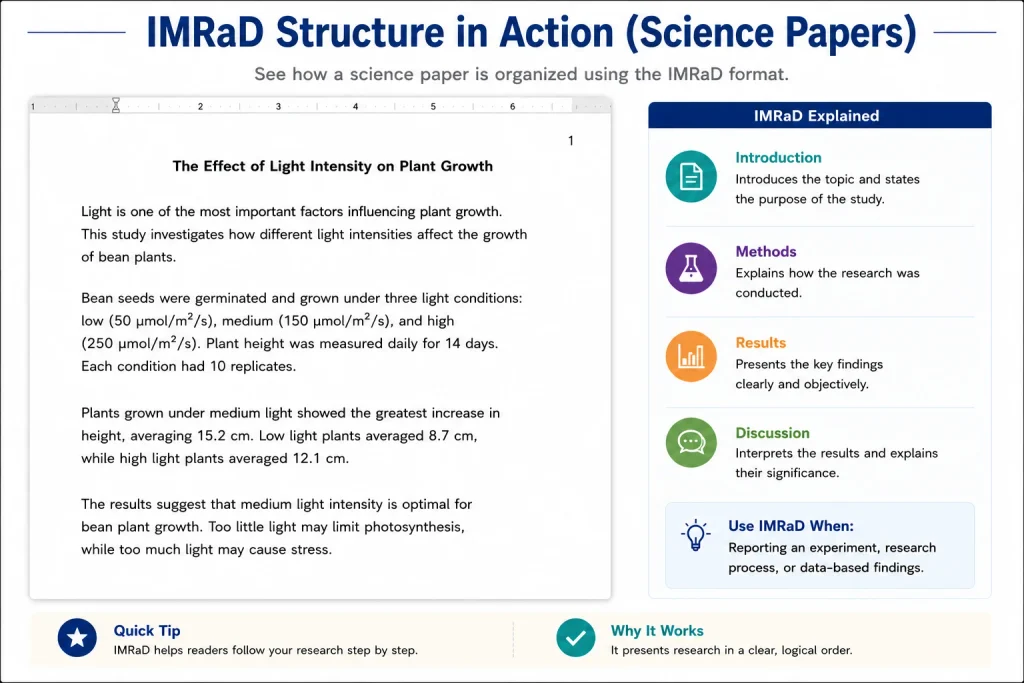
IMRaD stands for Introduction, Methods, Results, and Discussion. It is commonly used in scientific and technical writing because it presents research in a clear, logical order. The structure takes readers from the purpose of the study through the methods and findings to the final interpretation.
Use IMRaD when your assignment involves reporting an experiment, explaining a research process, or presenting data-based findings. It is especially common in lab reports and scientific research papers.
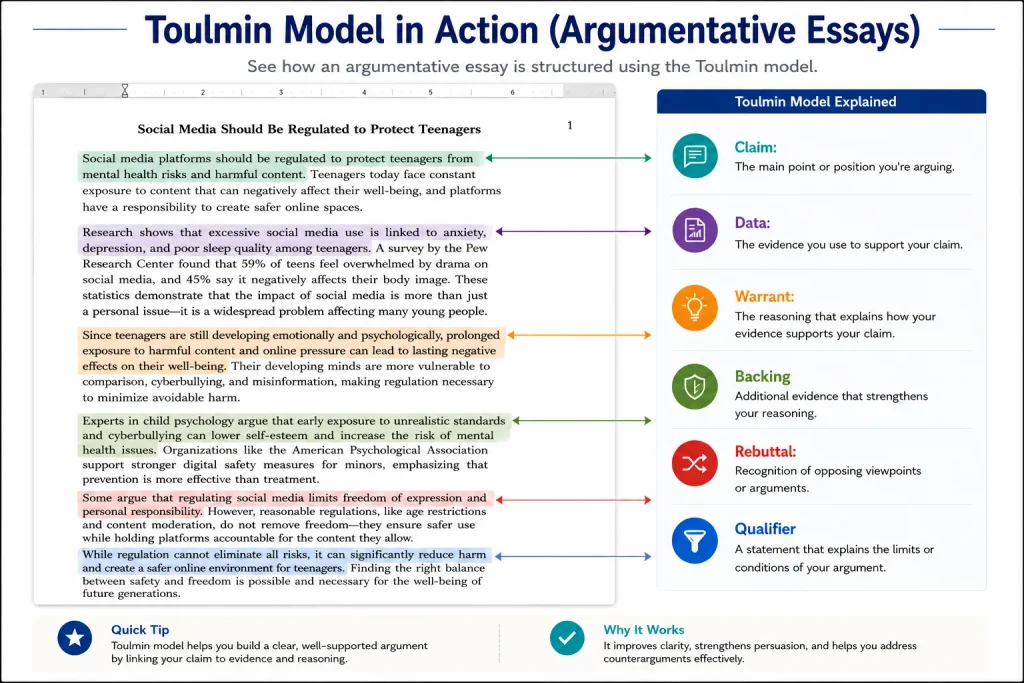
The Toulmin model breaks an argument into six parts, helping you build a clear and well-supported position:
Use the Toulmin model when your topic calls for a strong, defensible position supported by solid reasoning. It works particularly well for academic debates, policy arguments, and analytical essays.
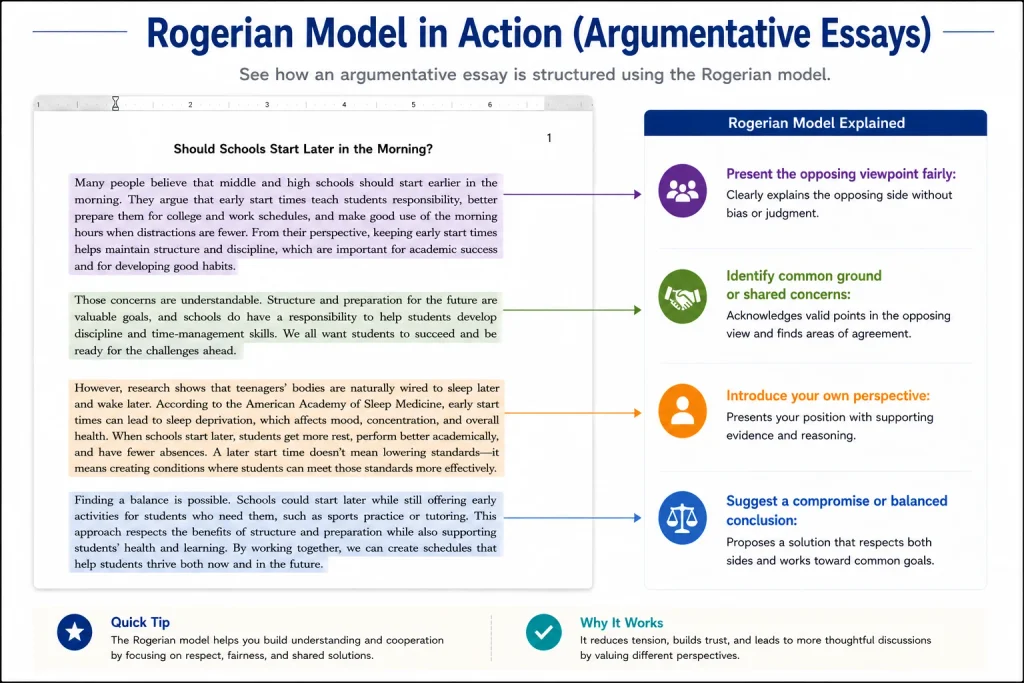
The Rogerian model takes a more collaborative approach to argument. Instead of immediately stating your position, you first give the opposing perspective a fair hearing, look for common ground, and then work toward a balanced conclusion:
Use the Rogerian model when you’re writing about a sensitive, personal, or polarizing topic and want to find common ground rather than simply “win” the argument. This approach can be especially useful when discussing social or emotionally charged issues.
There are two ways of comparing two subjects in an essay. They are explained below.
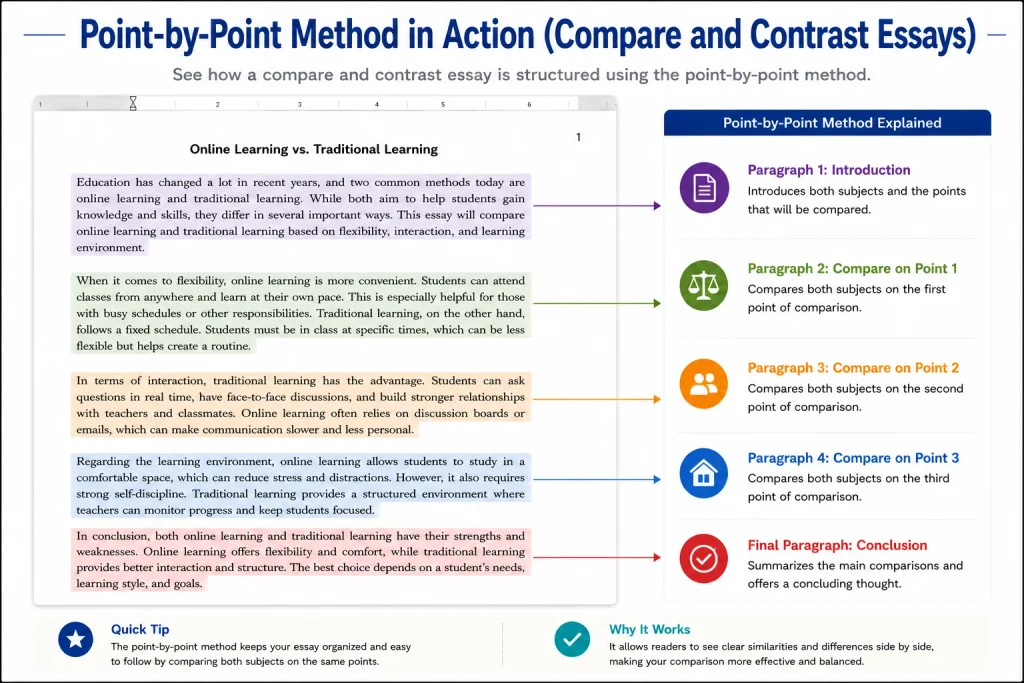
The Point-by-Point Method compares Subject A and Subject B together. Instead of discussing each subject separately, you choose specific points and compare both subjects on each one.
Simple structure:
Use the point-by-point method when you need to compare both subjects directly across shared criteria.
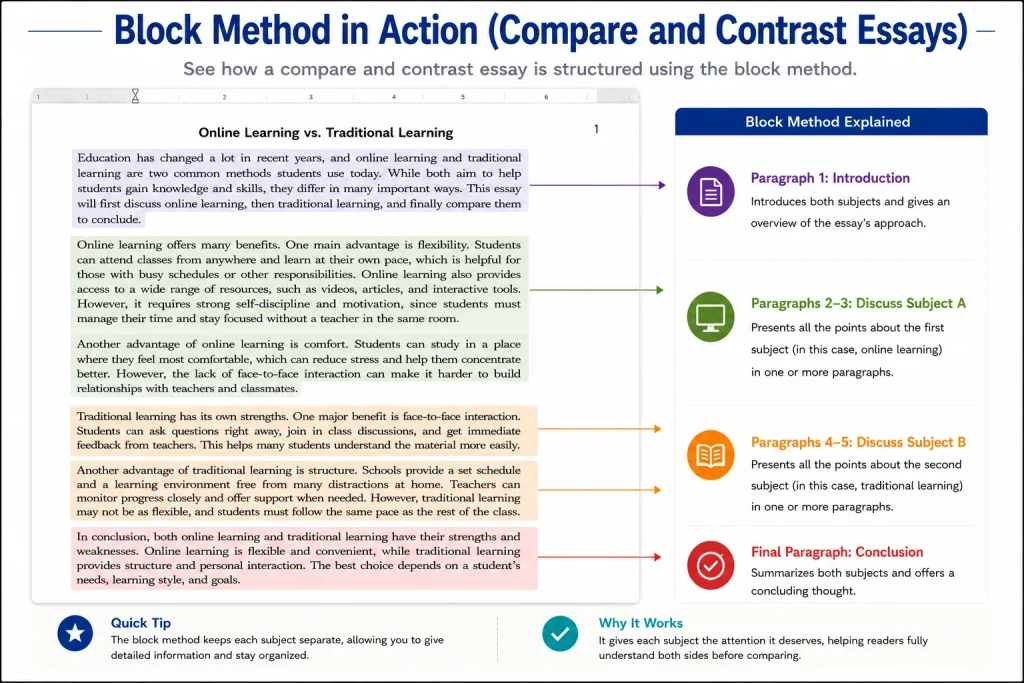
The Block Method keeps the two subjects separate. You discuss Subject A first, then move on to Subject B, usually in the next paragraph or section.
Simple structure:
Use the block method when each subject needs a detailed, standalone explanation.
There are many types of essays. And each one may call for different ways of organizing ideas, but the basic formatting rules usually stay the same. No matter what kind of essay you’re writing, a polished paper should have consistent spacing, clear headings, proper citations, and well-formatted paragraphs.
Here is a basic academic essay format that you can look at to write and organize your essay correctly for your better understanding.
Before you submit your essay, take a few minutes to go through these final checks. A quick review can help you catch small formatting mistakes and avoid losing marks unnecessarily.
Final tip: Give yourself a few quiet minutes for one last review before hitting submit. Those few minutes can make a big difference and help you avoid simple mistakes that could cost you marks.

Written by
Moeed is the Content Head at Free Essay Writer and has more than 5 years of experience in SEO and content writing. He writes clear, practical guides on essay writing, grammar and word meanings to help students write with confidence.
More from this authorOctober 9, 2026 · Moeed
Many people notice the same digits on a receipt, a license plate, or a clock face. A repeating pattern such…
Moeed
Read more
October 8, 2026 · Moeed
Many people notice the same digits on clocks, receipts, and license plates. A repeating pattern such as 222 often makes…
Moeed
Read more
October 8, 2026 · Moeed
Many people glance at a clock and see 11:11 at the exact moment a thought crosses their mind. The 1111…
Moeed
Read more
Generate a full essay free, then polish it with the built-in toolkit.
Start writing free