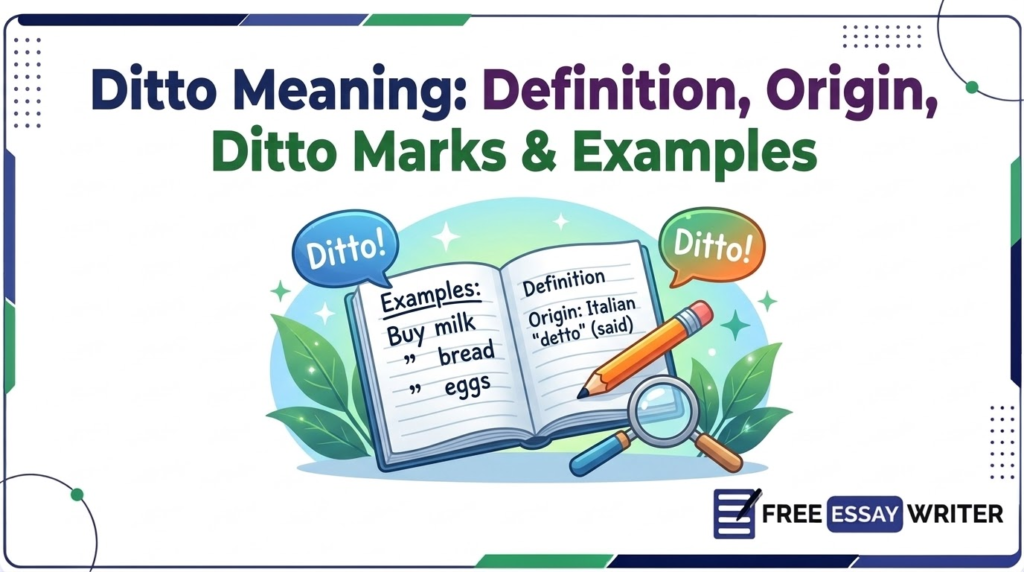
Ditto Meaning: Definition, Origin, Ditto Marks & Examples
Muhammad Bilal
Content Writer
Guide
November 21, 2026
21 min
A student reads a message saying “pizza tonight sounds great,” types one word, and hits send: ditto. That single word saves time and tells the friend that both people share the exact same opinion. The ditto meaning is simple, yet the word carries a long history from Italian trade records.
Many readers know ditto from casual speech but feel unsure about ditto marks, formal use, or correct spelling. Students who already explored the rsvp meaning guide will notice a similar pattern here. Both words entered English from other languages and now appear in everyday messages, invitations, and notes.
This article explains the definition, origin, grammar, and punctuation of ditto in clear and practical language. It also covers ditto marks, example sentences, synonyms, comparison tables, common mistakes, and frequent questions. Each section stays short and focused, so readers can find the exact answer for essays or daily writing.
Quick Answer: What Does Ditto Mean?
Ditto means “the same as already said,” and people use it to agree with a previous statement. In writing, a ditto mark (“) repeats the word directly above it in a list or table. The word works best in casual speech, while formal essays usually need clearer phrases.
Ditto Meaning at a Glance
A short summary helps readers grasp the word quickly before reading the detailed sections that follow below:
Feature
Details
Part of speech
Noun, adverb, verb, and interjection
Core meaning
The same thing again
Origin
Italian “detto,” meaning “said”
First English use
Early 1600s in trade records
Symbol
Ditto mark (“)
Abbreviation
do.
Common setting
Casual speech, lists, and inventories
The table shows that ditto works as several parts of speech while keeping one central idea of repetition.
What Is the Full Definition of Ditto?
Ditto refers to something already mentioned, repeated, or stated again without writing out the full words. Speakers use it to show agreement, while writers use it to avoid repeating identical items in lists.
Dictionaries list several senses, including “the same as before,” “a duplicate,” and “likewise” in casual replies. All of these senses share one idea: something earlier applies again in exactly the same way.
In simple words, ditto means “same here” or “the same thing again.”
Ditto as an Interjection
Most people use ditto as a quick reply, where it means the speaker agrees fully. A friend might say “I am tired,” and the reply “ditto” shows the speaker feels tired too.
Ditto as a Noun
As a noun, ditto means a repetition of something already stated or a duplicate copy of an item. Older office workers called duplicate documents “dittos,” especially copies made on spirit duplicator machines in schools.
Ditto as a Verb
As a verb, ditto means to repeat, copy, or echo what someone else said or did earlier. A sentence like “she dittoed his opinion” shows that she repeated his view during the meeting.
Ditto as an Adverb
As an adverb, ditto means “likewise” or “in the same manner,” usually inside short informal sentences. A shopper might write “apples, two pounds; pears, ditto,” meaning two pounds of pears as well.
Where Did the Word Ditto Come From?
The word ditto traces back to Italian, where “detto” means “said” or “the aforesaid” in formal writing. A Tuscan dialect form, “ditto,” carried the same meaning in business documents and trade records.
Italian Trade Records
Italian merchants used “detto” in account books to avoid writing the same month or item again and again. A ledger might list “the 5th of March” and then “the 9th ditto,” meaning the 9th of March.
Entry Into English
English traders borrowed the word in the early 1600s while recording goods, dates, and prices in shipping logs. Over time, the word moved from account books into everyday speech, where it gained the meaning “same here.”
From Ledgers to Pop Culture
Modern audiences often link ditto with a famous 1990 romantic film, where a character answers affection that way. That film helped ditto spread as a warm, playful reply between close friends and family members.
What Are Ditto Marks?
Ditto marks are small symbols that repeat the word directly above them in a list or table. Writers use straight double quotation marks (“) or the dedicated symbol 〃 to show repeated items quickly.
How Ditto Marks Work
Each ditto mark sits directly under the word it repeats, so readers can follow the column without confusion. A grocery list might show “2 cans tomato soup” and then place ditto marks under “cans” and “soup.”
3 boxes   blue pens
2   "     red   "
5   "     black "
The example above shows how ditto marks replace “boxes” and “pens” in the second and third rows. Readers understand the list as three boxes of blue pens, two of red, and five of black.
Where Ditto Marks Appear Today
Ditto marks still appear in handwritten inventories, classroom worksheets, receipts, and some legal or historical documents. Digital spreadsheets usually repeat full words instead, since copying cells takes almost no effort for modern users.
Unicode Ditto Mark Symbol
Unicode includes a dedicated ditto mark character, 〃, which looks like two short slanted lines placed side by side. Most writers still type a straight double quotation mark, because standard keyboards lack a direct ditto key.
How to Use Ditto in Sentences
Ditto fits naturally into short replies, informal notes, and lists where repetition would feel slow or awkward. The examples below show common patterns in speech, texts, and writing for different audiences.
Spoken and Text Examples
Casual conversation remains the most common home for ditto, especially in quick replies between friends:
Sentence
Meaning
“I loved that movie.” “Ditto.”
I loved it too.
“I need coffee right now.” “Ditto.”
I need coffee as well.
“Happy anniversary, dear.” “Ditto.”
Happy anniversary to the speaker too.
“That exam was hard.” “Ditto.”
I found it hard too.
Each reply shows agreement with the earlier statement, which keeps conversations short, friendly, and clear for both people.
Written List Examples
Ditto also appears in written lists, where it replaces repeated words to save space and time for writers:
List entry
Full meaning
Monday: math test; Tuesday: ditto
Tuesday also has a math test
Red shirts, 4; blue, ditto
Four blue shirts as well
Room 101 cleaned; Room 102 ditto
Room 102 also cleaned
These examples show ditto working as a written shortcut, although formal documents usually spell out every item fully.
Ditto vs Same Here vs Likewise
Several phrases share the ditto meaning, but each one carries a slightly different tone and level of formality. Knowing the differences helps writers choose the right phrase for each conversation or document.
Phrase
Tone
Best setting
Example
Ditto
Casual and playful
Texts and friendly chats
“Ditto, I loved it.”
Same here
Casual and warm
Spoken replies
“Same here, I am hungry.”
Likewise
Polite and neutral
Greetings and introductions
“Pleased to meet Sam.” “Likewise.”
Me too
Simple and direct
Everyday speech
“I am excited.” “Me too.”
As above
Formal
Reports and forms
“Same terms as above apply.”
Ditto sounds the most playful, likewise sounds the most polite, and “as above” suits formal written documents best.
Ditto vs Ditto Mark: What Is the Difference?
Many students confuse the spoken word ditto with the written ditto mark, although both share the same idea. The table below separates the two clearly for writing and grammar lessons:
Feature
Ditto (word)
Ditto mark (symbol)
Form
A spoken or written word
A punctuation symbol
Main use
Agreement or repetition in speech
Repeating items in lists
Appearance
Letters d, i, t, t, o
” or 〃
Common setting
Conversations and texts
Inventories and worksheets
The word expresses agreement in speech, while the mark saves space in written columns and handwritten lists.
Is Ditto Formal or Informal?
Ditto sounds informal in most modern contexts, so it suits friendly chats, texts, and personal notes best. Academic essays, business letters, and professional reports usually avoid the word in favor of clearer phrases.
Some formal documents still use ditto marks in tables, but style guides often recommend repeating full words instead. Repeated words prevent confusion when documents get scanned, translated, or read by assistive software for visually impaired readers.
Students writing essays should replace ditto with phrases like “the same applies” or “similarly” for a professional tone. That small change keeps the meaning clear while matching the expectations of teachers and academic reviewers.
Ditto in Different Contexts
The core meaning stays the same everywhere, but the shade of meaning changes slightly with each setting. The table below shows how context affects the word in common real world situations:
Context
Example
Shade of meaning
Warm reply
“Missing home today.” “Ditto.”
Warm shared feeling
Office meeting
“I ditto that proposal.”
Formal agreement
Shopping list
“Milk, 2; juice, ditto”
Same quantity again
Classroom
Teacher hands out dittos
Printed copies
Accounting ledger
“The 9th ditto”
Same month as above
Each context keeps the repetition idea, but the tone moves from warm and personal to practical and formal.
Ditto in Business and Office Writing
Office workers once used ditto marks heavily in handwritten ledgers, shipping logs, and stock reports before computers arrived. Clerks saved hours each week by marking repeated dates, product names, and prices with two quick strokes.
Modern offices still use the verb form in meetings, where a manager might say “I ditto that point.” That spoken use signals quick agreement without repeating a long argument the whole room already heard.
Written business communication rarely uses ditto now, since clear and complete wording reduces costly misunderstandings with clients. Contracts, invoices, and formal emails should repeat every important term, even when the repetition feels slow.
The History of Ditto Machines in Schools
Many schools from the 1950s through the 1980s used spirit duplicators to print worksheets, tests, and newsletters. Students and teachers called those printed copies “dittos,” which turned the word into everyday classroom vocabulary.
The machines used a special master sheet and alcohol based fluid to transfer purple ink onto blank paper. Former students often remember the faint purple text and the distinct smell of freshly printed ditto worksheets.
Photocopiers replaced spirit duplicators during the 1980s and 1990s, yet some teachers still call handouts “dittos” today. That habit shows how a machine name can outlive the machine itself inside a familiar community.
How to Teach the Ditto Meaning to English Learners
A simple lesson works best for learners who meet the word ditto for the first time in class. Start with a short dialogue where one speaker shares a feeling and the second speaker replies with ditto.
Next, show a handwritten shopping list with ditto marks and ask learners to rewrite each row. That exercise connects the spoken meaning with the written symbol and builds confidence with both forms.
Finally, ask learners to compare ditto, likewise, and same here in three short role plays with classmates. Practice in realistic situations helps learners choose the right phrase naturally during future conversations and writing tasks.
Ditto in Accounting and Historical Records
Historians and genealogists often meet ditto marks and the abbreviation “do.” in old census sheets and parish registers. A census page might list a surname once and then show ditto marks for every family member below.
Researchers must read those marks carefully, since a misplaced mark can assign a person to the wrong household. Comparing several nearby rows and checking column positions helps readers interpret faded handwriting with more accuracy.
Old shipping manifests and store ledgers also used ditto marks for repeated ports, product names, and unit prices. Those records show how merchants managed long lists by hand, long before spreadsheets made copying text simple.
Ditto vs Ibid: Two Ways to Repeat References
Students sometimes confuse ditto with ibid, since both words point back to something already written earlier. The table below explains how each word works in academic and everyday writing:
Feature
Ditto
Ibid
Origin
Italian “detto”
Latin “ibidem,” meaning “in the same place”
Main use
Repeating words or agreement
Repeating the previous citation
Setting
Casual speech and lists
Academic footnotes
Example
“Pears, ditto”
“Ibid., p. 45”
Ditto repeats words in lists or speech, while ibid repeats the previous source inside academic footnotes and endnotes.
Is Replying Ditto Rude?
Replying ditto is not rude in most casual situations, since the word shows quick and friendly agreement. Friends and family usually read the reply as warm, especially when it follows a shared feeling or experience.
The reply can feel cold in serious moments, such as an apology, heartfelt thanks, or sad news. In those cases, a full sentence shows more care and explains exactly how the speaker feels.
Tone also depends on the relationship, since close friends enjoy short replies while colleagues expect more. A quick check of the setting helps speakers decide whether ditto sounds playful or a little dismissive.
Real World Example: Ditto in a Classroom Inventory
A school librarian counts supplies at the end of term and writes a handwritten inventory on paper. The first row reads “12 boxes of pencils,” and the next rows list markers and erasers below.
Instead of writing “boxes of” again, the librarian places ditto marks under those words in each following row. Students who later read the list understand that every row describes boxes, which saves writing time.
Teachers who explain word origins often pair this lesson with the integrity meaning guide for practice. Both lessons show how familiar words carry history, precise meanings, and correct usage rules for students.
Key Characteristics of the Word Ditto
The key characteristics below help readers recognize ditto and use it correctly in speech, lists, and writing:
Ditto always signals repetition, agreement, or duplication of something already mentioned earlier in the conversation.
The word comes from Italian “detto,” which means “said,” and entered English through trade records.
Ditto works as a noun, verb, adverb, and interjection while keeping the same central repetition idea.
Ditto marks repeat the word directly above them, which saves space in handwritten lists and inventories.
The word sounds casual in modern speech, so formal essays usually replace it with clearer phrases.
The standard abbreviation “do.” appears in older ledgers, catalogs, and some historical accounting documents today.
Benefits of Knowing the Ditto Meaning
Learning the ditto meaning brings practical benefits for students, writers, teachers, and English learners in many settings:
Students can read older documents, ledgers, and historical records that use ditto marks and abbreviations correctly.
Writers can choose between ditto, likewise, and same here based on the tone each sentence needs.
English learners can follow quick casual replies in texts, chats, and conversations with native speakers easily.
Teachers can explain punctuation history and word origins with a simple and memorable classroom example.
Office workers can create quick handwritten inventories by using ditto marks instead of repeating long words.
How to Use Ditto Marks Correctly
A few simple steps help writers use ditto marks clearly in handwritten lists, worksheets, and simple tables. The steps move from layout to placement, review, and final clarity checks before sharing the document.
Step 1: Write the First Row in Full
Start the list with a complete first row, including every word that later rows will repeat. Readers need that full row as a reference point, since ditto marks only point upward to earlier text.
Step 2: Line Up Items in Clear Columns
Line up each word in a separate column, so every ditto mark sits directly under its matching word. Neat columns prevent confusion, especially when several words repeat across many rows of the list.
Step 3: Place One Ditto Mark per Repeated Word
Put a single ditto mark under each repeated word instead of one mark for an entire phrase. That rule keeps the meaning precise, since readers can match every mark with one specific word above.
Step 4: Write New Words in Full
Write any changed word in full, while keeping ditto marks only for words that stay the same. A list with “red pens” and then “blue” with a ditto mark under “pens” reads clearly.
Step 5: Review the List for Clarity
Read the finished list from top to bottom and confirm that every ditto mark points correctly. Replace ditto marks with full words whenever a column looks crowded, uneven, or hard to follow.
Tips for Using Ditto Naturally
These tips help readers use ditto naturally in conversations, texts, and handwritten notes without confusing anyone:
Use ditto as a reply only when the earlier statement applies to the speaker in the same way.
Keep ditto out of academic essays, cover letters, and business reports, where clearer phrases sound more professional.
Place ditto marks directly under the repeated word, so every reader can match each mark without guessing.
Choose likewise for polite greetings, since ditto can sound too casual when meeting someone for the first time.
Avoid ditto marks in digital documents, because copied text and screen readers may misread the symbol entirely.
Spell the word with two letter t characters, since “dito” is a common spelling mistake in quick messages.
Synonyms and Related Words for Ditto
Several words and phrases share the ditto meaning, so writers can vary their language across different settings. The table below lists common options with tone notes for quick reference:
Synonym
Tone
Example
Likewise
Polite
“Likewise, I enjoyed our talk.”
Same here
Casual
“Same here, I loved the trip.”
Me too
Simple
“Me too, I need a break.”
Similarly
Formal
“Similarly, the second study found growth.”
As above
Formal
“Terms as above apply to both orders.”
Duplicate
Neutral noun
“Please print a duplicate of the form.”
These synonyms let writers match the tone of each sentence while keeping the same idea of agreement.
Best Practices for Students and Teachers
Students should treat ditto as a casual word and save it for notes, texts, and friendly chats. Formal assignments need complete words, since graders expect clarity and precision in every repeated item or idea.
Teachers can use ditto marks as a fun punctuation lesson, showing how writers saved time before computers. A short activity where students rewrite a ditto list into full sentences builds both reading and writing skills.
Students and teachers should discuss the Italian origin of the word during vocabulary or etymology lessons. Origin stories help learners remember meanings longer, because the history connects the word with a vivid real context.
Common Mistakes When Using Ditto
1. Using Ditto in Formal Essays
Some students write ditto in academic papers to avoid repetition, which sounds too casual for graders. Formal essays need phrases like “similarly” or “the same applies,” which keep the tone professional and clear.
2. Misplacing Ditto Marks
Writers sometimes place ditto marks slightly to the left or right, so readers cannot tell which word repeats. Careful column spacing fixes the problem and keeps handwritten lists easy to read for everyone today.
3. Spelling It as Dito
The spelling “dito” appears often in quick messages, but the correct form always uses two letter t characters. Correct spelling matters in schoolwork, since graders often mark this small error as a basic spelling mistake.
4. Using Ditto When Meanings Differ
Some speakers reply ditto even when their situation differs from the original statement in an important detail. If a friend says “I passed with an A,” a ditto reply suggests the same grade.
5. Using Ditto Marks in Digital Files
Ditto marks inside spreadsheets or online forms can confuse software, search tools, and screen readers for many users. Digital documents should repeat full words, since copying and pasting text takes only a few seconds.
6. Confusing Ditto With Quotation Marks
Ditto marks look like closing quotation marks, so readers sometimes mistake them for quoted speech inside a list. Clear columns and context help readers understand that the marks repeat words instead of quoting someone.
Ditto Usage Checklist
Use this checklist before adding ditto or ditto marks to a message, worksheet, list, or handwritten document:
The earlier statement applies to the speaker in exactly the same way before replying with ditto.
The setting stays casual, such as texts, notes, or friendly chats, instead of formal academic writing.
The first row of any list appears in full, so ditto marks always have a clear reference above.
Every ditto mark sits directly under its matching word in a neat and evenly spaced column.
Changed words appear in full, while ditto marks repeat only the words that stay exactly the same.
Digital documents repeat full words instead of ditto marks, which helps software and screen readers process text.
The spelling uses two letter t characters, so the word reads as ditto and never as dito.
Ditto in Other Languages
Italian still uses “detto” as the past participle of “dire,” which means “to say” in standard modern Italian. Spanish speakers use “dicho” in a similar way, as in “lo dicho,” which means “what was said.”
Many languages also use ditto marks in handwritten lists, although the symbol shape sometimes differs between writing systems. Japanese writers, for example, use a similar repeat symbol that looks like the 〃 character in handwritten notes.
In casual English conversations worldwide, ditto now works as a shared reply that most learners recognize quickly. Its short form and clear meaning help the word travel easily across regions, accents, and age groups.
Frequently Asked Questions
What does ditto mean in text?
In text, ditto means “same here” or “I agree,” and people use it to repeat a shared feeling. A reply of “ditto” to “I miss the beach” means the sender misses the beach too.
What is the origin of the word ditto?
The word ditto comes from Italian “detto,” meaning “said,” through a Tuscan dialect form used in trade records. English merchants borrowed the word in the early 1600s while recording repeated dates and goods.
What is a ditto mark?
A ditto mark is a symbol, usually ” or 〃, that repeats the word directly above it in a list. Writers use ditto marks to save space in handwritten inventories, worksheets, and simple tables.
Is ditto a formal word?
Ditto sounds informal in most modern settings, so it suits texts, notes, and friendly conversations best. Formal essays and business reports usually replace ditto with clearer phrases like “similarly” or “the same applies.”
What does ditto mean as a reply to a loving message?
When someone answers a loving message with ditto, the ditto meaning is “the same feeling here.” The reply can sound playful or warm, depending on the relationship and tone between the two people.
What is the abbreviation for ditto?
The standard abbreviation for ditto is “do.,” which appears in older ledgers, catalogs, and accounting records. Modern writers rarely use the abbreviation, since it can confuse readers who expect the verb “do.”
Can ditto be used as a verb?
Ditto can work as a verb meaning to repeat, echo, or copy what someone said earlier. A sentence like “the manager dittoed the earlier warning” shows the verb form in a workplace setting.
What is the difference between ditto and likewise?
Ditto sounds casual and playful, while likewise sounds polite and neutral in greetings, introductions, and formal replies. Both words express the same ditto meaning of shared agreement, but their tone fits different situations.
What were dittos in schools?
In schools, dittos were printed copies of worksheets made on spirit duplicator machines before modern photocopiers became common. Many teachers and students from past decades still call handout copies “dittos” in casual conversation today.
How is ditto spelled correctly?
Ditto is spelled d, i, t, t, o, with two letter t characters in the middle. The misspelling “dito” appears often in quick messages, but standard dictionaries list only the double t form.
Key Takeaways
The ditto meaning is “the same as already said,” and people use it to agree or repeat something.
Ditto comes from Italian “detto,” meaning “said,” and entered English through trade records in the 1600s.
The word works as a noun, verb, adverb, and interjection while keeping one central repetition idea.
Ditto marks, written as ” or 〃, repeat the word directly above them in lists and tables.
Every ditto mark should sit directly under its matching word in a neat and evenly spaced column.
Ditto sounds casual, so formal essays and reports should use phrases like “similarly” or “as above.”
Likewise sounds more polite than ditto, which makes it better for greetings and professional introductions.
The abbreviation “do.” appears in older ledgers but rarely appears in modern writing or digital documents.
Digital files should repeat full words instead of ditto marks, which helps software and screen readers.
The correct spelling always uses two letter t characters, so “dito” counts as a spelling mistake.
Final Thoughts
Ditto is a small word with a long history, from Italian account books to friendly text replies. Its meaning stays simple, its marks stay useful in lists, and its tone stays casual today.
Students who know when to use ditto and when to choose clearer phrases will write with more confidence. The next time a friend shares a feeling, one short reply of ditto will say everything needed.
Explore more vocabulary, grammar, and essay writing guides on Free Essay Writer.



 Muhammad Bilal
Read more