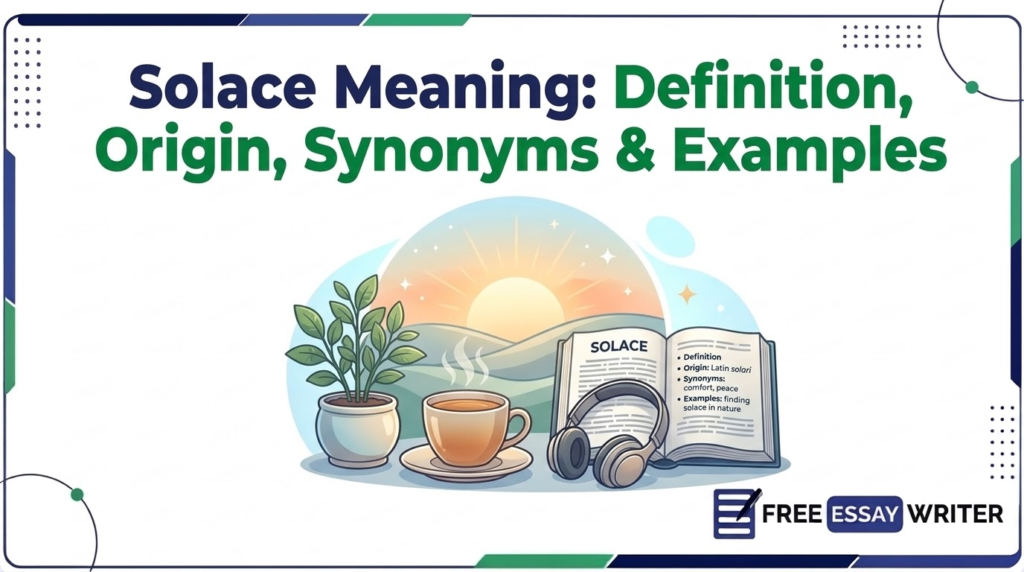
A student loses an important match and plays a favorite song on repeat afterward. That quiet comfort has a precise name, and the solace meaning explains it well. The word describes the relief people find during sadness, worry, or loss.
This guide covers the definition, origin, pronunciation, grammar, synonyms, and example sentences for the word. Readers who studied our guide on discernment meaning will find the same clear structure here. Each section helps students use the word correctly in essays, letters, and everyday conversation.
You will also learn common phrases such as “find solace” and “take solace,” plus mistakes that weaken writing. The examples suit school assignments, personal statements, and creative writing projects alike.
Quick Answer: What Does Solace Mean?
Solace means comfort or relief that someone receives during a time of sadness, stress, or disappointment. As a noun, it names the comfort itself, such as “music gave her solace.” As a verb, it means to comfort someone, though writers use the verb form far less often today.
Solace at a Glance
The table below gives a quick summary of the word before the detailed sections begin.
Detail
Answer
Word
Solace
Parts of speech
Noun and verb
Pronunciation
SOL iss
Core meaning
Comfort during distress
Origin
Latin through Old French
Common phrases
Find solace, take solace, seek solace
Main synonyms
Comfort, consolation, relief
Main antonyms
Distress, misery, anguish
The main takeaway is simple: solace always connects to comfort that eases some form of pain.
The Full Definition of Solace
Dictionaries define solace in two main ways, depending on its role as noun or verb.
Solace as a Noun
As a noun, solace means comfort or consolation in a time of distress or sadness. It can also name the source of that comfort, such as a person, place, hobby, or belief. For example, “The garden became her solace after a difficult year” names the garden as the comforting source.
Solace as a Verb
As a verb, solace means to give comfort to someone or to ease their sadness. A sentence such as “Friends solaced him after the loss” uses this form. Modern writers usually choose “comforted” or “consoled” instead, because the verb sounds formal and literary.
An Older, Rarer Sense
Older English texts sometimes used solace to mean pleasure, amusement, or entertainment. That sense appears in historical writing but rarely in modern essays or conversation. Students reading classic literature should recognize it so older passages make sense.
In simple words: solace is the comfort that helps a person through a hard moment.
Where Does the Word Solace Come From?
The word has a long history that stretches back to ancient Rome and medieval France.
The Latin Root
Solace comes from the Latin word “solacium,” which meant comfort or consolation. That noun grew from the Latin verb “solari,” which meant to console or to comfort. The same root also produced the English word “consolation” through a related path.
The Path Through French
Old French borrowed the Latin idea and used the form “solas” for comfort and pleasure. English speakers borrowed the word during the Middle Ages, when French strongly influenced English vocabulary. Over several centuries, the spelling slowly settled into the modern English form “solace.”
Latin solari (to console) -> Latin solacium (comfort) -> Old French solas -> Middle English solace
This short path shows how one Latin idea traveled into everyday English through French.
How to Pronounce Solace
Most English speakers pronounce solace as “SOL iss,” with stress on the first syllable. The first syllable rhymes with “doll,” and the second sounds like the end of “office.” American and British speakers usually share this pronunciation with only small vowel differences.
A common mistake pronounces the word as “so LACE,” which rhymes with “embrace.” That version sounds wrong to most listeners and may confuse readers during presentations. Practice the word aloud a few times before using it in speeches or class discussions.
Correct
Incorrect
SOL iss
so LACE
Stress on first syllable
Stress on second syllable
Rhymes with “polish” ending
Rhymes with “embrace”
The table helps learners avoid the most frequent pronunciation error with this word.
Solace in Example Sentences
Example sentences show how the word works in real writing far better than definitions alone.
Noun Examples
These sentences use solace as a noun, which matches most modern usage:
She found solace in long walks after her grandfather passed away.
The old letters offered him solace during his first lonely winter abroad.
Many students take solace in knowing that one exam does not define them.
Music remained her greatest solace through every stressful semester.
Each example names either the comfort itself or the source that provides it.
Verb Examples
These sentences use solace as a verb, which sounds formal and appears less often:
The teacher solaced the nervous class with calm, encouraging words.
He solaced himself with memories of happier summers at the lake.
Writers who want a simpler tone can replace the verb with “comforted” in both sentences.
Common Phrases With Solace
Several fixed phrases use solace, and each one carries a slightly different emphasis.
Find Solace
“Find solace” means to discover comfort in something during a hard time. For example, a writer might say, “He found solace in painting after losing his job.” This phrase appears more often than any other solace expression in modern English.
Take Solace
“Take solace” means to draw comfort from a fact, an idea, or a hopeful thought. For example, “We take solace in knowing the team gave its best effort.” The phrase often introduces a hopeful thought right after disappointing or upsetting news.
Seek Solace
“Seek solace” means to look actively for comfort or relief during a hard period. For example, a news report might say, “Many people seek solace in nature during stressful periods.” The phrase suggests effort, since the person searches for comfort instead of receiving it.
Offer or Provide Solace
“Offer solace” and “provide solace” describe someone or something giving comfort to others. For example, “The community center provided solace to families after the flood.” These phrases suit formal writing, school reports, public speeches, and news articles.
Phrase
Meaning
Example
Find solace
Discover comfort
She found solace in reading.
Take solace
Draw comfort from a fact
We take solace in the progress.
Seek solace
Look for comfort
He sought solace at the beach.
Offer solace
Give comfort to others
Friends offered solace and support.
Small solace
Limited comfort
The refund was small solace.
The table helps writers pick the right phrase for the exact meaning they want.
Synonyms for Solace
Synonyms help writers avoid repetition, but each one carries its own shade of meaning.
Synonym
Shade of meaning
Best use
Comfort
General ease from pain or worry
Everyday writing
Consolation
Comfort after a loss
Formal writing
Relief
Removal of pain or stress
Physical or emotional ease
Support
Help from people or groups
Social situations
Reassurance
Comfort that removes doubt
Worry and fear
Succor
Help in hard times
Literary writing
Cheer
Lifted mood
Light, positive tone
The table shows that comfort works almost anywhere, while succor suits only formal or literary writing.
Students should choose synonyms based on context instead of picking the most impressive word. “Relief” fits physical pain or finished stress, while “consolation” fits grief or loss. “Reassurance” works best when the comfort removes doubt, such as before an exam result.
Antonyms for Solace
Antonyms describe the pain or distress that solace eases, which helps writers build contrast.
Antonym
Meaning
Distress
Extreme worry or pain
Misery
Deep unhappiness
Anguish
Severe mental suffering
Torment
Ongoing pain or worry
Sorrow
Deep sadness from loss
Despair
Complete loss of hope
The table gives writers strong words for describing the problem before introducing the comfort.
Strong essays often place an antonym and solace close together for emotional contrast. For example, “Her despair slowly gave way to solace as friends visited each day.” That structure shows change, which makes personal writing more engaging for readers.
Solace vs Comfort vs Consolation
These three words overlap heavily, so many students wonder which one fits their sentence best.
Feature
Solace
Comfort
Consolation
Tone
Formal, gentle
Neutral, everyday
Formal
Main context
Sadness or stress
Any discomfort
Loss or defeat
Physical use
Rare
Common
Rare
Example
Music gave her solace.
The chair offers comfort.
The bronze medal was a consolation.
The table shows that comfort covers physical ease, while solace and consolation focus on emotional pain.
Solace usually describes quiet, personal comfort that a person discovers during sadness. Consolation often follows a specific loss or defeat, such as a missed prize or a breakup. Comfort stays the most flexible word, since it covers sofas, warm blankets, and kind words alike.
Common Sources of Solace
People find comfort in many different places, and naming those sources makes writing more vivid.
Music
Music ranks among the most common sources of solace for students and adults alike. A familiar song can calm racing thoughts and bring back steady, happy memories. Many people keep a short playlist ready for stressful days, exams, and long trips.
Nature
Walks in parks, forests, or along beaches give many people quiet relief from daily pressure. Fresh air, open space, and natural sounds help the mind slow down and rest. Writers often describe nature as solace because it offers peace without asking anything in return.
Faith and Reflection
Prayer, meditation, and religious gatherings offer solace to millions of people around the world. These practices give structure, hope, and a sense of meaning during painful periods. Students writing about faith should describe their own practice with honesty and respect.
Friends and Family
Supportive people often provide the deepest solace during grief, illness, or failure. A phone call, a shared meal, or a quiet visit can ease heavy moments. Essays that describe these small acts of kindness usually connect strongly with readers.
Writing and Creative Work
Journaling, drawing, and other creative work help many people sort through hard emotions. Putting thoughts on paper turns a confusing mess into clear, manageable ideas. Students who write regularly often find solace in their own notebooks during busy school years.
Pets
Dogs, cats, and other pets offer steady companionship without judgment or complicated conversation. Many people describe a pet as their main source of solace after a long day. A short story about a loyal pet can make a personal essay warm and memorable.
Source
Why it helps
Essay example
Music
Calms racing thoughts
I found solace in my grandmother’s old records.
Nature
Offers quiet space
The hiking trail became my weekend solace.
Faith
Gives hope and meaning
Evening prayer gave me solace before exams.
Friends
Shares the burden
My best friend’s visits offered real solace.
Writing
Organizes emotions
My journal became my private solace.
The table shows how each common source of solace can turn into a strong essay sentence.
Is Solace Countable or Uncountable?
Solace usually works as an uncountable noun, so writers rarely add “a” before it. Natural sentences say “She found solace,” not “She found a solace,” in most cases. This pattern matches other emotional nouns such as comfort, relief, and happiness.
Writers sometimes use “a solace” when they name one specific source of comfort. For example, “The library was a solace during her first year” sounds correct and natural. In that sentence, solace names the library itself instead of the comfort in general.
Sentence
Correct?
Reason
She found solace in books.
Yes
Uncountable comfort
Books were a solace to her.
Yes
Names one source
She found many solaces.
Rare
Sounds unnatural today
He gave me a solace.
No
Missing natural phrasing
The table helps students decide when the article “a” belongs before the word.
Practice: Fill in the Blank With Solace
Short practice helps learners remember the correct phrases and prepositions for the word.
Sentence
Answer
After the storm, the family found ___ in their neighbors’ kindness.
solace
She took solace ___ knowing her hard work mattered.
in
Many patients seek solace ___ music therapy sessions.
through
The coach offered words of ___ after the final loss.
solace
His sketchbook became a quiet ___ during the long semester.
solace
The answers show that “in” and “through” are the most natural prepositions after the word.
Teachers can turn this table into a quick warmup activity at the start of English class. Students can also write five original sentences using different solace phrases for homework. Repeated practice turns a new vocabulary word into a natural part of daily writing.
Words Students Confuse With Solace
Some words look or sound similar to solace, which causes spelling and meaning mistakes in essays.
Solace vs Solitude
Solitude means the state of being alone, while solace means comfort during distress. A person can find solace in solitude, which explains why students sometimes mix the words. Keep in mind that solitude describes a situation, while solace describes emotional relief.
Solace vs Solstice
A solstice is an astronomical event when the sun reaches its highest or lowest point in the sky. The words share the first three letters, but their meanings have no connection at all. Spell checkers will not catch this error, so careful proofreading matters for every draft.
Solace vs Solice
“Solice” is a common misspelling and does not exist as a standard English word. The correct spelling always ends with “ace,” much like the familiar word “place.” Writers who type quickly often make this mistake, so search drafts for it before submitting.
Word
Meaning
Example
Solace
Comfort in distress
She found solace in prayer.
Solitude
Being alone
He enjoyed the solitude of the cabin.
Solstice
Longest or shortest day
The winter solstice falls in December.
Solice
Misspelling
Not a correct word
The table helps students separate four lookalike words that often appear in school writing.
How to Use Solace in Essays and Personal Statements
The word fits reflective writing well, but it needs careful placement to avoid sounding forced.
Use It in Reflective Moments
Solace works best in paragraphs that describe a challenge and the comfort that followed. College personal statements often describe setbacks, which gives the word a natural place. Readers who enjoyed our breakdown of integrity meaning will notice that strong values words also need real examples.
Show the Source of Comfort
A sentence such as “I found solace” seems incomplete without naming the source. Add the specific activity, person, or place that provided comfort during that period. Specific details make the writing honest, memorable, and far more persuasive for admissions readers.
Avoid Overuse
Using solace three times in one essay weakens its emotional effect quickly. Rotate with comfort, relief, or reassurance when the meaning stays the same. One well placed use of solace carries more weight than several repeated mentions.
Match the Tone
Solace suits serious, thoughtful writing about grief, stress, recovery, or personal growth. It sounds out of place in casual writing about small problems, such as a late bus. Choose simpler words like “comfort” for light topics and ordinary everyday situations.
Writing About Solace With Care
Many essays about solace involve grief, illness, or family hardship, so tone matters a great deal. Write with honesty, and share only the details you choose to make public. Admissions readers value sincere reflection far more than dramatic descriptions of pain.
Focus on what changed after you found comfort, such as new habits, goals, or relationships. That forward movement shows growth, which most essay prompts quietly ask students to demonstrate. A clear arc from hardship to solace to growth gives the essay a strong, satisfying shape.
Teachers often suggest a simple structure for this type of paragraph:
Challenge -> Source of solace -> What changed -> Lesson for the future
This four part pattern keeps reflective writing focused, honest, and easy for readers to follow.
Solace in Literature and Everyday Culture
Writers have used the word for centuries to describe comfort found in faith, nature, art, and friendship. Classic poets often linked solace with music, gardens, and quiet evenings after hard days. Modern songs, novels, and films continue that tradition with stories about healing after loss.
The word also appears as a name for products, businesses, and places that promise calm. Spa brands, meditation apps, and care homes often choose names that suggest gentle comfort. Some parents also pick Solace as a given name because of its peaceful meaning. The name remains uncommon, which appeals to families who want something gentle and distinctive. Writers of fiction also give the name to calm, caring characters who support others through trouble.
Solace Meaning in Other Languages
Students learning other languages often search for direct translations of the word.
Language
Common translation
Spanish
Consuelo
French
Réconfort or consolation
German
Trost
Italian
Conforto or sollievo
Urdu
Taskeen
Arabic
Sulwan or tasliya
The table gives learners a starting point, though exact choices depend on context and region.
Spanish also has the word “solaz,” which shares the same Latin root as solace. In modern Spanish, though, “solaz” usually suggests relaxation or leisure instead of comfort during grief. That small difference shows why translators check context before choosing any equivalent word.
Tips for Using Solace Correctly
These tips help students use the word naturally and accurately in every type of writing:
Use solace mainly as a noun, since the verb form sounds formal in modern English.
Name the source of comfort clearly, such as music, family, faith, or a favorite place.
Pair solace with “find,” “take,” or “seek” to follow natural English phrasing patterns.
Pronounce the word as “SOL iss” with clear stress on the first syllable.
Check spelling carefully, because “solice” is a frequent typing error in student drafts.
Save the word for serious topics, and choose “comfort” for lighter everyday situations.
Common Mistakes With Solace
1. Spelling It as “Solice”
Many students type “solice” because the word sounds like it ends with “iss.” The correct spelling always uses the letters “ace” at the end of the word. Search every draft for this error before handing in any important assignment.
2. Confusing It With Solitude
Some writers use solace when they mean solitude, which changes the sentence meaning in a major way. Solitude means being alone, while solace means receiving comfort during a hard time. Read each sentence aloud to check which idea it truly expresses to readers.
3. Using Solace for Physical Comfort
Sentences such as “The new mattress gave me solace” sound odd to most readers. Solace usually refers to emotional comfort, not physical ease from furniture or clothing. Use “comfort” when describing chairs, beds, shoes, or a pleasant room temperature.
4. Leaving Out the Preposition
Writers sometimes write “She found solace music” and forget the word “in.” Natural English uses “solace in” or “solace from” before the source of comfort. Check every solace phrase for the right preposition during the final editing stage.
5. Overusing the Word
Repeating solace in several paragraphs makes student writing sound stiff and forced. Readers notice repeated formal words quickly, especially in short personal essays and statements. Use the word once or twice, then switch to simpler synonyms for variety.
Solace Usage Checklist
Use this checklist before submitting any essay or assignment that includes the word:
Confirm the sentence describes emotional comfort during sadness, stress, worry, or loss.
Check that the spelling ends with “ace” and never with “ice” anywhere in the draft.
Name the specific source of comfort, such as a person, place, hobby, or belief.
Use the right preposition, such as “solace in” or “solace from,” before the source.
Limit the word to one or two uses so the essay keeps its natural rhythm.
Replace solace with “comfort” when the topic involves physical ease or casual situations.
Read the sentence aloud to confirm the tone matches the seriousness of the topic.
Frequently Asked Questions
What is the solace meaning in simple words?
The solace meaning in simple words is comfort during a sad or stressful time. It describes the relief someone gets from a person, activity, place, or thought. For example, a student might find solace in music after a hard week.
Is solace a noun or a verb?
Solace works as both a noun and a verb in standard modern English. The noun form, meaning comfort, appears far more often in modern writing. The verb form, meaning to comfort someone, sounds formal and literary today.
How do you pronounce solace?
Most speakers pronounce solace as “SOL iss,” with stress on the first syllable. The first part rhymes with “doll,” and the ending sounds like “iss.” Avoid saying “so LACE,” which most listeners and English teachers consider incorrect.
What does “find solace” mean?
“Find solace” means to discover comfort in something during a difficult time. A person might find solace in friends, prayer, exercise, music, or nature. The phrase is the most common way to use the word today.
What is a synonym for solace?
Comfort is the closest and most flexible synonym for solace in everyday writing. Consolation, relief, and reassurance also work, depending on the exact situation described. Each synonym carries a slightly different shade of meaning for careful writers.
What is the opposite of solace?
The opposite of solace includes words such as distress, misery, anguish, and despair. These words describe the pain or worry that solace helps to ease. Writers often pair them with solace to show emotional change over time.
Where does the word solace come from?
Solace comes from the Latin word “solacium,” which meant comfort or consolation. It traveled into English through Old French during the Middle Ages in Europe. The Latin verb “solari,” meaning to console, forms the root of the word.
Can solace describe physical comfort?
Solace rarely describes physical comfort in modern English usage or student writing. It usually refers to emotional relief during sadness, stress, grief, or worry. Use “comfort” when writing about beds, chairs, clothes, or warm rooms in winter.
What is the difference between solace and solitude?
Solace means comfort during distress, while solitude means the state of being alone. A person can find solace in solitude, but the words describe different ideas. Mixing them up changes the meaning of a sentence in confusing ways for readers.
Is solace a formal word?
Solace is a slightly formal word that suits essays, speeches, and reflective writing. It sounds natural in serious topics such as grief, recovery, and personal growth. Casual conversations usually use “comfort” or “relief” instead of this formal word.
Key Takeaways
Solace means comfort or relief that someone receives during sadness, stress, worry, or loss.
The word works as a noun and a verb, though the noun appears far more often.
Solace comes from the Latin “solacium” and entered English through Old French centuries ago.
Most speakers pronounce the word as “SOL iss” with stress on the first syllable.
Common phrases include “find solace,” “take solace,” “seek solace,” and “offer solace.”
Comfort, consolation, relief, and reassurance work as synonyms in different emotional contexts.
Solitude, solstice, and the misspelling “solice” often get confused with solace in essays.
Strong essays name the specific source of solace instead of using the word alone.
Students should save solace for serious topics and use comfort for lighter situations.
Final Thoughts
The solace meaning centers on comfort that arrives when life seems heavy or uncertain. Students who learn its pronunciation, phrases, and limits can use the word with confidence. A single well placed use can add warmth and depth to any reflective essay or personal statement. Pair the word with honest details, and readers will connect with the comfort you describe.
Practice with the example sentences, avoid the common mistakes, and always name the source of comfort clearly. Explore more vocabulary guides and free writing tools on Free Essay Writer to strengthen every assignment.



 Muhammad Bilal
Read more