October 9, 2026 · Moeed
333 Angel Number Meaning: Career, Twin Flames & Signs
Many people notice the same digits on a receipt, a license plate, or a clock face. A repeating pattern such…
 Moeed
Read more
Moeed
Read more

Moeed
Moeed is the Content Head…
A well-structured essay outline is needed to write an exceptional essay as it helps to shape the entire content. Students often get worried when being assigned to draft an essay outline. It is considered to be a challenging and complicated task, but not an impossible one. So don’t worry. Learning how to create an essay outline won’t take much time. Keep on reading this blog to learn more about the complete format guide for an essay outline.
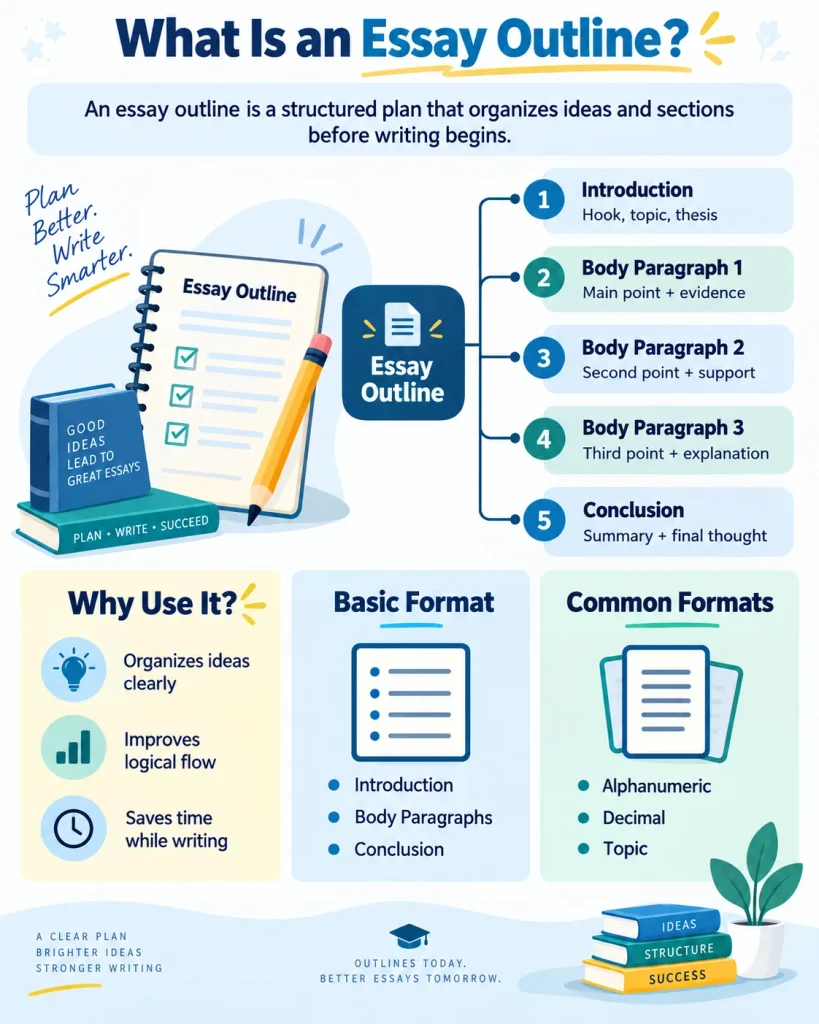
An essay outline is a structured plan that organizes main ideas and points before a writer begins writing. It helps writers arrange arguments clearly and maintain a logical flow throughout the essay while saving time during writing.
An essay outline has the following basic format:
Some common formats include the following options:
If you want to spend less time on the writing process, you should first learn how to write an outline. There are different ways of writing an outline. However, the basic essay outline structure applies to all essay types. Furthermore, a short essay consists of five body paragraphs. Nevertheless, it may differ for longer essays. Here is the complete format guide to assist you in writing your college essays and academic papers.
The introduction section should be compelling enough to attract the reader’s interest. It should provide a general idea of the background information about the topic. Avoid using lengthy and irrelevant details. It can further be spiced up with a thesis statement.
A writer can also use a dramatic tone and a hook sentence to grab the reader’s attention. A hook sentence engages the reader and motivates them to read your content more.
There are various forms of essay hooks that work for your introductory paragraphs. They include quotations, stories, jokes, phrases, facts, and historical dates.
Pointless and boring essays can make readers lose their interest in the beginning. Therefore, revise your sentences until you get a desired catchy hook.
A thesis statement is a sentence that expresses the main idea of an essay. It is considered to be the most crucial sentence in your essay.
The thesis statement is usually stated at the end of your introduction. It often makes a claim that directly answers your research question.
A writer has to be very specific while writing a strong and clear thesis statement. It summarizes the central theme of your essay in one sentence. Moreover, such an argument should present the hypothesis clearly that will be directly supported by evidence.
The body paragraphs are the linking paragraphs between the introduction and conclusion. It includes all the content of your essay. Each paragraph should contain a topic sentence and a single idea. Do not use opposing ideas, as it will minimize the effectiveness of your essay.
Apart from this, your body paragraphs should serve the actual purpose of your essay. For example, while writing a persuasive essay, the content should be designed in a way to persuade the audience. Similarly, an argumentative essay should convince the audience towards your point of view.
Also, use transition words to lead the reader from one idea to another. In between, for example, in addition, moreover, furthermore, nevertheless, etc., are examples of such transition words.
Always end your essay with a strong essay conclusion. It is the last section of your paper writing that summarizes the purpose along with the findings. Moreover, it should also restate the thesis statement and the supporting points.
Similarly, this section should be kept short and precise but powerful. The presented facts should be in the present tense with proper vocabulary. Therefore, your concluding statement should be influential enough to leave an impact on the reader’s mind.
The following are the two types of essay outline structure.
The most frequently used style is the alphanumeric outline structure. The subdivisions in this structure are described as:
The writers mainly prefer this structure as it may seem easier to display. It only consists of numerals. The outline for every section usually begins with 1.0 and continues with 2.0, 3.0, etc. Similarly, more decimals will be used when we add new information. It will look like 3.1, 3.2, etc. Apart from this, any further details will be presented in the form of 3.1.1, 3.1.2, 3.1.3. etc.
A typical essay outline template is followed for all types of essays. Have a look at the samples below to learn how to write an outline for a perfect essay.
An argumentative essay presents both sides of the argument. However, your side of the argument should be supported by some strong evidence and supporting details.
It is similar to the argumentative essay. But the only difference is that the author has to convince readers about his point of view.
This type of essay identifies the similarities and differences between the two objects. A writer should focus on the differences while comparing. While contrasting, he should focus on the similarities.
A narrative essay is a kind of story writing. The primary purpose is to describe an object creatively.
It is an essay style that describes an object and analyzes it. It should be unbiased and based entirely on the evidence.
It is a form of writing where the writer analyzes a topic in detail to prove a particular point of view. It is one of the types of writing that appears in the AP English exam.
A synthesis essay is about taking ideas from other sources and making them into one.
A literary analysis essay examines a literary piece of work. This essay proves that you have examined and evaluated literature work from different aspects.
In this essay type, the writer discusses the top reasons for poverty, like bribes, corruption, injustice, lawlessness, etc.
Creating an essay outline helps students organize ideas, structure arguments, and develop a clear writing flow before starting the final draft. A proper outline includes an introduction, body paragraphs, and conclusion while following formats like alphanumeric, decimal, or topic outlines.
By planning each section carefully, writers can improve clarity and maintain focus throughout their essays. If you need help creating structured drafts, try the free essay writer tool to generate ideas and organize content. You can also use writing tools like the paraphraser or grammar checker to refine your work.

Written by
Moeed is the Content Head at Free Essay Writer and has more than 5 years of experience in SEO and content writing. He writes clear, practical guides on essay writing, grammar and word meanings to help students write with confidence.
More from this authorOctober 9, 2026 · Moeed
Many people notice the same digits on a receipt, a license plate, or a clock face. A repeating pattern such…
Moeed
Read more
October 8, 2026 · Moeed
Many people notice the same digits on clocks, receipts, and license plates. A repeating pattern such as 222 often makes…
Moeed
Read more
October 8, 2026 · Moeed
Many people glance at a clock and see 11:11 at the exact moment a thought crosses their mind. The 1111…
Moeed
Read more
Generate a full essay free, then polish it with the built-in toolkit.
Start writing free