November 12, 2026 · Muhammad Bilal
Prejudice Meaning: Definition, Examples, Synonyms & Types
A new student walks into class, and some classmates decide what she is like before she says a single word.…
 Muhammad Bilal
Read more

Muhammad Bilal
Content Writer
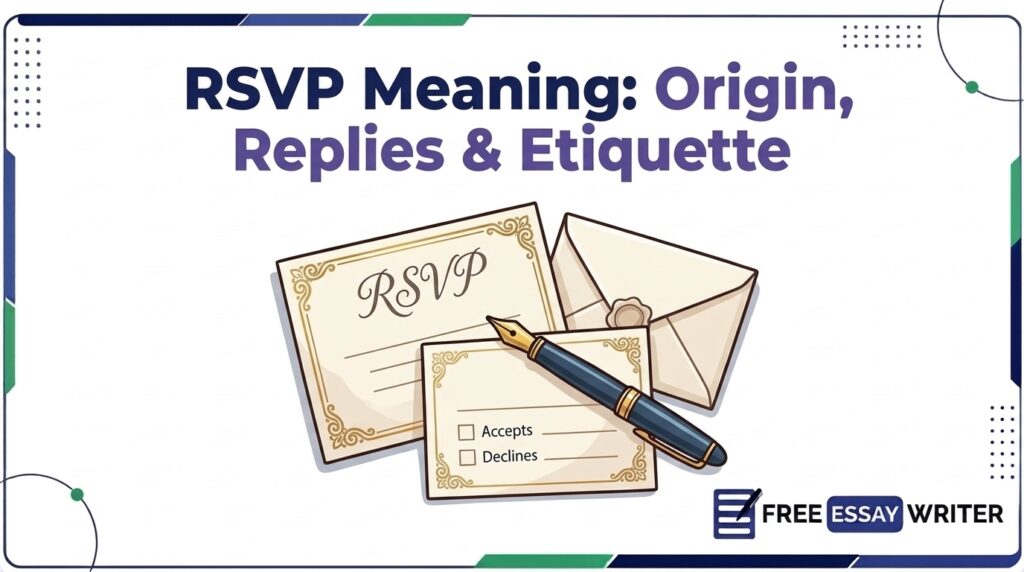
A wedding invitation arrives with four letters printed near the bottom: RSVP by June 1. Many guests know they should reply, yet fewer know what the letters mean.
The rsvp meaning comes from French and translates to “please respond,” a polite request for a reply. Writers who enjoy short forms like this one can also explore tldr meaning for another common abbreviation. This guide explains where RSVP came from, how to reply, and which mistakes to avoid.
Each section below moves from the basic definition toward real examples, reply templates, and etiquette rules. Students, event hosts, and guests will find practical wording for invitations, emails, texts, and formal cards.
RSVP means “please respond,” from the French phrase “répondez s’il vous plaît.” Hosts add it to invitations so guests confirm whether they will attend by a set date. Some invitations change the rule, such as “regrets only,” which asks only absent guests to reply.
The table below summarizes the abbreviation, its origin, and its common uses on invitations.
| Item | Details |
|---|---|
| Abbreviation | RSVP |
| Full French phrase | Répondez s’il vous plaît |
| English meaning | Please respond |
| Part of speech | Abbreviation, noun, or verb |
| Common places | Weddings, parties, business events, dinners |
| Typical reply | Accept or decline by a deadline |
| Formal tone | Yes, but used in casual invites too |
In plain terms, RSVP asks every invited guest to tell the host whether they plan to attend.
Simple words: when an invitation says RSVP, the host is asking for your answer.
RSVP stands for “répondez s’il vous plaît,” which means “respond, if you please” in French. English speakers shorten it to “please respond,” though the original phrase sounds slightly more formal. Most people never say the full French words and simply read the four letters aloud.
English speakers say each letter separately: “ar ess vee pee.” Nobody pronounces it as one word, and saying the full French phrase sounds unusual in daily conversation.
Yes, writers usually print RSVP in capital letters, because each letter represents a separate French word. Some style guides accept “R.S.V.P.” with periods, though most modern invitations drop them.
The phrase grew from French court etiquette, which guided polite social customs across Europe for centuries. English high society borrowed many French manners during the eighteenth and nineteenth centuries. Formal invitations borrowed “répondez s’il vous plaît,” and the abbreviation followed into printed cards.
Over time, RSVP spread from upper class dinners to weddings, business events, and children’s birthday parties. Today, the term appears on paper cards, emails, event apps, and social media invitations alike. Interestingly, French speakers today usually write “RSVP” less often than English speakers do.
Hosts need accurate guest counts for food, seating, venue size, and budgets. A short RSVP line asks for that information politely without sounding demanding or rude.
RSVP works as an abbreviation, a noun, and a verb, depending on the sentence structure. The table below shows each form with a short example sentence for reference.
| Form | Example | Meaning |
|---|---|---|
| Abbreviation | RSVP by May 10. | Please respond by May 10 |
| Verb | Please RSVP to Sarah. | Reply to Sarah |
| Noun | We received forty RSVPs. | Forty replies arrived |
| Adjective use | The RSVP card is inside. | The reply card |
All four uses point back to the same idea: a guest’s answer to an invitation.
Using RSVP as a verb sounds natural in modern English, as in “I already RSVPed yesterday.” The past tense appears as “RSVPed” or “RSVP’d,” and both spellings show up in everyday writing.
Writing “please RSVP” technically repeats “please,” because the French phrase already includes a polite request. Most readers accept it anyway, though careful writers sometimes drop the extra “please.”
These key characteristics explain how RSVP works on most invitations and event pages:
Not every RSVP line means the same request, so guests should read the exact wording carefully. The table below explains the common variations seen on invitations and event pages.
| RSVP wording | What it means | Who should reply |
|---|---|---|
| RSVP | Please respond | Every guest |
| Regrets only | Reply only if not attending | Guests who will miss it |
| RSVP by a date | Reply before the deadline | Every guest, on time |
| Kindly reply | Same as RSVP, in English | Every guest |
| Plus one included | Guest may bring one person | Guests, including the companion’s name |
Reading the exact phrase prevents confusion and helps the host plan with accurate numbers.
“Regrets only” asks guests to reply only if they cannot attend the event. Silence counts as a yes, so guests who plan to attend do not need to send anything.
Some invitations allow a guest to bring one companion, often called a plus one. Guests should include the companion’s name in their reply so the host can prepare place cards.
Weddings and formal dinners often ask guests to choose a meal on the reply card. Guests should mark their choice clearly, because caterers rely on those numbers for food orders.
Replying well takes less than a minute, yet it matters a great deal to the host. The steps below cover every common format, from paper cards to quick texts.
Find the reply date on the invitation and mark it on a calendar right away. Hosts usually set deadlines weeks before the event to confirm numbers with venues and caterers.
Use the method the host requested, such as a reply card, email, website, or phone call. Replying through the wrong channel can cause the answer to get lost before the event.
State clearly whether you will attend, and include the number of guests in your party. A clear “yes, two guests” works better than a vague “we will try to make it.”
Include meal choices, dietary needs, or companion names when the invitation asks for them. These details help hosts prepare food, seating, and name cards without extra follow up messages.
End with a short thank you, even when declining the invitation politely. A warm closing line keeps the relationship friendly, whatever the final answer happens to be.
Real examples make replies easier to write, so the following samples cover common situations. Each one stays short, clear, and polite for the host reading it.
“Thank you for the invitation. We are delighted to attend, and we will be two guests.” This reply confirms attendance and party size in one short, friendly message.
“Thank you for inviting us. Sadly, we have a family trip that weekend and cannot attend.” The reply declines kindly and gives a brief reason without long explanations.
“Thank you for the invitation. I will attend the product launch on Thursday at six.” Business replies stay short and professional, with the date and time repeated for clarity.
“Hi Maya, thanks for the invite! I’ll be there Saturday, and I’m bringing dessert.” Casual events welcome friendly texts, especially among close friends and neighbors.
| Situation | Short reply |
|---|---|
| Accept wedding | Delighted to attend, two guests. |
| Decline party | Thank you, but we cannot attend. |
| Accept work event | I will attend on Thursday at six. |
| Casual text | I’ll be there, thanks for inviting me! |
| Unsure | I’ll confirm by Friday, thank you. |
Short replies like these respect the host’s time and still sound warm and appreciative.
Hosts can make replies easier by writing clear RSVP instructions on every invitation. The best RSVP lines include a deadline, a contact method, and any extra details needed.
Formal invitations often use wording such as “The favor of a reply is requested by May first.” Wedding cards may include a separate reply card with a stamped envelope for easy returns.
Casual invitations work well with lines like “RSVP to Jordan by text by Friday.” Simple instructions encourage faster replies, especially from friends who rarely check email.
Event apps and websites often include a reply button, so guests click once to confirm. Hosts should still write the deadline clearly, because many guests ignore automated reminders.
| Event type | Sample RSVP line |
|---|---|
| Wedding | Kindly reply by June 1 using the enclosed card. |
| Birthday party | RSVP to Maya at the number below by Friday. |
| Office event | Please confirm attendance through the calendar invite. |
| Dinner party | Regrets only to Sam by Wednesday evening. |
Clear wording reduces confusion and saves hosts from chasing late answers before the event.
These two phrases sound similar, yet they ask for different behavior from guests. RSVP asks everyone to reply, while regrets only asks only absent guests to reply.
| Factor | RSVP | Regrets only |
|---|---|---|
| Who replies | Everyone | Only absent guests |
| Silence means | No answer yet | Attending |
| Best for | Weddings, dinners | Large casual events |
| Planning accuracy | Higher | Lower |
Hosts who need exact counts should always choose a full RSVP request instead of regrets only.
Many guests confuse these two cards, since both arrive before an event. A save the date announces the event early, while the invitation with RSVP asks for an actual reply.
| Factor | Save the date | Invitation with RSVP |
|---|---|---|
| Timing | Months before | Several weeks before |
| Purpose | Block the calendar | Confirm attendance |
| Reply needed | No | Yes |
| Details included | Date and place | Full schedule and reply instructions |
Guests should wait for the formal invitation before sending any official reply to the host.
Invitations often include other short forms, and knowing them helps guests respond correctly. The guide on icymi meaning covers another abbreviation that people often see in messages. The table below lists invitation terms that often appear beside RSVP on cards.
| Abbreviation | Meaning | Where it appears |
|---|---|---|
| RSVP | Please respond | Most invitations |
| BYOB | Bring your own beverage | Casual parties |
| TBD | To be decided | Early event details |
| ETA | Estimated time of arrival | Messages before events |
| PS | Postscript | End of handwritten notes |
Recognizing these short forms makes invitations easier to read and reply to without confusion.
The basic rule stays the same everywhere, yet each setting carries slightly different expectations. The sections below explain how RSVP works for common events that students and families attend.
Schools often send RSVP notes for parent meetings, graduations, field trips, and award ceremonies. Parents usually reply through a paper slip, school app, or email to the teacher. Quick replies help staff arrange chairs, programs, and refreshments for every family attending.
Parents planning a child’s party need numbers for cake, goody bags, and activity bookings. Many party venues charge per child, so a late reply can affect the final bill. Replying within a few days of receiving the invitation helps the host family plan comfortably.
Colleges and universities often limit ceremony seats, so they ask graduates to RSVP for guest tickets. Missing that deadline can mean fewer tickets for family members on the big day.
Virtual events also use RSVP, often through a registration button or calendar invite. Hosts use those numbers to choose platforms, plan breakout rooms, and send reminder emails.
| Setting | Common RSVP method | Why it matters |
|---|---|---|
| School events | Paper slip or app | Seating and materials |
| Birthday parties | Text or phone | Food and venue costs |
| Graduations | Online form | Limited guest tickets |
| Webinars | Registration button | Platform and reminders |
| Weddings | Reply card or website | Catering and seating |
Each setting depends on accurate replies, so the same courtesy applies across every event type.
Students sometimes need to write RSVP requests for club events, school functions, or class projects. A clear request includes the event name, date, deadline, and reply method in one sentence. For example, “Please reply to the club email by March 3 to confirm your attendance.”
Formal emails can place the RSVP request near the end, right before the closing line. Bolding the deadline helps busy readers notice it quickly while skimming the message.
“Dear members, our annual dinner takes place on April 12 at six in the school hall. Kindly reply by April 5 so we can confirm catering numbers with the venue.” This sample gives readers every detail they need to answer quickly and correctly.
Many hosts now collect replies through online forms, wedding websites, and event apps instead of paper cards. These tools record each answer, track meal choices, and send automatic reminders to guests. Hosts can see live numbers at any time, which makes final planning much faster.
Guests should still read each digital invitation carefully, because forms often include required questions. Skipping a meal choice or companion name can leave the reply incomplete in the host’s records.
| Tool type | Main advantage | Main drawback |
|---|---|---|
| Wedding website | Collects details in one place | Older guests may struggle |
| Event app | Automatic reminders | Guests must open the app |
| Calendar invite | Fast one click reply | Few extra details |
| Online form | Custom questions | Links can get lost |
Combining a digital form with a personal reminder message usually produces the fastest and most complete replies.
RSVP customs vary across countries, families, and communities, so hosts sometimes adjust their expectations. In some cultures, guests reply only when asked personally, and printed RSVP lines feel less important. In others, families answer as a group, so one reply covers several relatives at once.
Hosts planning events with guests from different backgrounds can add a personal phone call or message. That small step often brings replies from guests who overlook printed instructions on cards.
Hosts pay for food, chairs, rentals, and venue space based on expected guest numbers. Late or missing replies force them to guess, which often wastes money or leaves guests without seats. A quick answer shows respect and makes planning much easier for everyone involved.
These benefits show why prompt replies help both guests and hosts:
Missing an RSVP deadline usually forces the host to follow up, which adds stress to planning. Some hosts assume silence means no and plan without that guest entirely. Others hold a seat that stays empty, which wastes food and money on the event day.
Guests who miss the deadline should reply as soon as they notice and apologize briefly. A short message such as “Sorry for the late reply, I would love to attend” usually works well.
Plans change, and hosts understand when guests need to update their replies. Contact the host directly as soon as possible, especially when switching from yes to no.
Consider Priya, who mailed eighty wedding invitations with reply cards due six weeks before the ceremony. Sixty guests replied on time, but twenty stayed silent as the caterer’s deadline came closer. She spent three evenings texting and calling relatives to confirm the final numbers.
The next year, Priya helped her cousin plan a wedding with an online RSVP form and reminders. Replies arrived faster, and the cousin finalized numbers a full week before the deadline.
These tips help hosts collect replies quickly and plan with confidence:
Some guests think replying is optional when they plan to attend anyway. Hosts still need every answer, so silence creates confusion and extra follow up work.
Late replies can affect catering orders, seating charts, and final venue headcounts for hosts. Mark the date on a calendar as soon as the invitation arrives to avoid forgetting.
An invitation addressed to one person does not include partners, friends, or children automatically. Ask the host politely before bringing anyone not named on the invitation.
Guests sometimes send a yes reply to a regrets only invitation, which causes no harm. The bigger problem comes when absent guests stay silent and the host expects them.
Replies like “maybe” or “we’ll see” leave hosts unable to plan accurately. If unsure, tell the host when you will confirm, then follow through on that promise.
Skipping an event after replying yes wastes food and leaves an empty seat. Contact the host early whenever plans change, even if the update feels awkward to send.
Professional events follow the same basic rules, though replies should stay brief and formal. Colleagues and clients notice when guests answer late or skip events after confirming. A clear reply through the calendar invite or registration page usually works best.
Business hosts often track replies to plan catering, seating, and printed materials for attendees. Replying quickly reflects well on a guest’s professionalism and respect for colleagues’ time.
These short questions help readers test their knowledge of RSVP and its common variations.
RSVP comes from French and stands for “répondez s’il vous plaît,” meaning “please respond.”
Only guests who cannot attend should reply to a regrets only invitation sent by the host.
Writers use “RSVPed” or “RSVP’d” as the past tense, and both spellings appear often.
Use this checklist before sending any reply to an invitation:
On an invitation, the rsvp meaning is “please respond,” so the host wants your answer. Guests should reply by the listed deadline using the method the host requested.
RSVP stands for “répondez s’il vous plaît,” which means “please respond” in French. English invitations borrowed the phrase from French court etiquette several centuries ago.
Yes, guests should reply to an RSVP even when they are not going to the event. The only exception is a regrets only invitation, where guests who attend stay silent.
Not replying to an RSVP request usually feels rude to hosts, because they need accurate numbers. A short answer, even a polite no, shows respect for their planning effort.
RSVP regrets only means guests should reply only if they cannot attend the event. Hosts assume everyone else will come, so attending guests do not need to respond.
Yes, “please RSVP” appears often, though it technically repeats “please” because RSVP already means “please respond.” Most readers accept it, and few people notice the repetition.
Reply to an RSVP by text with a short message confirming attendance, guest count, and thanks. A line like “I’ll be there Saturday, thank you” works well for casual events.
Guests should RSVP by the deadline printed on the invitation, ideally several days earlier. Early replies help hosts confirm food, seating, and venue numbers without extra stress.
Yes, guests can change an RSVP answer, but they should contact the host as soon as possible. Early updates help hosts adjust food orders and seating plans without wasting money.
The past tense of RSVP appears as “RSVPed” or “RSVP’d” in everyday English writing. Both forms appear widely, so writers can choose either one and use it consistently.
The rsvp meaning is a simple request for an answer, yet that answer helps hosts plan every detail. Reply on time, use the requested method, and include any details the invitation asks for. A short, polite reply shows respect and keeps every event running smoothly for hosts and guests.
Explore more word guides on Free Essay Writer.

Written by
Part of the Free Essay Writer team, sharing practical advice on writing better essays, faster, and for free.
More from this authorNovember 12, 2026 · Muhammad Bilal
A new student walks into class, and some classmates decide what she is like before she says a single word.…
Muhammad Bilal
Read more
November 11, 2026 · Muhammad Bilal
A student reads two news stories about the same event and notices that one source leaves out key facts. She…
Muhammad Bilal
Read more
November 9, 2026 · Muhammad Bilal
A student writing a science report spots a shiny little lizard darting under a garden rock during recess. The teacher…
Muhammad Bilal
Read more
Generate a full essay free, then polish it with the built-in toolkit.
Start writing free