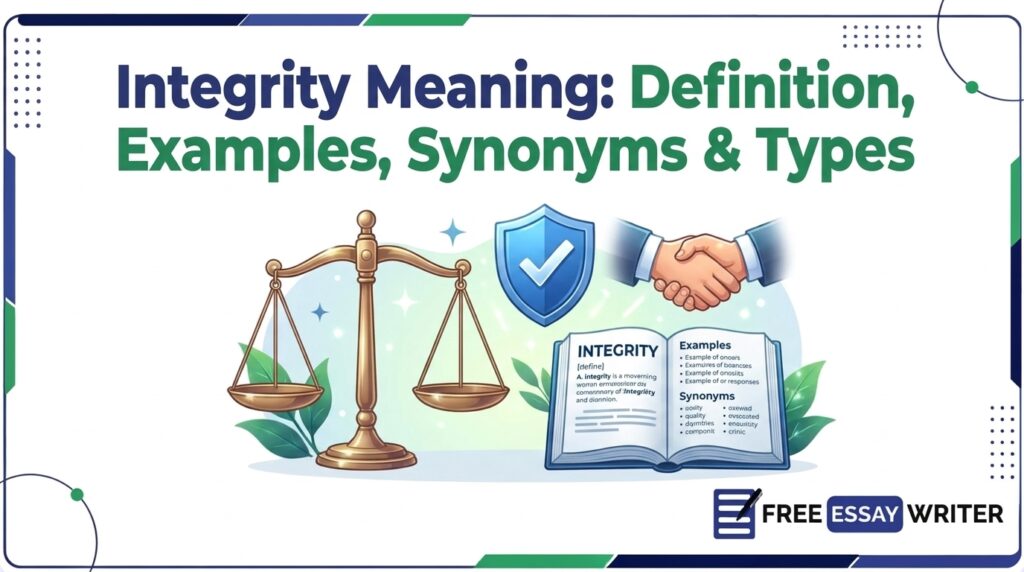
A cashier hands back too much change, and nobody would ever notice the mistake. The customer returns the extra money anyway, because keeping it simply feels wrong. That small choice shows the heart of the integrity meaning better than any dictionary line.
Students meet the word in essays, job seekers meet it in interviews, and engineers meet it in reports. Writers who follow our guide on research paper writing also meet it through academic integrity rules. This article explains what integrity means, where the word comes from, and how people use it today.
It also covers types, synonyms, antonyms, example sentences, and practical ways to build the trait. Each section stands alone, so readers can jump to the part they need.
Quick Answer: What Is the Integrity Meaning?
Integrity means acting on strong moral principles consistently, even when nobody is watching. It describes a person whose words, values, and actions match over time. The word can also mean being whole and undamaged, as in the structural integrity of a bridge.
Integrity Meaning at a Glance
The word carries several related senses that share one idea of wholeness. The table below sums up the main meanings before the detailed sections.
Sense
Meaning
Example context
Moral
Honesty and strong principles
Character, leadership, friendships
Structural
Physical soundness and strength
Bridges, buildings, aircraft
Data
Accuracy and consistency of information
Databases, research, finance
Academic
Honest work without cheating or plagiarism
Schools, universities, research
Wholeness
Being complete and undivided
Territory, artwork, ecosystems
Every sense points back to one core idea: something stays whole, sound, and true to itself.
Where Does the Word Integrity Come From?
The word integrity comes from the Latin noun integritas, which means wholeness or soundness. That noun grew from the Latin adjective integer, meaning whole, complete, or untouched. Mathematics still uses integer for whole numbers, which shows the same root at work.
English borrowed the word in the late Middle Ages, partly through Old French. Early uses described physical wholeness and innocence more often than moral character. Over the centuries, the moral sense grew stronger and became the most common meaning today.
In simple words, a person with integrity is morally whole, with no split between values and actions. This link between wholeness and honesty explains why the word feels so strong in daily speech.
What Does Integrity Mean in Simple Words?
In everyday speech, integrity means doing the right action simply because it is right. A person with integrity keeps promises, tells the truth, and treats others fairly. They do not change their values to win approval, avoid trouble, or gain money.
Integrity also involves consistency across different settings, audiences, and stages of life. A person who acts kindly in public but cruelly in private lacks integrity. The trait shows most clearly when honesty costs something, such as time, money, or comfort.
Children often learn the idea through simple stories about returning lost items or admitting mistakes. Adults face more complex tests, such as reporting errors at work or refusing unfair shortcuts. The principle stays the same at every age, even as the situations grow harder.
Dictionary Definitions of Integrity
Major English dictionaries define integrity with two or three closely related senses. Merriam Webster describes it as firm adherence to a code of moral values. Oxford and Cambridge dictionaries describe it as being honest and having strong moral principles.
Most dictionaries also list the sense of being whole, undivided, or in sound condition. This second sense appears in engineering, computing, and politics more than in casual talk. Readers should check the context to decide which definition a writer intends.
Dictionary sense
Plain meaning
Moral soundness
Honest and principled behavior
Unimpaired condition
Undamaged and working properly
Completeness
Whole and undivided
The table shows how one word stretches from character traits to physical objects without losing its core.
Types of Integrity
People use the word integrity in several fields, and each field adds its own detail. The sections below explain the most common types that readers will meet in daily life.
Personal Integrity
Personal integrity describes how well a person’s actions match their stated values. It appears in daily choices, such as keeping small promises and admitting mistakes honestly. Friends and family usually notice personal integrity long before they describe it in words.
Professional Integrity
Professional integrity means following ethical standards at work, even under pressure from bosses or clients. Doctors protect patient privacy, accountants report numbers accurately, and journalists check facts before publishing. Many professions publish formal codes of conduct that spell out these duties.
Academic Integrity
Academic integrity means completing schoolwork honestly and giving credit to the original sources. It forbids plagiarism, cheating on exams, fabricating data, and submitting someone else’s work. Universities treat breaches seriously, with penalties ranging from failed assignments to expulsion.
Structural Integrity
Structural integrity describes the ability of an object to hold its intended load without breaking. Engineers test the structural integrity of bridges, buildings, ships, and aircraft regularly. A crack in a support beam can threaten structural integrity even when the damage looks small.
Data Integrity
Data integrity means information stays accurate, complete, and consistent throughout its life. Banks, hospitals, and researchers depend on data integrity for correct decisions and records. Backups, access controls, and validation checks help protect data from errors and tampering.
Artistic Integrity
Artistic integrity describes an artist’s commitment to their own vision instead of pure commercial pressure. A musician who refuses to change a song for quick sales shows artistic integrity. Critics often praise this quality when they review films, books, and albums.
Integrity vs Honesty: What Is the Difference?
People often treat integrity and honesty as the same word, but they differ in scope. Honesty focuses on telling the truth and avoiding deception in spoken or written words. Integrity covers honesty plus consistent action, fairness, and keeping commitments over time.
Feature
Integrity
Honesty
Main focus
Matching actions to values
Telling the truth
Scope
Broad character trait
Narrower behavior
Shows up in
Choices, promises, and conduct
Statements and answers
Example
Refusing a bribe nobody would discover
Admitting a mistake when asked
Honesty forms one part of integrity, but integrity asks for more than truthful speech.
A person can be honest yet lack integrity in some areas of life. For example, someone might never lie but still break promises when they become inconvenient. Integrity joins honesty with reliability, so trust grows on both words and deeds.
Integrity vs Ethics vs Morals
Integrity, ethics, and morals overlap, which causes confusion in essays and conversations. Morals are personal beliefs about right and wrong, often formed by family, faith, or culture. Ethics are shared rules for conduct within a group, profession, or society.
Integrity describes how faithfully a person lives by their morals and the ethical rules they accept. In other words, morals and ethics set the standard, while integrity measures how well someone follows it. A person shows integrity when their behavior matches their principles without needing outside pressure.
Term
Simple meaning
Example
Morals
Personal beliefs about right and wrong
Believing that stealing is wrong
Ethics
Shared rules for a group
A medical code of conduct
Integrity
Living by those beliefs and rules
Refusing to falsify a patient record
The table helps writers choose the precise word when they discuss character in essays.
Synonyms for Integrity
Writers often need synonyms to avoid repeating the same word in an essay. Each synonym in the table below carries a slightly different shade of meaning.
Synonym
Best use
Honesty
Truthful speech and behavior
Uprightness
Formal moral strength
Probity
Strict honesty in public or financial roles
Rectitude
Moral correctness in formal writing
Sincerity
Genuine feelings without pretense
Trustworthiness
Reliability that earns confidence
Wholeness
The physical or complete sense
Soundness
The structural or logical sense
Writers should match the synonym to the sense of integrity they mean in each sentence.
For example, probity suits a news report about a government official handling public money. Soundness suits a technical report about a bridge or a careful logical argument. Honesty suits a casual story about a friend who returned a lost wallet.
Antonyms for Integrity
Antonyms help readers see the meaning of integrity more clearly through contrast. Common opposites include dishonesty, corruption, deceit, hypocrisy, and duplicity in most dictionaries.
Hypocrisy deserves special attention, because it directly opposes the consistency at the heart of integrity. A hypocrite claims one set of values but acts on another set entirely. Corruption describes the abuse of trusted authority for personal gain, often involving bribes.
For the structural sense, common antonyms include weakness, fragility, damage, and instability. A cracked dam lacks structural integrity, while a corrupt official lacks moral integrity.
Examples of Integrity in Daily Life
Concrete examples make the integrity meaning easier for readers to grasp and remember. The situations below show how the trait appears in ordinary settings every day.
A student notices a grading mistake that adds ten points and reports it to the teacher. An employee admits that a delayed project came from their own planning error, not a coworker’s fault. A shop owner refuses to sell expired products, although the loss hurts monthly profit.
A friend keeps a secret that another person shared in confidence, even when gossip would feel tempting. A referee makes a fair call against the home team while the crowd shouts loudly. A parent follows through on a promised outing, even after a tiring week at work.
These examples share one pattern: the right choice costs something, yet the person chooses it anyway.
Integrity Examples at Work
Workplaces test integrity often, because money, status, and deadlines create constant pressure on staff. Employers value integrity highly because trust reduces the need for constant supervision.
Situation
Choice that shows integrity
Expense reports
Claiming only real costs with receipts
Missed deadline
Explaining the true cause early
Safety concern
Reporting the risk to a supervisor
Client error in the company’s favor
Correcting the invoice quickly
Confidential data
Sharing it only with authorized people
Each choice protects long term trust, even when a shortcut would save time in the moment.
Many hiring managers ask interview questions about integrity to judge a candidate’s character. A common question asks candidates to describe a time they faced an ethical dilemma at work. Strong answers name the situation, the choice made, and the lesson learned afterward.
How to Use Integrity in a Sentence
Example sentences show how writers place the word naturally in different contexts. The table below covers moral, academic, structural, and data uses of the word.
Context
Example sentence
Character
Her integrity earned the respect of every colleague on the team.
Leadership
Voters wanted a mayor with integrity after years of public scandals.
Academic
The university updated its academic integrity policy for online exams.
Structural
Engineers checked the structural integrity of the old railway bridge.
Data
The audit confirmed the integrity of the company’s financial records.
Each sentence shows that nearby words usually reveal which sense of integrity the writer means.
Integrity works as an uncountable noun in most uses, so writers rarely add a or an before it. Phrases such as “a person of integrity” and “with integrity” appear often in formal writing. The adjective form does not exist as integral in this moral sense, so writers use principled instead.
Why Is Integrity Important?
Integrity matters because trust holds relationships, teams, and whole communities together over time. People share information, money, and responsibility more freely with those they trust. Without integrity, every promise needs checking, and cooperation slows to a crawl.
In leadership, integrity shapes how followers behave, because people copy what leaders do. A manager who bends rules teaches the team that rules do not matter. A manager who follows rules under pressure teaches the opposite lesson to everyone watching.
Integrity also supports personal peace of mind, because a person has nothing to hide. Research in psychology links consistent values and actions with lower stress and stronger self respect. Living with integrity removes the tiring work of keeping track of different stories.
Benefits of Integrity
People who practice integrity often enjoy six clear long term advantages in life:
Friends, coworkers, and family members trust them with important tasks and personal information.
Employers often give them more responsibility because they need less supervision and checking.
They avoid the stress of hiding mistakes, managing lies, or remembering conflicting stories.
Their reputation grows over time and opens doors to new jobs and partnerships.
They build stronger self respect because their actions match the values they claim.
Teams around them copy their example, which creates a healthier culture for everyone.
Key Characteristics of a Person With Integrity
People with strong integrity usually share a recognizable set of personal traits:
They tell the truth even when a small lie would make life easier.
They keep promises and follow through on commitments made to friends and colleagues.
They admit mistakes quickly and take responsibility instead of blaming other people.
They treat people fairly regardless of status, wealth, appearance, or personal connections.
They behave the same way in private as they do in public settings.
They stand by their principles under pressure from peers, bosses, or crowds.
Integrity in Leadership
Leaders face integrity tests more publicly than most people, because their choices affect many others. A leader who hides bad news to protect a reputation damages trust across the whole organization. A leader who shares hard truths early gives the team time to respond and adjust plans.
Management research often lists integrity among the traits employees value most in a manager. Teams follow leaders willingly when they believe promises will hold and rules will apply equally. When leaders break that belief, staff turnover usually rises and morale falls quickly.
Political leaders face the same test on a larger stage, where voters judge character closely. Scandals involving bribes, false statements, or broken promises often end careers that took decades to build.
Integrity in Relationships
In friendships and families, integrity shows up as reliability and honest communication. Friends trust people who keep secrets, show up when promised, and speak truthfully with care. Small betrayals, such as sharing private stories, can damage trust for years afterward.
Integrity in relationships also means admitting hurtful behavior and making real amends. A sincere apology names the mistake clearly and explains how future behavior will change. Words without changed actions usually fail to rebuild trust after a serious breach.
Partners and family members also show integrity by respecting agreed boundaries and shared plans. Consistent respect over time builds a foundation that survives arguments and hard seasons.
Integrity in Science and Research
Research integrity means scientists report methods and results honestly, including failed experiments. Fabricating data, altering images, or hiding inconvenient results all break this standard. Journals retract papers when investigators find serious problems with how researchers handled data.
Peer review supports research integrity by asking independent experts to check each study before publication. Funding agencies and universities also run offices that investigate claims of misconduct. These systems protect the public, because medicine and policy often depend on published research.
Students build research integrity early by recording sources carefully and quoting accurately. Good habits in school projects carry forward into professional research careers later.
Integrity in Business and Brands
Businesses show integrity when their marketing claims match what their products actually deliver. A company that advertises honest pricing but adds hidden fees damages customer trust quickly. Online reviews spread these stories fast, so dishonest practices rarely stay hidden for long.
Many companies publish codes of ethics and train staff on bribery, privacy, and fair competition. These programs work best when leaders model the same standards in daily decisions. Customers and investors increasingly reward brands that keep promises about quality, safety, and fair treatment.
Small businesses show integrity through simple acts such as honoring warranties and fixing mistakes without arguments. These everyday choices build loyal customers who return and recommend the business to friends.
Integrity in Literature and Film
Stories often explore integrity by placing characters under heavy pressure to give up their values. Atticus Finch in To Kill a Mockingbird defends an innocent man while his whole town turns against him. Readers remember him because his private beliefs and public actions stay the same.
Many films follow whistleblowers who risk careers to expose fraud, danger, or abuse of trust. These stories show integrity as costly, lonely, and brave at the same time. Students can use such characters as strong examples in essays about moral courage.
Integrity Across Cultures and Faiths
Most cultures and faith traditions praise integrity, though they describe it with different words. Many religious teachings stress honesty in trade, keeping promises, and treating others fairly. These shared values explain why integrity appears in codes of conduct around the world.
Some cultures focus more on group harmony, while others focus more on individual conscience. Both views still prize keeping one’s word and acting fairly toward neighbors and strangers. Writers who discuss integrity in essays can explore these differences to add depth and balance.
Real World Example: Integrity in a Classroom
Consider a fictional college student named Omar who is finishing a difficult history essay. A classmate offers him a finished essay from last year that matches the same prompt. The deadline is close, and nobody would likely notice if he copied several paragraphs.
Omar declines the offer and asks his professor for a short extension instead. He explains that a family emergency took two days of his planned writing time. The professor grants three extra days, and Omar submits original work with careful citations.
The example is invented, but it shows how integrity often involves asking for help instead of cutting corners. Our guide on essay format explains the citation styles that keep student writing honest and properly credited.
How to Build Integrity
Integrity grows through many repeated choices, not through a single dramatic moment. The six steps below help people strengthen the trait over months and years.
Step 1: Define Personal Values
Write a short list of values that matter most, such as honesty, fairness, and kindness. Clear values make decisions easier when pressure or temptation appears without any warning.
Step 2: Keep Small Promises
Arrive on time, return borrowed items, and finish agreed tasks on schedule. Small promises build the habit that big commitments later depend on in life.
Step 3: Tell the Truth Kindly
Share honest feedback with care, choosing words that respect the other person’s feelings. Truth delivered kindly protects both integrity and relationships at the same time.
Step 4: Admit Mistakes Quickly
Own errors as soon as they appear, and explain how to fix them. Fast admissions limit damage and show others that honesty matters more than pride.
Step 5: Review Choices Regularly
Spend a few minutes each week reviewing decisions that tested personal values. Regular reflection reveals patterns and helps people prepare for similar situations in the future.
Step 6: Choose Good Company
Spend time with people who value honesty and fairness in their own lives. Peers shape behavior strongly, so good examples make principled choices feel normal.
Common Mistakes When Using the Word Integrity
Writers and speakers misuse the word in a handful of predictable ways. The five mistakes below appear most often in student essays and reports.
1. Using Integrity as a Plain Synonym for Honesty
Integrity includes honesty but also covers consistency, fairness, and reliability across time. Writers should choose the word honesty when they mean truthful speech alone.
2. Confusing Integrity With Integration
Integration means combining parts into one system, while integrity means wholeness or moral soundness. The words share a Latin root but carry different meanings in modern English.
3. Adding an Article in the Moral Sense
Phrases like “he has an integrity” sound wrong because integrity is usually uncountable. Writers should say “he has integrity” or “he is a man of integrity.”
4. Ignoring the Structural Sense in Technical Writing
Engineering and computing texts often use integrity in the wholeness sense, not the moral sense. Readers who miss this context may misread technical reports and draw wrong conclusions.
5. Claiming Integrity Without Examples
Essays that call a person principled without giving examples sound empty and unconvincing. Strong writing shows integrity through specific actions and the consequences that follow them.
Tips for Writing an Essay About Integrity
Students often receive essay prompts about integrity, character, or ethics in school. These tips help them write stronger and more original essays on the topic:
Open with a short real or fictional scene that shows integrity under pressure.
Define integrity clearly early in the essay and explain which sense the essay discusses.
Compare integrity with honesty or ethics to show deeper knowledge of the concept.
Support each claim with a specific example from history, literature, or personal experience.
Cite every outside source properly to model academic integrity within the essay itself.
End with a reflection on how integrity applies to the writer’s own life or goals.
Integrity Meaning Checklist
Readers can use this checklist to apply the word correctly in writing and speech:
Check whether the context calls for the moral, structural, data, academic, or wholeness sense.
Use integrity without an article when describing a person’s moral character in most sentences.
Choose honesty instead when the sentence only concerns truthful speech or answers.
Support any claim about someone’s integrity with at least one specific example.
Avoid confusing integrity with integration, which means combining separate parts into one system.
Pick precise synonyms such as probity or soundness when the context needs extra precision.
Frequently Asked Questions
What is the simple integrity meaning?
The simple integrity meaning is acting on strong moral principles consistently, even without an audience. A person with integrity keeps their words, values, and actions in line.
What is an example of integrity?
Returning extra change that a cashier gave by mistake is a clear example of integrity. The person chooses honesty, although nobody would ever notice the original error.
What is the difference between integrity and honesty?
Honesty means telling the truth, while integrity covers honesty plus consistent and fair action. The integrity meaning is broader because it includes keeping promises and following principles.
What does academic integrity mean?
Academic integrity means doing schoolwork honestly and crediting every source used in assignments. It forbids plagiarism, cheating, fabricated data, and submitting work that someone else wrote.
What does structural integrity mean?
Structural integrity means an object can carry its intended load without breaking or failing. Engineers use this integrity meaning when they inspect bridges, buildings, and aircraft.
What is the origin of the word integrity?
The word integrity comes from the Latin integritas, meaning wholeness or soundness. That word grew from integer, which means whole or complete in Latin.
What is a synonym for integrity?
Common synonyms for integrity include honesty, uprightness, probity, rectitude, and trustworthiness in formal English. Writers should pick the synonym that matches the integrity meaning in each sentence.
What is the opposite of integrity?
The opposites of integrity include dishonesty, corruption, deceit, and hypocrisy in the moral sense. In the structural sense, opposites include weakness, damage, and instability in physical objects.
Why is integrity important at work?
Integrity matters at work because trust lets teams share information and responsibility freely. Employers often give more freedom and responsibility to employees who show integrity consistently.
Can a person learn integrity?
Yes, people can build integrity through repeated choices, clear values, and honest reflection. Keeping small promises and admitting mistakes quickly strengthen the trait over time.
Key Takeaways
The integrity meaning centers on acting by strong moral principles, even when nobody watches.
The word comes from the Latin integritas, which means wholeness or soundness.
Integrity can also mean physical wholeness, as in the structural integrity of a bridge.
Data integrity describes information that stays accurate, complete, and consistent over time.
Academic integrity forbids plagiarism, cheating, and fabricated data in schoolwork and research.
Honesty forms one part of integrity, but integrity also covers consistent action and promises.
Morals and ethics set the standards, while integrity measures how well people follow them.
Useful synonyms include honesty, uprightness, probity, rectitude, and trustworthiness for varied writing.
Hypocrisy directly opposes integrity because it splits stated values from real actions.
Integrity is usually uncountable, so writers say “has integrity” without an article.
People build integrity by defining values, keeping small promises, and admitting mistakes quickly.
Strong essays about integrity use specific examples and cite every source properly.
Final Thoughts
The integrity meaning goes deeper than honesty alone, because it asks words and actions to match. Whether the topic is a person, a bridge, or a database, integrity always points to wholeness. Small daily choices build this trait, and those choices shape trust in every part of life.
Explore more vocabulary and essay writing guides on Free Essay Writer.



 Muhammad Bilal
Read more
 Moeed