November 12, 2026 · Muhammad Bilal
Prejudice Meaning: Definition, Examples, Synonyms & Types
A new student walks into class, and some classmates decide what she is like before she says a single word.…
 Muhammad Bilal
Read more

Muhammad Bilal
Content Writer
A coworker takes credit for a group project, brushes off concerns, and expects constant praise from everyone. Someone in the office mutters the word “narcissist,” and everyone nods as if that settles it.
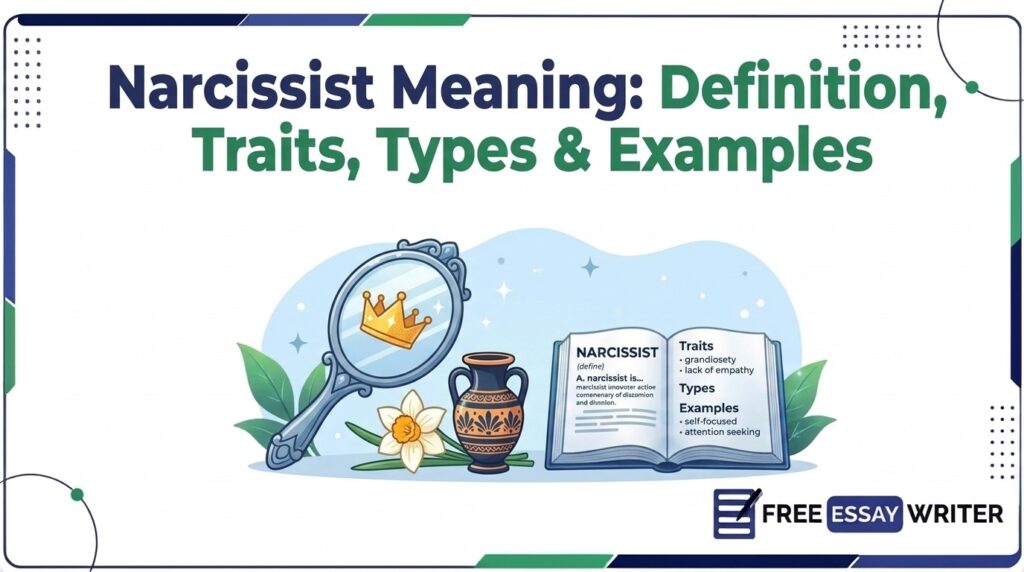
The narcissist meaning covers far more ground than most casual conversations about difficult people suggest. This guide explains the definition, origin, main traits, clinical side, and accurate use in writing.
Students who study character words can also review our prejudice meaning guide for related vocabulary. The sections below focus on narcissist in everyday speech, psychology, and essays.
A narcissist is a person with inflated self importance, a strong need for admiration, and limited empathy. In everyday speech, people use the word loosely for anyone vain or selfish. In psychology, the term links to narcissistic personality disorder, which only a qualified professional can diagnose.
The word carries a casual meaning, a psychological meaning, and a literary history. The table below shows each sense of the word with the setting where it usually appears.
| Sense | Meaning | Typical Setting |
|---|---|---|
| Everyday | A vain or self centered person | Casual talk, social media |
| Psychological | A person with strong narcissistic traits | Psychology articles, therapy |
| Clinical | A person diagnosed with narcissistic personality disorder | Medical and mental health care |
| Literary | A reference to the Greek myth of Narcissus | Literature, art, essays |
Context decides which sense a writer means, so careful writers make that sense clear.
In simple words, a narcissist loves their own image so much that other people’s needs fade from view.
Dictionaries define a narcissist as someone who admires themselves excessively and seeks attention or praise from others. The noun narcissist comes from narcissism, which describes the trait or pattern itself.
The adjective narcissistic describes behavior, attitudes, or people who show these traits. A writer might call a speech narcissistic if it focuses only on the speaker’s achievements.
The word family includes several forms that students should know before using them in essays. Each form plays a different grammatical role inside a sentence, so the choice matters.
| Word | Part of Speech | Example Use |
|---|---|---|
| Narcissist | Noun | The narcissist ignored every complaint. |
| Narcissism | Noun | Narcissism can damage close friendships. |
| Narcissistic | Adjective | His narcissistic speech bored the audience. |
| Narcissistically | Adverb | She narcissistically turned every topic to herself. |
Choosing the right form keeps sentences accurate and avoids awkward grammar in academic writing.
Most English speakers pronounce narcissist as NAR sih sist, with stress on the first syllable. The word narcissism follows a similar pattern, pronounced NAR sih siz um.
The word comes from Narcissus, a young hunter in Greek mythology who loved his own reflection. The Roman poet Ovid told the story in his long poem Metamorphoses.
In the myth, Narcissus rejects the nymph Echo and many other admirers who seek his affection. He later sees his face in a pool, stares at it endlessly, and wastes away beside the water.
A flower grows where Narcissus died, and the narcissus flower still carries his name today. The story became a symbol of self obsession in art, poetry, and later psychology.
Psychologists borrowed the name in the late nineteenth and early twentieth centuries. Sigmund Freud wrote an influential essay on narcissism in 1914, which spread the term through modern psychology.
Psychologists describe a common cluster of traits whenever they discuss narcissism in their research. These key characteristics appear in most professional descriptions of narcissistic behavior:
Psychology treats narcissism as a trait that exists on a spectrum, from healthy confidence to harmful patterns. Everyone shows some narcissistic traits at times, especially during stress, sudden success, or adolescence.
Healthy self esteem helps people set goals, accept compliments, and recover from setbacks. Problems appear when self focus becomes rigid, extreme, and damaging to relationships or work.
Narcissistic personality disorder, often shortened to NPD, is a formal mental health diagnosis. The DSM, published by the American Psychiatric Association, lists specific criteria for this condition.
The diagnosis requires a long lasting pattern of grandiosity, need for admiration, and lack of empathy. That pattern must appear across many situations and cause real problems in daily life.
Only a licensed mental health professional can diagnose narcissistic personality disorder after a proper assessment. Calling a coworker or relative a narcissist in casual speech does not equal a clinical diagnosis.
Research estimates vary widely because studies use different methods, samples, and populations around the world. Most estimates place NPD in a small minority of the general population, often under a few percent.
Many people with strong narcissistic traits never meet the full criteria for the disorder. That gap explains why professionals warn against using the label too freely online.
Some studies report slightly higher rates of the disorder among men than women, although findings differ. Researchers also note that people with the disorder rarely seek help unless another problem pushes them toward treatment.
Depression, anxiety, or relationship breakdowns often bring these individuals to therapy for the first time. Therapists then work on the narcissistic patterns alongside the problem that started the visit.
Researchers describe several forms of narcissism, and each one looks different from the outside. Knowing these types helps readers avoid a single stereotype of the loud, boastful narcissist.
| Type | Main Features | How It Appears |
|---|---|---|
| Grandiose | Open arrogance, dominance, attention seeking | Boasting, interrupting, showing off |
| Vulnerable | Hidden insecurity, sensitivity, resentment | Sulking, victim stories, quiet envy |
| Communal | Self image as extremely kind or generous | Public good deeds for praise |
| Malignant | Narcissism mixed with aggression and cruelty | Manipulation, hostility, exploitation |
These categories overlap, and one person can show traits from more than one type.
Grandiose narcissism matches the classic image of a confident, boastful person who loves the spotlight. These individuals often seem charming at first, which helps them win attention quickly.
Vulnerable narcissism, sometimes called covert narcissism, hides behind shyness, anxiety, or quiet resentment. These individuals still crave admiration, but they express hurt and envy in less obvious ways.
Communal narcissism appears in people who see themselves as unusually caring, helpful, or morally superior. Their kindness often depends on public recognition more than genuine concern for others.
Malignant narcissism describes a severe pattern that mixes narcissistic traits with hostility and antisocial behavior. Psychologists use this term carefully because it describes the most harmful end of the spectrum.
Several words overlap with narcissist, and writers often swap them without noticing the differences. The table below compares the most common related terms that students confuse in essays.
| Word | Core Meaning | Key Difference |
|---|---|---|
| Narcissist | Inflated self image plus low empathy | Includes need for admiration |
| Egotist | Talks about themselves constantly | Focus on self, not always low empathy |
| Egoist | Acts mainly from self interest | Describes motives, not vanity |
| Vain | Overly proud of looks or abilities | Narrower, often about appearance |
| Selfish | Puts own needs first | Common trait, not a full pattern |
| Sociopath | Disregards rules and others’ rights | Centers on antisocial behavior |
Each word carries a different weight, so precise writers choose the one that fits the evidence.
An egotist talks about themselves often and overrates their importance in conversations. A narcissist shows that trait plus a deeper need for admiration and weaker empathy.
Selfish behavior appears in nearly everyone at times, such as taking the last slice of pizza. Narcissism describes a stable, long lasting pattern across many relationships and situations.
Sociopath is an informal term linked to antisocial personality disorder, which centers on rule breaking. Narcissists focus more on admiration and self image than on breaking rules.
Seeing the word in context helps students use it correctly in essays and conversations. Each example below shows a different sense or form of the word.
The manager acted like a narcissist, taking credit for every success and blaming staff for failures. This sentence uses the casual sense of the word to describe poor workplace behavior.
Her therapist explained that narcissistic traits exist on a spectrum, not as a simple yes or no. This sentence reflects the psychological sense of the word that professionals usually prefer.
In Ovid’s myth, Narcissus stares at his reflection until he wastes away beside the pool. This sentence connects the word to its literary origin in ancient Roman poetry.
The novel’s villain behaves narcissistically, turning every family crisis into a story about himself. This sentence shows the adverb form of the word inside a piece of literary analysis.
Writers have explored narcissistic characters for centuries, long before psychology named the pattern. Students often meet these characters in literature classes, reading lists, and essay prompts.
Jay Gatsby, Dorian Gray, and Shakespeare’s King Lear all show narcissistic traits in their stories. Essays about these characters often discuss pride, image, and the cost of self obsession.
When writing about fictional characters, describe the traits you see instead of diagnosing a disorder. Phrases like “shows narcissistic traits” sound more accurate than “has narcissistic personality disorder.”
Readers who build their vocabulary for essays can also explore our guide to discernment meaning. That word helps writers describe careful judgment, which contrasts well with narcissistic blindness.
Researchers have not found one single cause for narcissism or narcissistic personality disorder. Most experts point to a mix of genetic, family, and social factors that interact over time.
Some studies link narcissistic traits to childhood experiences, such as excessive praise without limits or harsh criticism. Others point to temperament, which describes the inborn style a child brings into the world.
Culture may also play a part, since some settings reward self promotion, fame, and constant comparison. Social media platforms can reward attention seeking behavior with likes, shares, and followers.
No single parenting style or event guarantees that a child will become narcissistic. Professionals view the condition as a complex outcome of many influences acting together.
Many readers first meet the word while trying to make sense of a painful friendship or romance. Narcissistic traits can strain any close relationship, including family ties and long term partnerships.
Early stages often look exciting, because charm and attention can make a new partner seem perfect. Later stages may bring criticism, coldness, or blame when the partner stops providing constant admiration.
Friends of a person with strong narcissistic traits may notice one sided conversations and broken promises. These friends often give support but receive little interest in their own lives or problems.
Family members may sense pressure to meet unrealistic standards or protect the person’s public image. Children in such homes sometimes learn to hide their own needs to keep the peace.
Online communities created a whole vocabulary around narcissism, and many terms now appear in daily speech. Students should know these words, although most of them lack formal clinical definitions today.
| Term | Common Meaning | Where It Appears |
|---|---|---|
| Narc | Short slang for narcissist | Social media, forums |
| Love bombing | Intense early attention and praise | Relationship advice posts |
| Gaslighting | Making someone doubt their memory | Psychology articles, news |
| Flying monkeys | People who act for a manipulator | Support group discussions |
| Hoovering | Attempts to pull someone back | Breakup advice threads |
These terms help people describe experiences, but writers should define them clearly in formal essays.
Gaslighting began with a 1938 play and later film called Gas Light, where a husband tricks his wife. The term now describes any pattern that makes someone question their own memory or judgment.
A strong vocabulary helps writers avoid repeating the same word throughout an essay or report. The table below lists close synonyms and clear opposites for the word narcissist.
| Synonyms | Antonyms |
|---|---|
| Egotist | Altruist |
| Egomaniac | Humble person |
| Self admirer | Selfless person |
| Show off | Modest person |
| Braggart | Empathetic listener |
Each synonym carries a slightly different tone, so pick the one that matches your evidence and audience.
Altruist works as a strong antonym because it describes someone who acts mainly for the good of others. Humble and modest describe people who downplay their achievements and share credit freely.
The same word can carry a different weight depending on where people use it. Knowing these settings helps readers interpret the term correctly in news, workplaces, and classrooms.
Workplace articles often describe narcissistic bosses who take credit, avoid blame, and punish honest feedback. Human resources teams usually focus on specific behaviors, since labels alone cannot support a complaint.
Teachers sometimes see narcissistic traits in students who dominate group work or dismiss classmates’ ideas. Most young people grow out of these habits as they mature and gain experience.
Social media posts often use narcissist as a quick insult for exes, influencers, or celebrities. Readers should treat these claims with caution, since few posters hold any clinical training.
Journalists and biographers sometimes discuss narcissistic traits in famous leaders or business figures. Careful writers quote experts and describe behavior, since remote diagnosis breaks professional ethics rules.
Consider a high school student writing an essay about Jay Gatsby and his famous parties. The first draft called Gatsby “a narcissist with a personality disorder” in the opening paragraph.
The teacher marked the claim as unsupported, since no character in the novel receives a diagnosis. The student then revised the sentence to say Gatsby “shows narcissistic traits through his obsession with image.”
The revised essay added evidence, such as the lavish parties and the carefully built fake past. That change turned an emotional label into a strong, defensible argument with clear textual support.
Social media spread the word narcissist far beyond psychology classrooms and therapy offices. Many people now use it for any partner, parent, or boss who behaved badly.
Overuse weakens the word and can hurt people who live with real mental health conditions. It also hides other explanations, such as stress, poor communication, or simple disagreement.
Mental health professionals encourage people to describe specific behaviors instead of attaching quick labels. Saying “he never listens and dismisses my concerns” often works better than “he is a narcissist.”
Many readers search for this term because someone in their life shows narcissistic traits. A few practical habits help protect your time, energy, and wellbeing in those situations.
Write down specific incidents, such as broken promises, insults, or constant interruptions. Clear notes help you see whether the behavior forms a pattern or stays a rare event.
Decide which behaviors you will not accept, then state those limits calmly and briefly. Repeat the boundary whenever needed, without long debates, excuses, or emotional arguments.
People with strong narcissistic traits often resist admitting mistakes, even with strong evidence. Focus on your own decisions instead of trying to win their agreement.
Spend time with friends, family, or groups who respect your opinions and needs. A strong support network reduces the impact of any single difficult relationship.
A counselor or therapist can help you sort out confusing or painful relationship patterns. Professional support matters most when the behavior involves threats, control, or abuse.
Students and writers often misuse the word in essays, reports, and everyday conversations. The list below covers the errors that appear most often in student writing.
Calling someone a narcissist in an essay does not make a medical claim true. Use phrases like “narcissistic traits” unless a credible source confirms a clinical diagnosis.
Confident people can accept criticism, celebrate others, and admit mistakes without much trouble. Narcissism usually involves fragile self esteem hidden behind a loud demand for admiration.
Narcissist names a person, while narcissism names the trait or pattern itself. Writing “he showed narcissist” instead of “he showed narcissism” creates a grammar error.
Many writers type “narcisist” or “narcissit” by mistake when they rush quick drafts. Remember the double s in the middle and the ending “ist” for the correct spelling.
Some people call others narcissists to end an argument without addressing the real issue. Strong essays support claims with evidence instead of relying on emotional labels.
Writers sometimes forget that the word comes from Greek mythology and carries literary depth. A short reference to Narcissus can add richness to essays about pride or vanity.
Careful word choice makes essays clearer and more credible for teachers and readers. These tips help students use the term with accuracy and respect:
Long exposure to narcissistic behavior can drain energy, confidence, and focus for school or work. These tips help people protect their wellbeing while they decide how to handle the relationship:
Use this checklist before you include the word narcissist in an essay or report:
Many readers worry that confidence means narcissism, but the two differ in important ways. The table below shows how healthy self esteem compares with narcissistic patterns.
| Area | Healthy Self Esteem | Narcissism |
|---|---|---|
| Criticism | Accepts feedback and learns | Reacts with anger or denial |
| Others’ success | Celebrates and supports | Envies or dismisses |
| Empathy | Notices others’ needs | Overlooks others’ needs |
| Mistakes | Admits and repairs | Blames others |
| Praise | Enjoys but does not demand | Needs constant admiration |
Healthy confidence leaves room for other people, while narcissism pushes them into the background.
Learning the full meaning of this word helps students, writers, and professionals in several ways. These benefits show why precise vocabulary matters beyond spelling tests:
A narcissist is a person who admires themselves too much and seeks constant attention from others. The narcissist meaning also includes low empathy and a strong sense of self importance.
The main signs of a narcissist include grandiosity, a need for admiration, and limited empathy. Many also show entitlement, envy, and strong reactions whenever someone criticizes them.
Narcissist works as an everyday word, while narcissistic personality disorder is the medical term. Only a licensed mental health professional can diagnose that disorder after an assessment.
The word narcissist comes from Narcissus, a figure in Greek mythology who loved his own reflection. The Roman poet Ovid told his story in the famous long poem Metamorphoses.
Narcissist names a person who shows strong self admiration and low empathy. Narcissism names the trait or pattern of behavior that such a person displays.
Change remains possible for some people with narcissistic traits, especially with long term therapy and motivation. Progress usually takes time because the patterns tend to run deep and resist feedback.
A covert narcissist, also called a vulnerable narcissist, hides self importance behind shyness or insecurity. These individuals still crave admiration but express their hurt and envy in quiet ways.
Most people show some narcissistic traits at times, such as enjoying praise or seeking attention. Narcissism becomes a problem when the pattern stays rigid and harms relationships.
The correct spelling of narcissist uses a double s in the middle and the ending ist. Common misspellings include narcisist and narcissit, which most spell checkers catch quickly.
You can call a character a narcissist in an essay if you support the claim with evidence. Phrases like “shows narcissistic traits” usually sound more careful and more academic to teachers.
The narcissist meaning stretches from an ancient Greek myth to modern psychology and everyday speech. Knowing each sense helps you write and speak about the word with accuracy and fairness.
Use the term carefully, support your claims with evidence, and choose narrower words when they fit better. That simple habit keeps your essays credible and your everyday conversations fair and respectful.
Explore more vocabulary and writing guides on Free Essay Writer for clear explanations, examples, and free student tools.

Written by
Part of the Free Essay Writer team, sharing practical advice on writing better essays, faster, and for free.
More from this authorNovember 12, 2026 · Muhammad Bilal
A new student walks into class, and some classmates decide what she is like before she says a single word.…
Muhammad Bilal
Read more
November 11, 2026 · Muhammad Bilal
A student reads two news stories about the same event and notices that one source leaves out key facts. She…
Muhammad Bilal
Read more
November 10, 2026 · Muhammad Bilal
A wedding invitation arrives with four letters printed near the bottom: RSVP by June 1. Many guests know they should…
Muhammad Bilal
Read more
Generate a full essay free, then polish it with the built-in toolkit.
Start writing free