AWOL Meaning: Definition, Origin, Military Use & Examples
Muhammad Bilal
Content Writer
Guide
November 24, 2026
20 min
A coworker skips three meetings without a word, and the office jokes that the coworker went AWOL. A student reads a war novel and sees those same four letters beside a missing soldier. Both readers want a clear explanation of the AWOL meaning and how the term works today.
This guide explains what AWOL stands for, where it came from, and how its two meanings differ. It covers pronunciation, grammar, synonyms, example sentences, and the legal side of AWOL in the armed forces. Our furlough meaning guide makes a natural companion, since both terms involve time away from duty.
Each section answers one common question, so readers can jump straight to the part they need. The examples come from military writing, workplaces, schools, and everyday conversation between friends.
Quick Answer: What Is the AWOL Meaning?
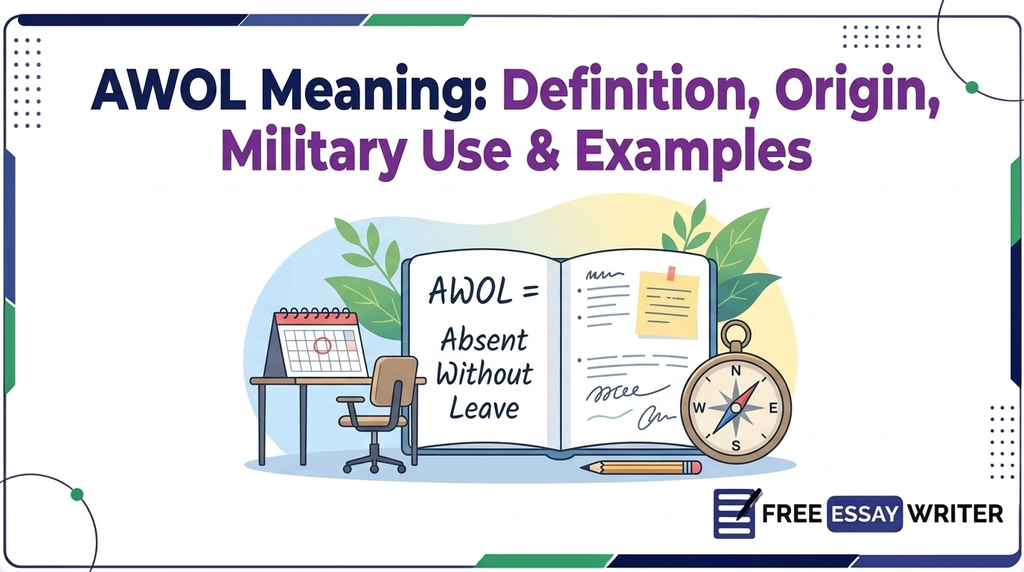
AWOL means “absent without leave,” which describes someone who leaves duty without permission. The term began in the military, where unauthorized absence is a serious offense under military law. In everyday speech, people use AWOL for anyone who disappears or stops responding without explanation. Context decides whether the word sounds serious, legal, or playful in a sentence.
AWOL Meaning at a Glance
The table below gathers the core facts about the term in one place for quick reference.
Feature
Details
Full form
Absent without leave
Alternate full form
Absent without official leave
Origin
United States military usage
Part of speech
Adjective, adverb, sometimes noun
Military status
Punishable offense
Casual meaning
Missing or unreachable without explanation
Common phrase
Go AWOL
The table shows one consistent idea: AWOL always involves being absent without the expected permission.
What Does AWOL Stand For?
AWOL stands for “absent without leave,” and some sources expand it as “absent without official leave.” Both versions carry the same meaning, because “leave” already refers to official permission to be away. The shorter version appears most often in dictionaries, newspapers, and military guides.
In military language, “leave” means authorized time away from duty, similar to vacation days in civilian jobs. A service member on approved leave is absent with permission, so the absence is lawful. A service member who leaves without that approval is absent without leave, which creates the AWOL status.
In simple words, AWOL means being somewhere other than where duty requires, without permission to leave.
Is AWOL an Acronym or an Abbreviation?
AWOL works as an acronym when people pronounce it as a single word, such as “AY wall.” It works as an initialism when people say each letter separately, such as “A W O L.” Both pronunciations appear in everyday speech, and both remain correct in modern English.
Most style guides write the term in capital letters without any periods. Older documents sometimes show periods between the letters, but that style now looks dated in most publications.
Origin and History of AWOL
The term grew out of United States military record keeping, where clerks needed short labels for absent soldiers. Many popular accounts link the abbreviation to the American Civil War, when desertion and absence were widespread problems. Dictionaries record wide use of the term from around the World War I period onward.
Some colorful stories claim that absent Civil War soldiers had to wear signs reading “AWOL” as punishment. Historians treat many of these stories with caution, because solid documentation is limited. AWOL began as military shorthand and spread into civilian speech during the twentieth century.
After the world wars, millions of veterans brought military slang home into offices, schools, and families. AWOL became a common way to describe anyone who vanished from an expected place. Films, novels, and television shows about military life spread the term further across the English speaking world.
Military slang often travels this way, moving from barracks to everyday speech within a single generation. Terms such as “boot camp” and “hit the deck” followed a similar path into civilian vocabulary. AWOL stands out because its casual meaning stays close to the original military sense. Both meanings still describe someone missing from a place where others expect them.
How to Pronounce AWOL
Speakers use two main pronunciations, and both are widely recognized across English speaking countries.
Style
Pronunciation
Where it appears
As a word
AY wall
Casual speech, news, films
As letters
A W O L
Formal military speech, some regions
The single word version sounds more casual, while the letter by letter version sounds more formal.
Writers never need to worry about pronunciation in text, because the spelling stays the same either way. Speakers should simply match the style that sounds natural in their community or workplace.
AWOL in the Military
In the United States armed forces, the Uniform Code of Military Justice covers AWOL absences. Article 86 of that code covers failing to report and leaving a place of duty. Military AWOL is a legal matter, not a casual joke among friends.
The Navy and Marine Corps often use the term “unauthorized absence,” shortened to UA, for the same offense. The Army and Air Force more commonly use AWOL in everyday speech and paperwork. Both terms describe the same basic situation under United States military law.
What Happens When a Service Member Goes AWOL?
Consequences depend on the length of the absence, the circumstances, and the service member’s record. A short absence may lead to administrative punishment, reduced rank, or loss of pay. Longer absences can lead to court martial proceedings and a less favorable discharge.
After about thirty days of continuous absence, the military usually drops the member from its rolls. Commanders may then treat the case as possible desertion, depending on the evidence of intent. Each case follows military regulations, so outcomes vary widely between individual service members.
Length of absence
Common administrative effect
A few hours or days
Counseling or minor punishment
Several days to weeks
Formal charges become more likely
About thirty days or more
Dropped from rolls in many cases
Evidence of permanent intent
Possible desertion charge
These general patterns explain the system, but official military legal guidance governs every real case.
AWOL vs Desertion
People often treat AWOL and desertion as the same offense, yet military law separates them clearly. The difference centers on intent, and the length of the absence matters less.
Feature
AWOL
Desertion
Core idea
Absence without permission
Absence with intent to stay away
Intent required
No permanent intent needed
Intent to remain away permanently
UCMJ article
Article 86
Article 85
Seriousness
Serious
More serious
AWOL describes the unauthorized absence itself, while desertion adds the intent to abandon service for good.
A soldier who misses three days after a family emergency is usually AWOL, not a deserter. A soldier who leaves, changes identity, and moves abroad may face desertion charges instead. Military courts look at evidence such as statements, actions, and length of absence to decide intent.
AWOL in Everyday Speech
Outside the military, AWOL has become a playful or mildly critical word for anyone who disappears. People say a friend “went AWOL” after ignoring messages for a week. Parents might say the family dog went AWOL during a loud summer thunderstorm.
Casual AWOL carries no legal meaning at all in everyday conversation between friends. It simply signals that someone or something is missing without explanation or permission. The tone ranges from teasing to frustrated, depending on the situation and the speaker.
The term also applies to objects that vanish at the worst moment. A remote, a phone charger, or a stapler can all “go AWOL” in a busy home. That playful use shows how far the word has traveled from its military roots.
Social media made the casual sense even more common, especially in replies and group chats. A user who leaves a project chat for days might return to messages asking about the AWOL spell. Sports fans also use the term for star players who perform poorly in big games and finals. That sporting use means the player seemed absent in spirit while still standing on the field.
Journalists sometimes apply the term to officials who skip important votes or avoid reporters during crises. Headlines such as “Mayor goes AWOL during flood response” signal criticism without making a legal claim. These uses all share one core idea: someone was missing when others expected them present.
AWOL at Work
Workplaces borrow the term to describe employees who miss scheduled work without notice or approval. Human resources teams often use a more formal phrase, such as “no call, no show” or “job abandonment.” Calling an employee AWOL in casual conversation signals frustration about unexplained absence.
Company policies usually define how many missed workdays count as job abandonment. Some policies treat three consecutive unreported absences as a voluntary resignation by the employee. Employees should read their handbook carefully, because rules differ between employers and countries.
Our rsvp meaning guide explains another term about responding to expectations and invitations. Clear communication prevents most AWOL situations that managers and teams face at work. A quick message to a supervisor turns an unexplained absence into an excused one.
AWOL vs No Call No Show
Many people use AWOL and “no call, no show” interchangeably at work, yet the phrases differ slightly.
Feature
AWOL
No call, no show
Origin
Military
Workplace and HR
Tone
Informal outside the military
Neutral and administrative
Scope
Any unexplained absence
Missed scheduled shift without notice
Common user
Coworkers and friends
Managers and HR teams
Managers usually write “no call, no show” in records, while coworkers say AWOL in conversation.
AWOL in Schools and Universities
Teachers sometimes use AWOL jokingly for students who skip class or vanish during group projects. A group project partner who stops answering messages before a deadline is a classic example. Formal school records use terms such as “unexcused absence” or “truancy” instead.
University students also use the term for roommates, study partners, or friends who suddenly disappear from group chats. The tone usually stays lighthearted, though repeated absence can damage trust and grades. Students writing formal essays should avoid AWOL unless the topic involves military history.
AWOL vs Ghosting
Modern speakers sometimes mix AWOL with ghosting, since both describe sudden silence or absence. The two terms come from different worlds and carry slightly different shades of meaning.
Feature
AWOL
Ghosting
Origin
Military language
Internet and dating culture
Core idea
Absent without permission
Stopped replying without explanation
Physical absence
Often involved
Not required
Typical setting
Work, school, military
Friendships, chats, online contacts
AWOL focuses on missing an expected place, while ghosting focuses on ending communication.
A coworker who stops showing up at the office has gone AWOL from work. A friend who still attends class but ignores every message is ghosting instead. Writers should pick the term that matches whether the person vanished physically or only stopped talking. Some situations involve both, such as an employee who misses work and also ignores every phone call. In that case, AWOL describes the missed work, while ghosting describes the silence that follows.
AWOL in Books, Films, and Media
War novels, films, and television dramas often feature AWOL characters, because the situation creates instant tension. A character who goes AWOL faces danger, guilt, and difficult choices, which drives a strong story. Writers use the term to signal that a character has broken an important rule.
Comedies use the term too, usually for lighter situations such as a missing best man before a wedding. That playful use shows how the word now works in both serious and humorous storytelling. The same four letters can signal tragedy in one story and comedy in another.
Students analyzing military fiction should note how authors use AWOL to reveal character motives and pressures. An essay that explains why a character leaves duty earns more credit than a simple summary.
Grammar: How AWOL Works in a Sentence
AWOL usually works as an adjective or adverb that follows a verb such as “go” or “be.” The phrase “go AWOL” is by far the most common pattern in modern English.
Pattern
Example
Go AWOL
The new intern went AWOL after lunch.
Be AWOL
The sergeant was AWOL for two days.
AWOL as noun
Military police searched for the AWOL.
AWOL soldier
The AWOL soldier returned on Monday.
The “go AWOL” pattern sounds most natural in casual writing, while “be AWOL” fits formal reports better.
Writers should keep the term in capital letters in every sentence pattern. Lowercase “awol” looks like a typing error to most readers and editors.
Synonyms for AWOL
Several words share part of the AWOL meaning, though each carries its own tone and context.
Synonym
Best use
Absent
Neutral, formal contexts
Missing
General disappearance
Truant
School absence
Unaccounted for
Official reports and searches
No call, no show
Workplace absence
Vanished
Dramatic or literary writing
Unauthorized absence
Navy and Marine Corps usage
Missing and absent sit closest to the casual sense, while unauthorized absence matches the military sense.
Informal Alternatives
Casual speech offers playful alternatives such as “ghosted,” “went missing,” and “dropped off the map.” Ghosting describes someone who stops replying to messages, especially in friendships or online chats. These options suit relaxed conversation but sound too casual for official records.
Antonyms for AWOL
Antonyms help clarify meaning by showing the opposite situation in plain terms.
Antonym
Meaning
Present
Physically at the expected place
On duty
Actively working or serving
Accounted for
Location known and confirmed
On leave
Absent with official permission
Excused
Absence approved in advance
“On leave” makes an especially useful contrast, because it shows that absence alone does not create AWOL status.
Example Sentences Using AWOL
These example sentences show how the term works across military, workplace, and casual settings.
Military Examples
The private went AWOL after receiving bad news from home and returned four days later. Military police located the AWOL sailor at a bus station near the base. The commander reviewed the case to decide whether the absence counted as AWOL or desertion.
Workplace Examples
The project lead went AWOL during the busiest week of the quarter, which delayed the client launch. Human resources recorded the absence as a no call, no show instead of using the word AWOL. Our usual delivery driver went AWOL, so the manager covered the morning route personally.
Everyday Examples
My phone charger goes AWOL every time my younger brother visits for the weekend. The cat went AWOL during the fireworks and appeared under the porch at sunrise. Half the group chat went AWOL once the conversation turned to splitting the dinner bill.
Common Mistakes When Using AWOL
1. Confusing AWOL With Desertion
Many writers treat AWOL and desertion as identical, yet desertion requires intent to stay away permanently. Using the wrong term in military writing can misrepresent a person’s legal situation.
2. Using Lowercase Letters
Writing the term in lowercase letters looks careless and confuses some readers. Keep all four letters capitalized in every context and every type of document.
3. Adding Unnecessary Periods
Older texts sometimes show periods between the letters, but modern style guides drop them. Writing the term without periods matches current publishing standards in most countries.
4. Using AWOL in Formal Workplace Records
Human resources documents need neutral and precise terms such as “unreported absence” or “job abandonment.” AWOL can sound accusatory in official records, especially before all facts are known.
5. Joking About Military AWOL Lightly
Military AWOL can carry serious consequences for service members and their families. Writers should keep a respectful tone when discussing real military cases and families.
6. Saying “Absent Without Leave Without Permission”
That phrase repeats the same idea, because “without leave” already means without permission. Choose one wording to keep the sentence clean, direct, and easy to read.
Tips for Using AWOL Correctly
These tips help writers use the term naturally and accurately:
Use “go AWOL” for casual disappearances, since that pattern sounds most natural to native speakers.
Keep all four letters capitalized and skip periods, which matches current style guide preferences.
Choose “desertion” only when the absence involves clear intent to leave service permanently.
Prefer neutral terms such as “unreported absence” in formal workplace and school records.
Match the tone to the situation, keeping humor for objects and friends, not real military cases.
How to Use AWOL in Writing Step by Step
Writers who want to use the term correctly can follow a few simple steps.
Step 1: Identify the Context
Decide whether the sentence describes a military case, a workplace situation, or a casual disappearance. The context decides how serious or playful the term will sound to readers.
Step 2: Choose the Right Pattern
Use “go AWOL” for casual writing and “be AWOL” or “AWOL soldier” for formal descriptions. Both patterns remain grammatically correct in standard American, British, and Australian English.
Step 3: Check the Legal Meaning
For military topics, confirm whether the situation involves simple absence or possible desertion. Using the precise term protects accuracy and fairness in news reports and essays.
Step 4: Format the Term Correctly
Write AWOL in capital letters without periods throughout the entire essay or document. Consistent formatting keeps the writing clean, professional, and easy for readers to scan.
Step 5: Review the Tone
Read the sentence aloud and confirm that the tone fits the audience and situation. Replace AWOL with a neutral term if the sentence sounds too casual for its purpose.
Real World Example: AWOL in a News Report
Consider a local news story about a soldier who missed a scheduled flight after a family emergency. The reporter writes that the soldier was “listed as AWOL” for six days before returning to base. The story then explains that commanders would review the case under military law.
That careful wording reports the official status without assuming intent or guilt. A less careful reporter might call the soldier a deserter, which would misstate the legal situation. Accurate terms matter most when a real person’s record and reputation are involved.
Practice Questions on the AWOL Meaning
Short practice questions help readers test their knowledge before using the term in essays or conversations.
Question 1: AWOL or Desertion?
A soldier misses two days of duty after a family emergency, then returns and reports to a commander. Should readers call this situation AWOL or desertion under United States military law? It is AWOL, because no evidence shows an intent to leave service permanently.
Question 2: Correct Formatting
Which form follows modern style guides, the version with periods or the plain capital version? The plain capital version is correct, because current guides drop the periods and keep all capital letters.
Question 3: Best Workplace Term
Which phrase suits an official human resources record: “went AWOL” or “no call, no show”? The second phrase suits official records better, because it sounds neutral and administrative.
Best Practices for Writing About Military Absence
Writing about real service members requires accuracy, fairness, and sensitivity toward families and communities. Reporters and students should rely on official statements and avoid guessing about intent or punishment.
Use “listed as AWOL” when reporting an official status that has not been fully resolved. That wording reports facts without suggesting guilt, punishment, or a final outcome. Avoid calling anyone a deserter unless official charges or findings clearly support that description.
Students writing history essays should explain the difference between AWOL and desertion early in the paper. That short explanation helps readers follow later arguments about punishment, morale, and military discipline.
AWOL Usage Checklist
Use this checklist before placing AWOL in any piece of writing:
Confirm whether the context is military, workplace, school, or casual everyday conversation.
Use “go AWOL” for casual disappearances and “be AWOL” for more formal descriptions.
Write all four letters in capitals and leave out periods between the letters.
Separate AWOL from desertion whenever the writing discusses real military cases or legal topics.
Replace AWOL with neutral terms in formal human resources records and official school reports.
Keep a respectful tone whenever the writing involves real service members and their families.
Read the final sentence aloud to confirm that the tone fits the audience and purpose.
Frequently Asked Questions
What Does AWOL Stand For?
AWOL stands for “absent without leave,” and some sources expand it as “absent without official leave.” Both versions describe leaving an assigned duty or post without official permission. The AWOL meaning stays exactly the same in either written form or spoken version.
What Is the AWOL Meaning in Text Messages?
In text messages, AWOL usually means someone disappeared or stopped replying without explanation. A friend might write “you went AWOL last night” after an unanswered message. The tone in texting is usually playful and friendly, not serious or legal.
Is Going AWOL a Crime?
In the military, going AWOL is an offense under military law and can lead to punishment. In civilian life, going AWOL from a job or social plan is not a crime. Civilian consequences usually involve job loss, missed grades, or damaged trust instead.
What Is the Difference Between AWOL and Desertion?
AWOL describes an absence without permission, regardless of how long it lasts. Desertion adds the intent to remain away permanently or avoid important duty. Desertion is the more serious military offense of the two and carries heavier penalties.
How Long Can a Soldier Be AWOL Before Desertion?
There is no single automatic switch from AWOL to desertion based on time alone. After about thirty days, the military usually drops the member from its rolls. Commanders then review evidence of intent before considering any formal desertion charges.
How Do People Pronounce AWOL?
Most people pronounce AWOL as one single word that sounds like “AY wall.” Some speakers say each letter separately, especially in formal military settings and briefings. Both pronunciations are correct and widely recognized across English speaking countries and regions.
Can AWOL Describe Objects?
Yes, people often use AWOL playfully for missing objects such as remotes, keys, and chargers. This usage carries no serious meaning and simply signals that something disappeared. It works best in casual speech, social media posts, and light writing.
What Does Going AWOL at Work Mean?
Going AWOL at work means missing scheduled work or duties without notice or approval. Human resources teams usually call this a no call, no show or job abandonment. Company policies decide the consequences for repeated unreported absences from scheduled work.
What Does UA Mean in the Navy?
UA stands for “unauthorized absence,” the term the Navy and Marine Corps often use instead of AWOL. Both terms describe the same basic offense under United States military law. The choice of term differs mainly by branch tradition and paperwork style.
Should AWOL Have Periods Between the Letters?
Modern style guides write AWOL in capital letters without periods between the letters. Older documents sometimes show periods, but that style now looks dated to most editors. Writers should choose the modern form for clean, current, and professional writing.
Key Takeaways
The AWOL meaning is “absent without leave,” which describes leaving duty without official permission.
The term began in United States military usage and spread into civilian speech during the twentieth century.
Military AWOL falls under Article 86 of the Uniform Code of Military Justice and carries real consequences.
Desertion differs from AWOL because desertion requires intent to remain away permanently from service.
The Navy and Marine Corps often use “unauthorized absence,” shortened to UA, for the same offense.
In everyday speech, AWOL playfully describes people, pets, or objects that disappear without explanation.
Workplaces prefer neutral terms such as “no call, no show” or “job abandonment” in official records.
Writers should capitalize all four letters, skip periods, and match the tone to the context.
The phrase “go AWOL” is the most common and natural pattern in modern English writing.
Final Thoughts
The AWOL meaning starts with a simple idea: being absent without the permission that duty requires. In the military, that idea carries legal weight and clear consequences under military law. In everyday speech, it becomes a playful way to describe missing friends, coworkers, pets, and phone chargers.
Writers who separate AWOL from desertion and format the term correctly will use it with confidence. That small amount of care keeps both casual and formal writing accurate and clear. Explore more word meanings and writing guides on Free Essay Writer, where students find simple explanations every week.



 Muhammad Bilal
Read more