October 13, 2026 · Moeed
LLM Meaning: Definition, How LLMs Work, Examples & Uses
A classmate mentions an LLM during a group project, and half the group nods without knowing the term. A search…
 Moeed
Read more
Moeed
Read more

Moeed
Moeed is the Content Head…
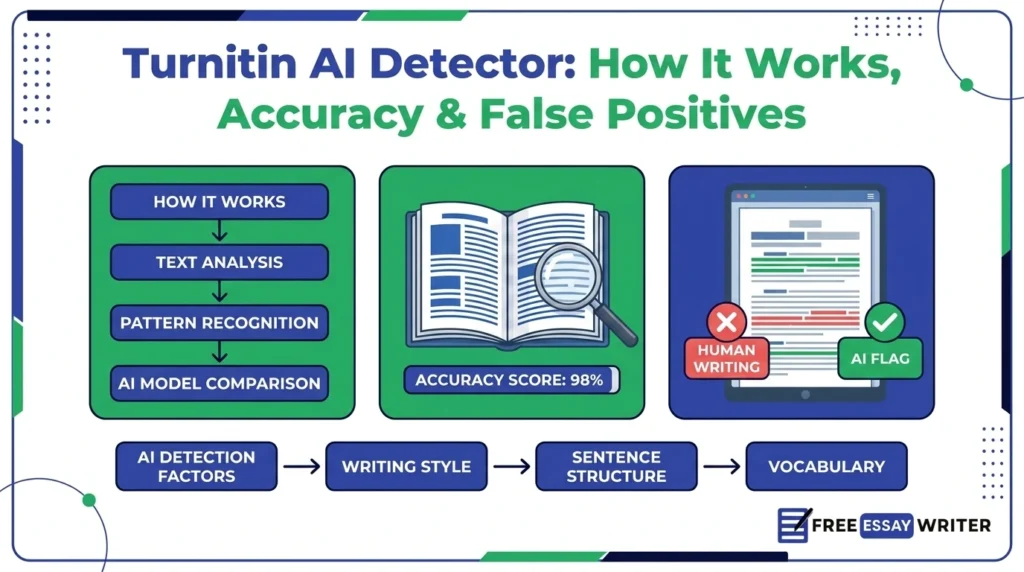
A student uploads a finished essay to a class portal and waits for the instructor’s feedback. Days later, a report appears beside the paper with a percentage that the student never saw coming. That report comes from the Turnitin AI detector, which estimates how much text a language model wrote.
Many students and instructors treat that number as a verdict, but the tool makes a statistical prediction. An AI detector can give a rough preview before a draft reaches an instructor.
This guide explains how the tool works, how it scores a paper, and how accurate it is. It also covers false positives, the difference from the Similarity Report, and a pre-submission checklist. Turnitin publishes its own figures, while independent researchers report different results, so both sides appear here.
The Turnitin AI detector is a classifier that estimates how much of a submission AI likely wrote. Instructors see a percentage and highlighted sentences, but Turnitin says the result never proves misconduct alone. Scores below 20% appear only as an asterisk because reliability drops in that range.
The table below lists the main facts that control how the tool behaves in practice.
| Item | Detail |
|---|---|
| Launch | April 2023 |
| What it measures | Share of qualifying prose likely AI-generated |
| Minimum length | 300 words of long-form prose |
| Maximum length | 30,000 words |
| File size | Under 100 MB |
| File types | .docx, .pdf, .txt, .rtf |
| Languages | English, Spanish, Japanese, Arabic |
| Score display | 20% to 100% shown; 1% to 19% shown as an asterisk |
| Document false positive rate | Under 1% for documents with 20% or more AI writing |
| Sentence-level false positive rate | About 4% |
| Bypasser detection | Added August 2025, English only |
Together, these limits explain why short essays, bullet lists, and code often produce no usable score.
Large language models build sentences by choosing likely next words, one after another. Human writers often pick less predictable words, and that gap gives a classifier something to measure. Turnitin trained its model on differences in word probability between human writing and AI output.
The University of Melbourne reports that training data includes roughly two decades of authentic academic writing. That archive spans geographies and subject areas, plus writers who learned English as a second language. Hence the detector reads word-choice patterns, not meaning, facts or the quality of an argument.
Turnitin analyzes only qualifying text, meaning prose sentences inside long-form writing such as essays, articles and dissertations. The model does not reliably assess poetry, scripts, code, bullet points, tables or annotated bibliographies. Hence a document that mixes prose with tables can show a mismatch between percentage and highlights.
The tool reports two kinds of results, and each carries a different error rate. The document score gives one overall percentage, while highlights mark individual sentences the model flagged.
Turnitin puts the document false positive rate under 1% for files with 20% or more AI writing. The sentence-level rate sits near 4%, so a highlighted sentence may still be human-written. Turnitin’s sentence-level report adds that 54% of those flagged sentences sit beside genuine AI writing. So errors cluster at the boundaries between human passages and machine passages in mixed documents.
Release notes list updates in August 2025, October 2025, February 2026 and May 2026. Two of those releases aimed to improve recall while keeping false positives low. Older reports do not change automatically, so an instructor must resubmit a paper to see new results.
| Date | Change |
|---|---|
| Apr 2023 | AI writing detection launches |
| Jul 2024 | Asterisk replaces scores from 1% to 19% |
| Apr 2025 | Japanese detection added |
| Aug 2025 | Bypasser detection added for English |
| Oct 2025 | Model update improves recall |
| Feb 2026 | Model update improves recall |
| May 2026 | Spanish model improved |
Each release changes results only for new submissions, so score comparisons across dates need care.
The report opens with an overall percentage of qualifying text that the model judged likely AI-generated. A submission breakdown bar shows where flagged passages sit across the pages. Blue highlights mark text that a language model likely produced, including text a paraphrasing tool may have altered.
| Display | Meaning | Note |
|---|---|---|
| Asterisk (*) | 1% to 19% detected; no percentage or highlights | Turnitin says false positives run higher here |
| 20% to 100% | Percentage and blue highlights shown | Human review still required |
The 20% floor exists because Turnitin found more false positives among low scores. Reports generated before July 8, 2024 may still show numerical scores below 20%. Turnitin details every display state and file requirement in its AI writing report guide.
A score of 40% means the model flagged roughly 40% of the qualifying text. It does not state a 40% probability that the student cheated on the assignment.
A Turnitin AI score measures how much text the model flagged, not how likely a student is guilty.
Besides scores, the report can show four status messages that explain a missing result.
| Status | Meaning | Usual fix |
|---|---|---|
| Loading | Processing still running | Wait several minutes |
| Processing error | Turnitin failed to process the file | Resubmit the file |
| File didn’t meet requirements | Length, size or format problem | Review the file rules |
| Detection not enabled | Setting was off at submission | Resubmit after enabling |
Each status message points to a resubmission, a file fix, or a short wait, not a rewrite.
Turnitin claims 98% accuracy with under 1% false positives, measured on documents with 20% or more AI writing. Those figures come from Turnitin’s own testing, not from an independent peer-reviewed audit. Turnitin narrowed its claim after launch, restricting the under-1% rate to documents with heavier AI content.
Researchers led by Debora Weber-Wulff tested 14 detectors, including Turnitin, and judged the tools neither accurate nor reliable. Overall accuracy stayed below 80% for every tool in that study, according to the same reporting. Reporting on the study says Turnitin alone classified every document in the AI-generated test classes correctly.
A separate Stanford study tested seven other detectors on 91 essays by non-native English speakers. Those detectors flagged 61.3% of the human-written essays as AI on average.
Turnitin tested nearly 2,000 English learner samples and reports a 1.4% false positive rate. Native English writers showed 1.3% in the same test, so Turnitin reports no bias. Both figures come from Turnitin itself, so outside replication would add confidence.
Vendor accuracy figures blend false positives and false negatives under specific test conditions. Document length, the share of AI text, and the model behind that text all change results. Real submissions rarely match those lab conditions, so vendor and independent numbers often diverge.
A false negative means the tool misses AI text, especially after paraphrasing or light editing. Turnitin accepts more false negatives on purpose, since its stated priority is protecting honest students. Turnitin scientist David Adamson calls this choice precision over recall, and the company defends the trade-off.
Both camps agree that no detector reaches certainty, and Turnitin says so on its own guide page. Turnitin states that the model may misidentify human-written, AI-generated, and AI-paraphrased text. Institutions have reacted differently, and Vanderbilt reportedly turned the feature off over false positive concerns.
A false positive means the tool labels fully human-written text as AI-generated. Predictable wording triggers the flag, and honest writers often produce predictable wording. Turnitin also links wrong sentence flags to the boundary between human and AI text.
Lab reports, case notes, and legal briefs follow fixed templates with repeated sentence frames. Templated prose lowers word-choice variety, and low variety resembles machine output to a classifier. Writers in these genres should keep drafts, since the format itself invites suspicion.
Writers still learning English often rely on common words and short, safe sentence patterns. Turnitin disputes bias in its own model, but the Stanford findings still justify extra care with such flags.
Repeated editing removes rough edges, and smooth prose can read as predictable to a model. Writers who polish across repeated drafts should save each version as proof of the process.
| Situation | Likely cause | First check |
|---|---|---|
| Heavily revised prose | Uniform sentence rhythm | Compare with earlier drafts |
| Templated lab or case report | Repeated genre structure | Read flagged sentences in context |
| Non-native English essay | Common word choices, simple syntax | Review the writer’s earlier work |
| Mixed human and AI paragraphs | Boundary sentences flagged wrongly | Check sentences beside true AI text |
| Reference list or bullets | Non-prose content in the file | Confirm which text counts as qualifying |
Each pattern points to a review step, not to a conclusion about honesty.
Scores above 20% carry less risk, but the tool still cannot promise certainty. Instructional designers at the University of Denver reported that human-written test texts still drew AI flags. Hence, even a high score still needs a careful human read before anyone acts.
Certain kinds of content fall outside the reliable range of the Turnitin AI detector. Poetry, scripts, code, bullet lists, tables and annotated bibliographies all sit outside that range. Files with under 300 words of prose produce no report at all.
Languages beyond English, Spanish, Japanese and Arabic also fall outside the supported set. Mixed human and AI drafts produce uneven results, and edited AI text can slip past a precision-first model. These limits mean a clean report never proves that no AI tool touched the work.
Turnitin calls the AI percentage independent of the similarity score, and AI highlights stay out of that report. Similarity matches point to a source that anyone can open, while an AI flag offers no such source.
| Feature | AI writing report | Similarity Report |
|---|---|---|
| Question answered | Did a model likely write this text? | Does this text match existing sources? |
| Method | Language-pattern classification | Text matching against a source database |
| Output | Percentage plus AI highlights | Percentage plus matched sources |
| Evidence type | Statistical prediction | Traceable source overlap |
A paper can score 0% similarity and still draw an AI flag, or the reverse.
Turnitin reaches students through institutions, while standalone checkers sit open on the web. The University of Melbourne says Turnitin’s student writing archive separates it from tools like ZeroGPT.
| Factor | Turnitin AI detector | Standalone checkers |
|---|---|---|
| Access | Instructor account through an institution | Public website or paid plan |
| Score visibility | Usually instructors only | Anyone who pastes text |
| Training data | Archive of student and AI text | Varies by vendor |
| Bypasser detection | English only, since August 2025 | Varies by vendor |
| Published claims | False positive figures on Turnitin’s site | Varies by vendor |
No standalone tool can reproduce a Turnitin score, so a pre-check gives only a rough signal.
Instructors reach the AI writing report through the Similarity Report function, and students usually cannot see it. The University of Melbourne states that neither the percentage nor the highlights appear for students. Policies vary by institution, so students should read their own school’s academic integrity rules.
Turnitin advises against using the score as the sole basis for any adverse action. Its guides tell instructors to apply professional judgment, course context, and institutional policy. Drafts, notes and version history often settle the matter faster than any score.
Institutions treat the tool differently, and policies range from routine use to full shutdown. The University of Melbourne says it has processes in place to reduce false positive risks. Melbourne also notes that high scores do not automatically lead to allegations or findings of misconduct.
Turnitin publishes guidance on questions to ask when a report shows AI writing. Good questions focus on the writing process and avoid any language of accusation.
An instructor might ask which source the writer read first and how the outline changed. Another question asks the writer to define a key term from the paper in fresh words. A third question asks where a flagged paragraph came from and why it opens that way.
Writers who did the work can usually answer these easily, and gaps in knowledge show quickly. Instructors should also compare the flagged text with earlier assignments from the same student.
A pre-check cannot copy Turnitin exactly, but four habits reduce unpleasant surprises.
Turnitin needs at least 300 words of long-form prose and no more than 30,000 words. Files must stay under 100 MB and use .docx, .pdf, .txt, or .rtf formats. Language also matters, because only English, Spanish, Japanese and Arabic files qualify.
Paste the draft into a free AI detector and note which passages it flags. Treat the output as a rough signal, because each detector uses different training data and thresholds. Do not treat a low pre-check score as a guarantee of a low Turnitin score.
Read each flagged passage aloud and ask whether it sounds like the writer’s normal voice. Rewrite generic sentences with specific examples, personal analysis, and course material only the writer knows. Honest revision improves the paper regardless of what any detector reports afterward.
Save dated drafts, outlines, notes, and sources in one folder from the first day. Version history in Google Docs or Word shows how a paper grew over time. That record lets a writer answer questions quickly if an instructor requests proof of authorship.
A flag usually starts a review, not a penalty, so the first task is reading the course policy. Calm, factual answers serve a writer better than anger or immediate apologies.
Collect dated drafts, outlines, notes, browser history for sources, and any tracked-change files. Timestamps in those files often answer authorship questions faster than any long explanation. This process evidence carries more weight than any argument about detector statistics.
Offer to walk the instructor through the argument, the sources, and the choices behind each section. Authors can usually explain their own reasoning in detail, and that conversation carries real weight.
Institutions typically publish an appeal route for integrity findings, and students should follow it in writing. Written requests create a record, and Turnitin’s own guidance supports human judgment over automated scores.
Consider a hypothetical graduate student who learned English as a second language. The student writes a 2,500-word literature review over three weeks and submits it through the course portal. The instructor’s report shows 34% AI writing, with blue highlights across the methods and summary paragraphs.
The instructor makes no accusation and asks to see drafts, notes, and the reading list behind the review. The student shares dated drafts, highlighted PDFs, and a version history stretching back three weeks. Because the evidence shows a normal writing process, the instructor closes the review without any penalty.
This scenario serves as an invented illustration, so treat the 34% figure as an example only.
Suppose a report shows 27% AI writing, with blue highlights in two body paragraphs. The rest of the paper carries no highlights, and the introduction matches the student’s earlier style.
A careful reviewer first checks whether those paragraphs contain quotations, definitions, or templated methods text. Afterward, the reviewer asks the student to explain both paragraphs and share the notes behind them. The percentage alone never settles the case, but the flagged paragraphs guide where to look.
Students who want to avoid disputes can follow these four working principles:
Instructors who review reports can follow these four principles to stay fair:
Schools and departments that license the tool can follow these four institutional principles:
A 30% score describes the share of flagged text, not the odds that cheating occurred. Readers who confuse the two can overreact to mid-range scores that need a closer read.
Each detector uses its own training data, so a 5% result elsewhere guarantees nothing. Test results across tools vary widely, so a pre-check deserves cautious reading.
Chasing a lower number encourages awkward rewrites that damage the paper’s quality. Turnitin added bypasser detection in August 2025, so rewording tools can add flags.
Version history becomes the strongest defense when a dispute arises, but deleted drafts erase that record. Keep every file until the course ends and any appeal window closes.
Files with under 300 words of prose fail the requirements, and bullets or tables score unreliably. Missing reports mean the file failed the rules, not that the writing passed.
Policies differ by class, and a permitted grammar tool in one course may break rules in another. Written permission from the instructor prevents later disputes before any report ever appears.
A flagged writer who has no drafts or notes can only argue statistics against the detector. Process evidence wins the discussion faster than any claim about false positive rates.
Use this list before submitting a paper or before reviewing a Turnitin report:
The Turnitin AI detector claims 98% accuracy in its own internal testing. Independent studies of AI detectors report weaker results overall, so human review should follow every score.
Students usually cannot see the Turnitin AI detector score because the report appears only to instructors. Institution settings can differ, so students should confirm the policy with their school.
In the Turnitin AI detector, an asterisk marks a detection between 1% and 19% with no percentage shown. Turnitin hides low scores because its testing found more false positives in that range.
The Turnitin AI detector needs at least 300 words of long-form prose in the file. The upper limit is 30,000 words, and files must stay under 100 MB.
The Turnitin AI detector supports English, Spanish, Japanese, and Arabic files under its current requirements. Only the English detector includes paraphrase and bypasser detection, according to Turnitin’s guide.
Since August 2025, the Turnitin AI detector also flags text that bypasser tools may have modified. This capability works in English only and appears inside the AI-generated category.
Yes, the Turnitin AI detector can flag human-written work, and Turnitin acknowledges a small false positive risk. Its own published figures put the sentence-level false positive rate near 4%.
Independent research on other AI detectors found high false positive rates for non-native English essays. Turnitin reports similar false positive rates for both groups in its own AI detector testing.
No, Turnitin says its AI detector score should not serve as the sole basis for adverse action. Instructors must weigh drafts, course context, and institutional policy before deciding anything.
Students can prepare by keeping dated drafts, following the course AI policy, and running a free pre-check. A pre-check only estimates the risk, because no outside tool reproduces the real Turnitin result.
In the Turnitin AI detector, blue highlights mark text that a language model likely generated. That category also includes text a paraphrasing tool or bypasser may have altered.
No, the Turnitin AI detector does not retroactively update reports created before a model release. Instructors must resubmit a paper to see a score from the newer model.
The points below sum up the main facts about the tool and its limits:
The Turnitin AI detector gives instructors a statistical signal, not a verdict about any student. Turnitin itself admits the model can misjudge human, AI, and paraphrased text, so human review stays mandatory. Honest writers protect themselves best with clear drafts, clean sources, and a habit of saving every version.
A quick check with an AI detector before submission adds one more layer of preparation. Instructors, meanwhile, get the most reliable picture by combining the report with drafts and conversation.
Explore more writing guides on FreeEssayWriter.net.

Written by
Moeed is the Content Head at Free Essay Writer and has more than 5 years of experience in SEO and content writing. He writes clear, practical guides on essay writing, grammar and word meanings to help students write with confidence.
More from this authorOctober 13, 2026 · Moeed
A classmate mentions an LLM during a group project, and half the group nods without knowing the term. A search…
Moeed
Read more
October 13, 2026 · Moeed
A friend texts “IMO the sequel beats the original,” and the three letters stall the chat. The IMO meaning looks…
Moeed
Read more
October 13, 2026 · Moeed
A paycheck lands in a bank account overnight, and the statement lists it as an “ACH credit.” The ACH meaning…
Moeed
Read more
Generate a full essay free, then polish it with the built-in toolkit.
Start writing free