Skink Meaning: Definition, Types, Facts & Word Origin Explained
Muhammad Bilal
Content Writer
Guide
November 9, 2026
21 min
A student writing a science report spots a shiny little lizard darting under a garden rock during recess. The teacher calls it a skink, and suddenly the student needs a clear definition for the assignment. The skink meaning fits neatly into any informative essay about animals, once writers know the basic facts.
This guide explains what a skink is, where the word comes from, and what makes skinks unique among lizards. It also covers common skink types, interesting facts, a surprising Scottish food meaning, example sentences, and frequent mistakes.
Quick Answer: What Is the Skink Meaning?
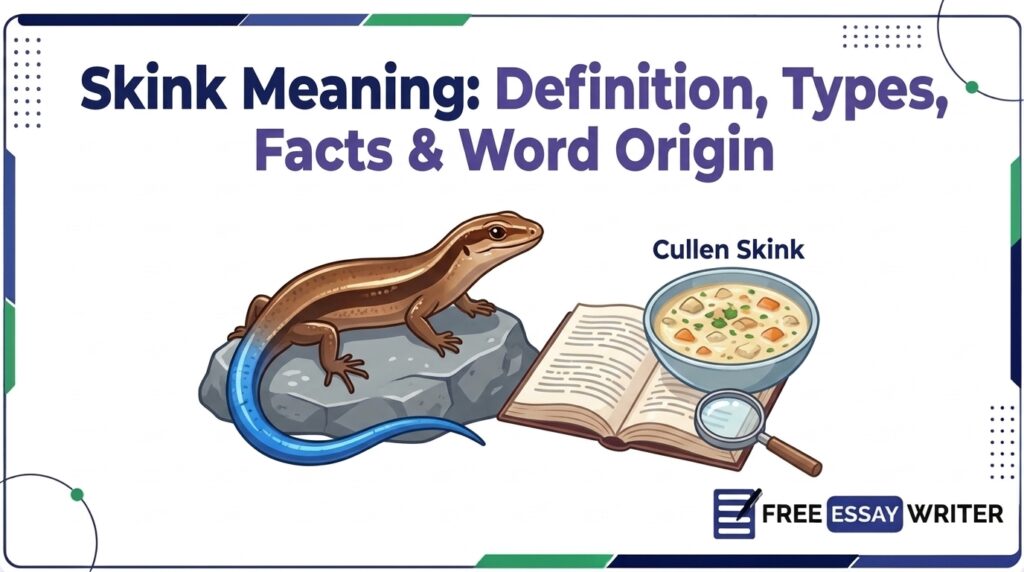
A skink is a small or medium lizard with smooth, shiny scales and usually short legs. Skinks belong to the family Scincidae, which scientists count among the largest lizard families on Earth. In Scotland, the word skink also names a traditional soup, so context usually decides the intended meaning.
What Does Skink Mean?
In everyday English, skink means any lizard from the family Scincidae, which holds over 1,500 species. Most skinks look sleek and glossy, as if someone polished their scales before letting them outside. Many species have short legs, and some have lost their legs almost entirely over millions of years.
In simple words, a skink is a shiny lizard that often looks like a small snake with legs. That description helps young readers picture the animal quickly before they learn deeper scientific details. Teachers often use this image when introducing reptiles in primary and middle school science lessons.
Sense
Short definition
Example
Zoology
Lizard in the family Scincidae
A blue tongued skink
Scottish cooking
Thick soup or broth
Cullen skink
Older Scots
Shin of beef or a broth from it
A pot of skink
Informal comparison
Something quick and slippery
He slid away like a skink
The table shows that the reptile sense dominates modern English, while the food senses survive mostly in Scotland.
Pronunciation and Grammar
Skink rhymes with think, and English speakers pronounce it the same way in American and British accents. The word works as a countable noun, so writers say “a skink”, “two skinks”, or “the skink family”. The adjective form, scincid, appears mainly in scientific papers about skink species and their evolution.
Is Skink a Common Word?
Skink appears often in biology textbooks, nature documentaries, and pet guides, especially in Australia and America. Everyday speakers who live near gardens or forests usually know the word, because skinks visit backyards often. Readers in colder northern countries meet the word less often, since fewer skink species live there.
Where Does the Word Skink Come From?
The word skink comes from the Latin “scincus”, which Latin writers borrowed from the ancient Greek “skinkos”. Greek and Roman writers used the term for a desert lizard, probably the sandfish skink of North Africa. English writers took up the word during the sixteenth century, when interest in natural history grew across Europe.
Ancient writers believed that the sandfish skink had medicinal value, and traders sold dried skinks in markets. Modern science rejects those old medicinal claims, but the name survived and spread across many European languages. Today scientists use Scincidae as the official family name, built directly from that ancient Latin root.
Greek skinkos -> Latin scincus -> English skink -> Scientific family Scincidae
This timeline shows how a single desert lizard name grew into the label for a worldwide reptile family.
The Scottish Skink
The Scottish word skink has a separate origin in older Scots and related Dutch words for shin. People originally used it for a shin of beef and the broth cooked from that cut. Over time, the word came to mean thick soups, and Cullen skink became the most famous example.
Physical Features of Skinks
Skinks share several physical features that help people recognize them, even across distant habitats and continents. Their smooth scales, long bodies, and quick movements set them apart from rougher, spikier lizards such as iguanas.
Smooth, Shiny Scales
Skink scales overlap like roof tiles and often contain small bony plates called osteoderms underneath. This structure gives skinks their glossy look and also adds a light layer of protection against predators. Many people describe skinks as looking wet, even when the animal sits on dry rocks.
Body Shape and Legs
Most skinks have long, rounded bodies with necks that blend smoothly into their heads and shoulders. Many species have short legs, and burrowing species often have tiny legs or no legs at all. This shape helps skinks slide through leaf litter, loose soil, and narrow cracks between stones.
Tails That Break Away
Many skinks can drop their tails when a predator grabs them, a defense that scientists call caudal autotomy. The dropped tail keeps wriggling for a short time, which distracts the predator while the skink escapes. Most species can regrow a tail, although the new tail usually looks shorter and less colorful.
Feature
What it looks like
Purpose
Scales
Smooth, glossy, overlapping
Protection and easy movement
Body
Long and rounded
Moving through soil and leaves
Legs
Short, tiny, or absent
Burrowing and sliding
Tail
Often detachable
Escaping predators
Tongue
Sometimes brightly colored
Warning or display
The table shows that each skink feature supports a life spent moving quickly through tight, low spaces.
Common Types of Skinks
Scientists have described well over 1,500 skink species, and new ones still appear in scientific journals every year. The examples below represent the species that students, pet owners, and nature lovers mention most often.
Blue Tongued Skink
Blue tongued skinks live mainly in Australia and nearby islands, and they sport bright blue tongues. When threatened, they open their mouths wide and flash that tongue to startle predators away. Their calm nature has also made them popular pets in many countries around the world.
Five Lined Skink
The common five lined skink lives across much of the eastern United States in forests and gardens. Young five lined skinks have bright blue tails, while adults usually fade to brown or olive colors. Many American students meet this species first during school nature walks and backyard explorations.
Solomon Islands Skink
The Solomon Islands skink ranks among the largest skinks, and adults can reach roughly 30 inches in length. Unlike most skinks, it lives in trees and eats mainly leaves, fruit, and flowers. Scientists also note its unusual social behavior, since family groups often stay together for long periods.
Sandfish Skink
The sandfish skink lives in North African and Middle Eastern deserts, where it swims through loose sand. Its smooth scales and pointed snout let it burrow below the surface within seconds. This species likely inspired the original Greek and Latin words that gave English the name skink.
Shingleback Skink
The shingleback skink, sometimes called the sleepy lizard, lives in dry parts of southern Australia. It has a short, fat tail that looks almost like a second head, which confuses predators. Researchers have studied shingleback pairs that return to the same partner season after season for many years.
Species
Region
Notable trait
Blue tongued skink
Australia and nearby islands
Bright blue tongue display
Five lined skink
Eastern United States
Blue tail in young skinks
Solomon Islands skink
Solomon Islands
Large size and tree living
Sandfish skink
North Africa, Middle East
Swims through sand
Shingleback skink
Southern Australia
Tail that mimics a head
The table shows how widely skinks vary, from desert swimmers to tree dwellers living across distant regions.
Where Do Skinks Live?
Skinks live on every continent except Antarctica, and they occupy deserts, rainforests, grasslands, gardens, and mountains. Australia hosts a particularly rich variety, with hundreds of native species found nowhere else in the world. Tropical islands across the Pacific and Indian Oceans also support many unique skink species.
Most skinks prefer places with plenty of cover, such as leaf litter, fallen logs, rocks, and loose soil. Backyard gardens with stone walls and mulch often attract local skinks looking for insects and warm basking spots. Gardeners who notice skinks usually have a healthy population of insects nearby for the lizards to eat.
What Do Skinks Eat?
Most skinks eat insects, spiders, snails, worms, and other small invertebrates found close to the ground. Larger species such as blue tongued skinks eat a mix of insects, snails, fruit, flowers, and leafy greens. The Solomon Islands skink stands out as an almost fully plant eating species within the family.
Skinks usually hunt by sight and smell, flicking their tongues to collect scent particles from the air. Many species forage during warm daylight hours, while some desert species stay active during cooler mornings and evenings. Their diet helps gardeners, because skinks reduce populations of snails and insects that damage plants.
Are Skinks Dangerous?
Skinks are not venomous, and they pose almost no danger to people who handle them gently. Larger species can bite when frightened, and a bite from a big blue tongued skink may pinch firmly. Washing hands after handling any reptile helps reduce the risk of bacteria such as salmonella.
Do not grab a wild skink by its tail, because the tail may break and stress it. Observing skinks from a short distance gives a better experience for both people and lizards. Local wildlife laws in some regions also protect native skinks from collection or disturbance.
Skinks as Pets
Blue tongued skinks rank among popular pet lizards, because they usually stay calm and tolerate gentle handling. Owners need a spacious enclosure, a heat lamp, a UVB light, and a varied diet. Captive blue tongued skinks often live for fifteen years or more when owners provide proper care.
Responsible owners buy skinks only from legal, captive breeding sources instead of taking animals from the wild. Many countries restrict the export of native skinks, so wild caught animals may come from illegal trade. Prospective owners should research local laws and talk with a reptile veterinarian before bringing any skink home.
Care need
Typical requirement
Enclosure
Large, secure tank with hiding spots
Heat
Warm basking area and cooler side
Lighting
UVB lamp on a daily schedule
Diet
Insects, greens, vegetables, and some fruit
Health checks
Regular visits to a reptile veterinarian
The table shows that pet skinks need steady care, so owners should plan carefully before buying one.
Signs of a Healthy Pet Skink
A healthy skink usually has clear eyes, smooth scales, a rounded body, and a steady appetite. Owners should watch for stuck shed skin, weight loss, or sluggish behavior, which can signal health problems. Early visits to a qualified reptile veterinarian usually prevent small issues from becoming serious illnesses.
Why Skinks Matter in Nature
Skinks play a valuable role in many ecosystems, because they eat large numbers of insects, snails, and spiders. Birds, snakes, and small mammals also eat skinks, which makes them an important link in food chains. Scientists sometimes study local skink populations to measure the health of forests, grasslands, and gardens.
Habitat loss, invasive predators, and climate change threaten several skink species on islands and in fragile habitats. Conservation groups protect these species through habitat restoration, predator control, and careful breeding programs. Students who learn about skinks often become more interested in protecting local wildlife and natural spaces.
Skink vs Lizard vs Salamander
Readers often confuse skinks with other small, quick animals that live in similar places. The table below separates skinks from general lizards and from salamanders, which belong to another class.
Animal
Class
Skin
Key difference
Skink
Reptile
Smooth, dry scales
One lizard family among many
Lizard
Reptile
Scales, often rough
Broad group including skinks
Salamander
Amphibian
Moist, scaleless skin
Needs damp places to survive
Snake
Reptile
Scales, no legs
No eyelids or external ears
The comparison shows that every skink is a lizard, but many similar animals are not skinks.
Skink vs Lizard
Every skink counts as a lizard, because the family Scincidae sits inside the larger lizard group. The word lizard covers thousands of species, including geckos, iguanas, chameleons, monitors, and skinks. Calling a skink a lizard is correct, while calling every lizard a skink is a common mistake.
Skink vs Salamander
Salamanders look similar at first glance, but they are amphibians with moist, scaleless skin and no claws. Skinks have dry, scaly skin and clawed toes, which lets them live in hotter and drier places. Salamanders usually need damp environments, so they hide near streams, ponds, and wet logs.
Skink vs Snake
Legless skinks can look almost exactly like small snakes, which confuses many hikers and gardeners. Many skinks still have movable eyelids and visible ear openings, while snakes have neither feature. These small details help observers identify a legless skink correctly without handling the animal.
What Is Cullen Skink?
Cullen skink is a thick Scottish soup made with smoked haddock, potatoes, onions, and milk or cream. The dish comes from the small fishing village of Cullen on the northeast coast of Scotland. Many Scottish restaurants serve Cullen skink as a starter, especially during cold winter months.
The name surprises many visitors, who expect a dish involving the lizard instead of a creamy fish soup. In this sense, skink simply means soup or broth, following the older Scots meaning of the word. Food writers often mention Cullen skink when they explain how one word can carry unrelated meanings.
Ingredient
Role in Cullen skink
Smoked haddock
Main flavor and protein
Potatoes
Thick, filling texture
Onions
Sweet, savory base
Milk or cream
Rich, smooth broth
Butter and herbs
Extra richness and garnish
The table shows that Cullen skink relies on simple ingredients, which explains its long popularity in Scottish homes.
Key Characteristics of Skinks
These key characteristics help students describe skinks accurately in reports, essays, and science projects:
Skinks have smooth, shiny, overlapping scales that often contain small bony plates underneath for protection.
Most skinks have long, rounded bodies with short legs, and some species have no legs at all.
Many skinks can drop their tails to escape predators, and most species can regrow them later.
Skinks live on every continent except Antarctica, with especially rich variety across Australia and Pacific islands.
Most skinks eat insects and small invertebrates, while larger species also eat fruit, flowers, and leaves.
Skinks are not venomous, so they pose almost no danger to people who observe them respectfully.
These characteristics give writers a reliable starting point for any accurate description of skinks and their behavior.
Examples of Skink in Sentences
Example sentences show how writers use the word skink in science writing, storytelling, and food descriptions. The examples below cover each common sense so readers can compare them easily.
Science Examples
A five lined skink rested on the warm stone wall, its tail glowing bright blue in the sun. The blue tongued skink opened its mouth wide and flashed its tongue at the curious family dog. Researchers counted more than twenty skink species living inside the small national park during their survey.
Descriptive Writing Examples
The skink slipped between the garden stones like a drop of oil sliding across a smooth plate. Its scales shimmered copper and bronze as it paused beside the flowerpot, tasting the air with its tongue. Students looking for more sensory techniques can study descriptive essay examples that use vivid details like these.
Food Examples
Our hotel in Aberdeen served a warm bowl of Cullen skink with fresh bread and butter. Grandmother’s Cullen skink recipe uses smoked haddock, potatoes, onions, and a generous splash of cream. The menu listed Cullen skink as the soup of the day, which confused our American friends at first.
How to Use Skink Correctly in Writing
Writers can follow a short process to use the word skink accurately in essays, reports, and creative work. The steps below help students avoid confusion between the reptile and the Scottish soup meanings.
Step 1: Identify the Context
Decide whether the text discusses wildlife, pets, cooking, or Scottish culture before choosing a meaning for skink. Science reports almost always use the reptile sense, while travel and food writing may use the soup sense. Clear context helps readers understand the intended meaning immediately without extra explanation.
Step 2: Add a Specific Species or Dish
Name a specific species, such as the blue tongued skink, or a specific dish, such as Cullen skink. Specific names make writing more precise and show readers that the writer researched the topic carefully. Teachers usually reward this detail, because it turns a general statement into a factual one.
Step 3: Describe Observable Features
Mention features such as glossy scales, short legs, or a detachable tail when describing the reptile. For the soup, describe the smoky fish, creamy broth, and soft potatoes that define the dish. Concrete details make descriptions vivid and help readers picture the subject clearly.
Step 4: Check Facts Against Reliable Sources
Confirm facts using museum websites, university biology departments, zoo resources, or recognized field guides. Reliable sources prevent common errors, such as calling skinks venomous or confusing them with salamanders. Accurate facts build credibility, especially in school reports, science projects, and informative articles for readers.
Common Mistakes With Skink Meaning
Writers and readers repeat several predictable errors when they use the word skink. Avoiding these mistakes improves accuracy in schoolwork, published articles, and everyday conversation with friends.
1. Calling Skinks Salamanders
Some people call skinks salamanders because both animals look slim and move quickly near the ground. Salamanders are amphibians with moist skin, while skinks are reptiles with dry scales. Mixing them up creates factual errors that teachers and readers notice immediately.
2. Assuming All Skinks Are Small
Many readers picture skinks as tiny garden lizards, but some species grow surprisingly large. The Solomon Islands skink can reach roughly 30 inches, which surprises people who expect a small reptile. Writers should mention species size instead of assuming every skink fits in a palm.
3. Believing Skinks Are Venomous
Some folk stories claim that skinks carry venom, especially brightly colored species with blue tails. Scientists have found no venom in skinks, so these stories spread fear without any factual basis. Writers should correct this myth when they discuss skinks in informative pieces.
4. Forgetting the Scottish Meaning
Readers who see “Cullen skink” on a menu sometimes assume the dish contains reptile meat. The word skink here simply means soup, following an older Scots usage unrelated to lizards. Knowing both meanings prevents awkward confusion during travel or while reading Scottish recipes.
5. Misspelling the Word
Some writers spell the word as “scink” because the scientific family name begins with those letters. The correct English spelling is skink, while Scincidae remains the proper scientific family name. Spell checkers usually catch this error, but careful proofreading still helps writers avoid embarrassment.
Tips for Writing About Skinks in School Assignments
These tips help students write clear, accurate, and engaging reports about skinks and other reptiles:
Start with a clear definition that explains what a skink is before adding interesting facts.
Choose one or two specific species instead of trying to cover every skink in a short report.
Use reliable sources such as museums, zoos, and university biology websites for all factual claims.
Add sensory details about scales, movement, and color to make descriptions vivid for readers.
Include a simple table comparing skinks with other lizards to organize information clearly.
Proofread carefully for spelling, especially the difference between skink and the scientific name Scincidae.
These habits help students turn a simple animal topic into a well organized and confident piece of writing.
Real World Example: A Student Report on Skinks
A seventh grade student named Ali receives an assignment to write a report about a local animal. He remembers seeing shiny lizards in his grandmother’s garden and decides to research skinks for the project. His first draft simply says skinks are small lizards, which his teacher marks as too general.
Ali then visits his local natural history museum website and learns about the five lined skink in detail. He adds facts about blue tails, tail dropping, insect diets, and the lizard family Scincidae. His revised report includes a small comparison table and earns strong praise for its accuracy and organization.
This example shows how a clear definition, specific species, and reliable sources improve a general report. Students who follow the same steps can write confident reports about almost any animal they choose.
Skink Meaning Checklist
Use this checklist before submitting any essay, report, or article that mentions skinks:
Confirm whether the text refers to the reptile, the Scottish soup, or the older Scots meaning.
Name at least one specific species or dish to make the writing precise and factual.
Describe key features such as smooth scales, short legs, and detachable tails accurately.
Avoid myths such as venomous skinks, and correct them politely when they appear in sources.
Check spelling carefully, using skink for the common word and Scincidae for the scientific family.
Cite or rely on trusted sources such as museums, zoos, and university biology departments.
A writer who completes this checklist will present the skink meaning clearly and accurately to any audience.
Frequently Asked Questions
What is the simple skink meaning?
The simple skink meaning is a smooth, shiny lizard from the family Scincidae, usually with short legs. Skinks live on every continent except Antarctica and include well over 1,500 known species.
Are skinks poisonous or venomous?
Skinks are not venomous, and they pose almost no danger to people who observe them respectfully. Larger skinks can bite when frightened, so people should handle them gently and wash their hands afterward.
Why do some skinks have blue tails?
Many young skinks, such as the five lined skink, have bright blue tails that attract predator attention. A predator may grab the colorful tail, which breaks away and lets the young skink escape safely.
What is the difference between a skink and a lizard?
Every skink is a lizard, because skinks form one family within the much larger lizard group. The skink meaning refers to lizards with smooth scales, long bodies, and usually short legs.
What is Cullen skink?
Cullen skink is a thick Scottish soup made with smoked haddock, potatoes, onions, and milk or cream. In this case, the skink meaning is soup or broth, following an older Scots usage.
Can skinks regrow their tails?
Most skinks can regrow their tails after dropping them to escape a predator during an attack. The new tail usually looks shorter and less colorful than the original tail that broke away.
Do skinks make good pets?
Some skinks, especially blue tongued skinks, make calm pets for owners who learn proper reptile care. Owners need correct lighting, heating, diet, and space, and they should buy only from legal, responsible breeders.
Where does the word skink come from?
The word skink comes from the Latin “scincus”, which came from the ancient Greek word “skinkos”. Ancient writers probably used the word for the sandfish skink of North African deserts.
What do skinks eat?
Most skinks eat insects, spiders, snails, and worms found close to the ground in gardens and forests. Larger species also eat fruit, flowers, and leaves, while some species eat mainly plants.
How do you pronounce skink?
Speakers pronounce skink so that it rhymes with think, in both American and British English accents. The skink meaning stays the same in pronunciation, whether the speaker means the lizard or the soup.
Key Takeaways
The skink meaning in English usually refers to a smooth, shiny lizard from the family Scincidae.
Skinks have long bodies, glossy overlapping scales, and short legs, while some species have no legs.
Scientists recognize well over 1,500 skink species living on every continent except Antarctica.
Many skinks drop their tails to escape predators, and most species can regrow them later.
Popular species include the blue tongued skink, five lined skink, sandfish skink, and Solomon Islands skink.
Skinks are not venomous, so they pose almost no danger to people who observe them respectfully.
The word comes from the Latin scincus and the ancient Greek skinkos, likely naming a desert lizard.
In Scotland, skink also means soup, and Cullen skink is a famous smoked haddock soup.
Writers should name specific species, describe clear features, and check facts against reliable sources.
Every skink is a lizard, but salamanders are amphibians and never count as skinks.
Final Thoughts
The skink meaning covers a remarkable reptile family and a comforting Scottish soup that share a name. Students who learn both senses can write accurate science reports and avoid surprises on Scottish restaurant menus. Clear definitions, specific species names, and reliable sources make any piece about skinks stronger and more trustworthy.
Writers who practice describing animals like skinks also build skills they can use across every type of essay. Careful observation, precise vocabulary, and organized facts turn simple topics into confident, engaging writing.
Explore more free writing and vocabulary guides for students on FreeEssayWriter.




 Muhammad Bilal
Read more


 Moeed