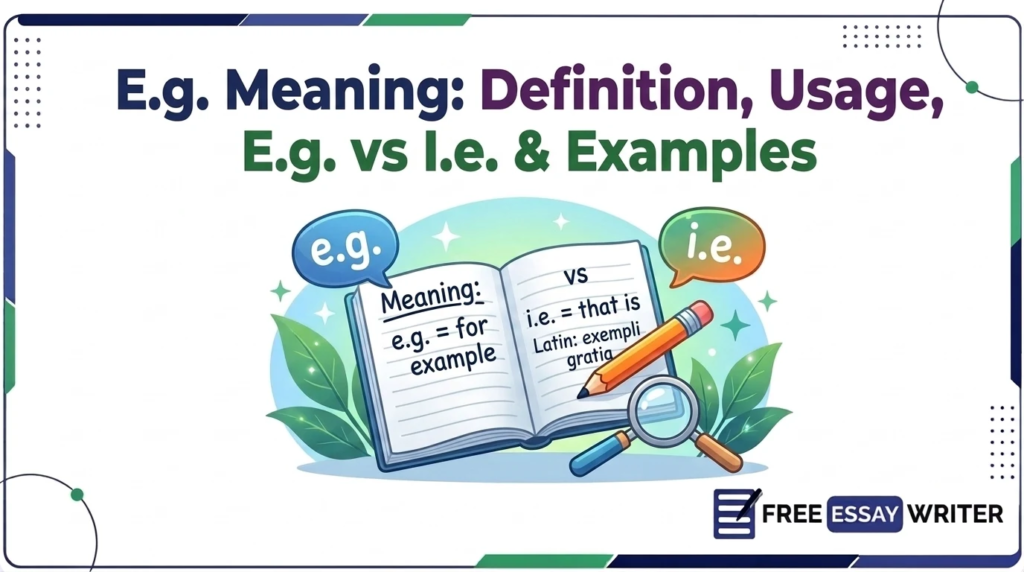
E.g. Meaning: Definition, Usage, Punctuation & E.g. vs I.e.
Muhammad Bilal
Content Writer
Guide
November 23, 2026
22 min
A student finishes an essay draft and pauses over a sentence that lists examples after an abbreviation. That moment of doubt about the exact e.g. meaning stops many writers before they hit submit.
This guide explains what e.g. stands for, how to punctuate it, and how it differs from i.e. It also covers style guide rules, common errors, practice questions, and a quick checklist for clean academic writing.
Writers who enjoy small but tricky words may also like our guide on ditto meaning. Both terms look simple, yet each one carries rules that careful writers follow in formal work.
Quick Answer: What Does E.g. Mean?
E.g. means “for example” and comes from the Latin phrase exempli gratia, meaning “for the sake of example.” Writers place it before one or more examples that illustrate a broader point. It never introduces a full list, so the examples after it remain a sample only.
E.g. Meaning at a Glance
The table below gathers the key facts about e.g. in one place for quick reference.
Feature
Details
Full Latin form
Exempli gratia
English meaning
For example
Pronunciation
Said as “ee jee” or “for example”
Main use
Introduces sample items
Common partner
Parentheses or commas
Often confused with
I.e., meaning “that is”
The single most useful fact is simple: e.g. always means “for example” and nothing more.
Definition of E.g.
E.g. is an abbreviation that signals the examples after it represent a larger group or idea. The reader understands that other examples exist, though the writer names only a few.
For instance, “Bring a fruit, e.g., an apple or a banana” means any fruit works for the trip. The apple and banana simply show the type of item the writer has in mind.
Dictionaries such as Merriam Webster and the Oxford English Dictionary list e.g. as a standard abbreviation in English. It appears in textbooks, legal writing, research papers, and everyday emails across many countries.
In simple words, e.g. means “here are some examples, but not all of them.”
Origin of E.g.
E.g. comes from Latin, which served as the language of scholarship in Europe for many centuries. Writers shortened exempli gratia to e.g. in notes and margins to save space and ink.
Latin abbreviations moved into English through law, medicine, religion, and university texts during the medieval era. Many of them, including e.g., i.e., and etc., remain in daily use more than five hundred years later.
The phrase exempli gratia translates as “for the sake of an example” or “for example’s sake.” Over time, English speakers dropped the literal translation and kept the shorter sense of “for example.”
How to Pronounce E.g.
Most English speakers read e.g. aloud as “for example” instead of saying the letters. Some speakers say the letters “ee jee,” which sounds natural in casual talk and classroom settings.
Option
How it sounds
Where it fits
Say the meaning
For example
Speeches and presentations
Say the letters
Ee jee
Casual talk
Say the Latin
Ex em plee grah tee ah
Rare, mostly academic
Reading it as “for example” usually sounds smoothest, especially when presenting written work aloud.
How to Use E.g. Correctly in a Sentence
E.g. works best inside parentheses or after a comma, followed by one or more representative examples. The structure tells readers that the list illustrates a category instead of naming every member.
E.g. Inside Parentheses
Parentheses keep the examples separate from the main sentence and make the main idea easier to read. A sentence like “Citrus fruits (e.g., lemons and limes) contain vitamin C” shows this clean pattern.
E.g. After a Comma
Writers can also place e.g. after a comma when the examples flow naturally from the main clause. “Many sports need little equipment, e.g., running and swimming” uses this comma pattern correctly.
E.g. After a Semicolon
Some longer sentences place e.g. after a semicolon to introduce a full clause of examples. “The course covers several skills; e.g., outlining, drafting, and editing” shows this less common form.
Punctuation Rules for E.g.
Punctuation changes slightly between American and British English, so writers should match the expected style.
Rule
American English
British English
Periods
e.g.
e.g. or eg
Comma after
Usually yes
Often no
Italics
No
No
Example
(e.g., apples)
(e.g. apples)
The key point is consistency, since mixing styles inside one paper looks careless to markers.
The Comma After E.g.
Most American style guides, including Chicago and APA, place a comma after e.g. in running text. British writers often skip that comma, and some British publishers also drop the periods entirely.
Periods in E.g.
Each letter in e.g. stands for a separate Latin word, so American English keeps both periods. Writing “eg” without periods appears in British publishing, but most American teachers mark it as an error.
Italics and Capital Letters
E.g. appears in regular type and not in italics, though the abbreviation comes from Latin. Writers should avoid starting sentences with e.g., because “E.g.” at the start looks awkward and informal.
E.g. at the End of a Sentence
When e.g. sits in parentheses at the end of a sentence, the parenthesis comes before the period. A sentence like “Pack light snacks (e.g., nuts or fruit).” follows this order correctly.
If the abbreviation itself ends the sentence, writers use only one period instead of doubling it. That rule rarely matters for e.g., since examples usually follow the abbreviation inside the sentence.
Careful placement of the final period keeps the paper tidy and prevents the doubled punctuation markers often spot. Small layout habits like this one add polish to every page of a long assignment.
E.g. vs I.e.
E.g. gives examples, while i.e. explains or restates something with more precise words. This difference matters because swapping them can change the meaning of a sentence entirely.
Feature
E.g.
I.e.
Latin phrase
Exempli gratia
Id est
Meaning
For example
That is
What follows
Some examples
The full clarification
Sample
Pets (e.g., cats)
The tallest pet (i.e., the horse)
Use e.g. when other options exist, and use i.e. when only one specific answer fits the sentence.
Consider “Bring a dessert (e.g., cake)” versus “Bring the dessert (i.e., cake).” The first sentence welcomes any dessert, while the second sentence asks for cake and nothing else.
E.g. vs Etc.
E.g. introduces a sample of examples, while etc. signals that a list continues beyond the items shown. Using both together repeats the same idea, since e.g. already tells readers the list is incomplete.
Feature
E.g.
Etc.
Position
Before examples
After examples
Meaning
For example
And so on
Use together
Not recommended
Not recommended
Do not write “e.g., apples, pears, etc.” because the etc. adds nothing the e.g. has not already said.
E.g. vs For Example
E.g. and “for example” share the same meaning, but they suit different positions and different levels of formality. Writers usually choose e.g. inside parentheses and “for example” in the main flow of a sentence.
Feature
E.g.
For example
Best position
Parentheses
Main sentence
Tone
Compact and technical
Smooth and readable
Sentence start
Avoid
Works well
Many teachers prefer “for example” in essays because it reads more naturally than a Latin abbreviation.
E.g. in Academic Writing and Style Guides
Style guides give clear rules for e.g., and students should follow the guide their course or journal requires.
Style guide
Rule for e.g.
APA
Use e.g. only inside parentheses, with a comma after
MLA
Use e.g. mainly in parentheses and notes
Chicago
Use e.g. in parentheses and notes, with a comma after
AP style
Use e.g. with a comma after
APA style also uses e.g. inside citations, such as “(e.g., Smith, 2020; Lee, 2022).” That pattern shows the cited studies represent a wider group of research on the same topic.
Students can read our guide on imo meaning for another short form that slips into drafts. Informal abbreviations like imo rarely belong in academic work, while e.g. suits formal writing in the right spots.
E.g. in Texting and Online Writing
People use e.g. in emails, chats, and social posts the same way they use it in formal writing. Casual writers often skip the periods and type “eg,” which looks fine in quick messages between friends.
Online forums and product reviews use e.g. to show sample features, brands, or settings that users recommend. A comment like “Try a budget phone, e.g., a Pixel A series model” shows this everyday use.
Even in casual writing, e.g. should still introduce examples and never a definition or full explanation. Readers who know the rule may misread a message that uses e.g. where i.e. belongs.
Alternatives to E.g.
English offers several plain phrases that carry the same meaning as e.g. and suit different tones.
Alternative
Tone
Example
For example
Neutral
Many birds, for example, robins, migrate
For instance
Neutral
Some fruits, for instance, kiwis, ripen fast
Such as
Smooth
Cities such as Lahore and Karachi grow fast
Including
Smooth
Tools including hammers and saws
Like
Casual
Snacks like chips and nuts
Such as works well inside sentences, while for example suits the start of a sentence.
Each alternative keeps the idea of examples, so writers can rotate them to avoid repeating e.g. too often. Rotation keeps long essays fresh and stops readers from noticing the same abbreviation in every paragraph.
E.g. in Other Languages
Many languages use their own abbreviation for “for example,” so translators and bilingual writers should know them.
Language
Abbreviation
Full phrase
German
z. B.
zum Beispiel
Spanish
p. ej.
por ejemplo
French
p. ex.
par exemple
Italian
ad es.
ad esempio
Dutch
bijv.
bijvoorbeeld
Urdu
Maslan
Maslan, meaning for example
These forms show that the idea of a short example marker exists across many languages and cultures.
Students writing in English should still use e.g. and avoid mixing in abbreviations from other languages. Mixing forms confuses readers and suggests the writer has not followed English style conventions.
E.g. in Legal, Business, and Technical Writing
Legal documents use e.g. to show that a rule covers a broad category beyond the listed items. A contract might say “restricted items (e.g., weapons and chemicals)” to show the list is illustrative only.
Business reports use e.g. inside tables, footnotes, and slide notes where space stays limited. A short parenthesis with e.g. keeps charts readable while still giving managers concrete examples.
Technical manuals and software guides use e.g. before sample values, file names, or commands. A line like “Enter a folder name (e.g., Reports)” shows users the format without forcing one answer.
Should Students Use E.g. or For Example?
Students should match the choice to the assignment, the style guide, and the level of formality expected. Many teachers accept e.g. inside parentheses but prefer “for example” in the main body of an essay.
Using “for example” in body text reads smoothly and avoids errors with commas, periods, and capitalization. Saving e.g. for parentheses keeps the abbreviation in the place where style guides expect it most.
A balanced paper might use “for example” four times and e.g. two times inside parentheses. That mix keeps the writing varied without leaning too heavily on Latin abbreviations.
E.g. vs Viz.
Viz. comes from the Latin word videlicet and means “namely,” so it introduces a complete and exact list. E.g. offers a sample, while viz. names every item the writer has in mind.
Feature
E.g.
Viz.
Meaning
For example
Namely
List type
Partial sample
Complete list
Common today
Widely used
Rare and formal
Most modern writers replace viz. with “namely” or a colon, since viz. now looks old fashioned.
E.g. vs Cf.
Cf. comes from the Latin word confer and means “compare,” pointing readers to another source. Writers place cf. before a reference that offers a contrast or a related point.
E.g. supports a claim with examples, while cf. points readers toward a source for comparison. Mixing them up confuses readers in research papers, where each abbreviation carries a precise citation role.
E.g. in Lists and Bullet Points
Writers sometimes place e.g. at the start of a bullet point to introduce sample items. That pattern works in slides and notes, though full essays usually express examples inside complete sentences.
When a bullet list follows e.g., every item should match the same category the introduction describes. Mixing unrelated items under one e.g. weakens the list and confuses readers about the main point.
Short lists of two or three examples work best, because they show the category without crowding the page. Longer lists suit tables, where readers can scan items quickly without losing the sentence thread.
Real World Example: A Business Email
A project manager emails the team for updates on “key tasks, e.g., budgets and timelines.” The team understands that budgets and timelines are examples, so they also share hiring and risk updates.
Later, the manager writes “the final deadline, i.e., March 30” in the same message. That line gives one exact date, so the team treats it as a fixed target.
The contrast between both lines shows how each abbreviation shapes what readers do next. Clear abbreviations save follow up questions and help busy teams act on messages faster.
Other Common Latin Abbreviations
E.g. belongs to a small family of Latin abbreviations that still appear in modern English writing.
Abbreviation
Latin phrase
Meaning
e.g.
Exempli gratia
For example
i.e.
Id est
That is
etc.
Et cetera
And so on
et al.
Et alii
And others
cf.
Confer
Compare
viz.
Videlicet
Namely
N.B.
Nota bene
Note well
ibid.
Ibidem
In the same place
Knowing this family helps writers pick the exact abbreviation each sentence needs.
Memory Tricks for E.g. and I.e.
Simple memory tricks help writers remember the difference between e.g. and i.e. during quick edits. Pick the trick that feels easiest, then use it every time doubt appears.
Think of e.g. as “example given,” which links the letters to the idea of examples.
Think of i.e. as “in other words,” which links the letters to the idea of explanation.
Picture e.g. as an “example generator” that produces a few sample items for readers.
Replace the abbreviation with “for example” and check whether the sentence still makes sense.
These tricks work because each one ties the letters to the job the abbreviation performs.
Real World Example: Editing a Student Essay
A first year student writes, “Many renewable sources exist, i.e., solar and wind energy.” The tutor circles i.e. because geothermal and hydro sources also exist, so solar and wind are only examples.
The student revises the line to read, “Many renewable sources exist (e.g., solar and wind energy).” The new version tells readers that the list gives samples and leaves room for other sources.
Later in the essay, the student writes, “The cheapest option, e.g., solar, won the vote.” The tutor suggests i.e. here, because the sentence names one specific option instead of offering samples.
These two edits show how a single abbreviation can make a sentence accurate or misleading. Small fixes like these improve clarity and earn better marks in academic writing.
Key Characteristics of E.g.
The points below list the key characteristics that define correct use of e.g. in English writing:
E.g. always means “for example” and never introduces a complete or exhaustive list of items.
E.g. comes from the Latin phrase exempli gratia and keeps periods after each letter in American English.
E.g. usually sits inside parentheses or after a comma, followed by one or more sample items.
E.g. takes a comma after it in most American style guides, including APA and Chicago.
E.g. does not pair with etc., because both already signal that more examples exist beyond those shown.
Benefits of Using E.g. Correctly
Correct use of e.g. brings several clear gains for students and professional writers alike:
Accurate abbreviations show markers that the writer pays attention to small details and formal conventions.
Compact parentheses with e.g. keep long sentences readable without breaking the main argument.
Clear examples help readers grasp abstract ideas faster, especially in technical or scientific writing.
Consistent punctuation across a paper creates a polished look that supports a stronger overall grade.
Correct use prevents confusion between examples and definitions, which protects the meaning of key claims.
How to Use E.g. Step by Step
The steps below help writers add e.g. to any sentence without punctuation or meaning errors.
Step 1: Check for Examples
Confirm that the words after the abbreviation are examples and not a full definition or complete list. If the words explain or restate the idea, switch to i.e. instead of e.g.
Step 2: Choose the Position
Place e.g. inside parentheses for a short aside, or after a comma when examples flow in the sentence. Avoid starting a sentence with e.g., and use “For example” in that position instead.
Step 3: Add Correct Punctuation
Write e.g. with a period after each letter, then add a comma after it in American English. Follow the course style guide when it sets a different rule for commas or periods.
Step 4: Remove Any Etc.
Check the end of the example list and delete any etc. that follows the examples after e.g. The abbreviation already signals that the list is incomplete, so etc. only repeats the idea.
Step 5: Read the Sentence Aloud
Read the sentence aloud and replace e.g. with “for example” to test whether it still makes sense. If the sentence sounds wrong, review whether i.e. or a plain phrase fits better.
Tips for Writing With E.g.
The tips below help writers use e.g. smoothly in essays, reports, emails, and research papers:
Use e.g. inside parentheses for short asides, and use “for example” in the main sentence flow.
Keep two or three examples after e.g., since long lists make sentences heavy and hard to follow.
Match the comma rule to the style guide, and keep that rule consistent across the whole paper.
Avoid stacking e.g. and i.e. close together, because readers may struggle to track both meanings.
Spell out “for example” when writing for young readers or audiences unfamiliar with Latin abbreviations.
Check every e.g. during proofreading, because swapped abbreviations often slip past spell checkers.
Common Mistakes With E.g.
1. Confusing E.g. With I.e.
The most common error swaps e.g. and i.e., which changes the meaning of the sentence. Use e.g. for samples and i.e. for a single explanation or a complete restatement.
2. Adding Etc. After the Examples
Writers often add etc. at the end of an e.g. list out of habit, creating repetition. Remove the etc., since e.g. already tells readers that more examples exist.
3. Dropping the Periods
Typing “eg” without periods looks casual and often earns a correction in American academic writing. Keep both periods in formal work unless the style guide clearly allows the shorter form.
4. Forgetting the Comma
Many American style guides expect a comma after e.g., and markers notice when it goes missing. Add the comma consistently, or follow the British style throughout if the course allows it.
5. Starting a Sentence With E.g.
A sentence that begins with “E.g.” looks informal and can confuse readers about capitalization rules. Start the sentence with “For example” instead, which reads smoothly and looks professional.
6. Using E.g. Before a Single Definition
Some writers place e.g. before a definition, such as “a canine, e.g., a dog,” which misleads readers. Use i.e. or rephrase the sentence when the words after the abbreviation define the term.
E.g. Usage Checklist
Use this checklist before submitting any essay, report, or assignment that contains the abbreviation e.g.:
The words after e.g. are examples and not a full definition or complete restatement.
Each e.g. includes a period after both letters, matching the expected American or British style.
A comma follows e.g. whenever the course style guide or teacher expects that rule.
No sentence begins with e.g., and “For example” replaces it at the start of sentences.
No etc. appears at the end of any list that already starts with e.g.
Every i.e. in the paper introduces a clarification and not a set of sample items.
Test Your Knowledge: E.g. Practice Questions
Practice questions help writers check whether the difference between e.g. and i.e. feels clear and automatic.
First, choose the right abbreviation for this sentence: bring a warm drink (___ tea or cocoa). The answer is e.g., because tea and cocoa are only two examples of warm drinks.
Second, choose for this sentence: meet at the capital of France (___ Paris). The answer is i.e., because Paris is the one specific answer and not an example.
Third, fix this sentence about a shop: we sell fruit, e.g., apples, pears, etc. The correct version removes etc., since e.g. already shows that other fruits exist beyond those listed.
Best Practices for Latin Abbreviations in Essays
Use Latin abbreviations sparingly, because too many make writing feel stiff and harder to follow. A few well placed abbreviations look professional, while a crowded page looks like shorthand notes.
Check the assignment brief and style guide before writing, since some teachers ban abbreviations in body text. Following the brief shows attention to instructions, which often matters as much as content.
When in doubt, write the English phrase in full, such as “for example” or “that is.” Clear English rarely loses marks, while a misused Latin abbreviation often draws red ink.
Why E.g. Still Matters in Modern Writing
Some writers wonder whether Latin abbreviations still belong in modern English, since plain phrases work well. E.g. survives because it saves space and signals examples instantly to trained readers.
Scientific journals, textbooks, and legal codes rely on e.g. inside tight parentheses and footnotes. Students who learn its rules early can read and write these formal texts with more confidence.
Search engines and AI tools also see e.g. often, so the abbreviation remains part of everyday online language. Knowing the correct e.g. meaning helps readers interpret instructions, forms, and product details accurately.
Next Step: Polish Every Sentence Before Submitting
Small details like e.g. and i.e. add up across a long essay and shape how markers judge quality. A focused proofreading pass for abbreviations takes only a few minutes and removes easy errors.
Search the document for “e.g.” and “i.e.” and check each one against the rules in this guide. Then read the paper aloud once more to catch rhythm problems and missing commas.
Frequently Asked Questions
What is the simple e.g. meaning?
The simple e.g. meaning is “for example,” taken from the Latin phrase exempli gratia. Writers use it before sample items that represent a larger group or idea.
What does e.g. stand for?
E.g. stands for exempli gratia, a Latin phrase meaning “for the sake of example.” English writers shortened it centuries ago, and the short form remains standard today.
Do you put a comma after e.g.?
Most American style guides place a comma after e.g., including APA and Chicago. British writers often skip the comma, so the right choice depends on the expected style.
What is the difference between e.g. and i.e.?
E.g. means “for example” and introduces samples, while i.e. means “that is” and introduces a clarification. Swapping them changes the meaning, so writers should check each abbreviation carefully before submitting.
Can e.g. start a sentence?
E.g. can technically start a sentence, but most editors advise against it because it looks awkward. Writers should use “For example” at the start of sentences instead of the abbreviation.
Should e.g. be italicized?
E.g. should appear in regular type and not italics, though it comes from Latin. Major style guides treat common Latin abbreviations like e.g. as standard English terms.
Can I use etc. after e.g.?
Writers should not use etc. after a list that starts with e.g., because both signal more examples. Using both repeats the idea, so remove etc. and keep e.g. at the start.
Is eg without periods correct?
Eg without periods appears in some British publishing, but American English expects periods after each letter. Formal academic writing in the United States usually marks “eg” as an error.
How do you pronounce e.g.?
Most people read e.g. aloud as “for example,” while some say the letters “ee jee.” Both options work, though “for example” sounds smoother during presentations and speeches.
Is e.g. formal or informal?
E.g. suits formal writing when placed in parentheses, and it also appears in casual messages. The e.g. meaning stays the same in both settings, so only punctuation habits change.
Key Takeaways
E.g. means “for example” and comes from the Latin phrase exempli gratia meaning for example’s sake.
The abbreviation introduces sample items and never a complete or exhaustive list of every option.
American English writes e.g. with periods after each letter and usually adds a comma after it.
British English sometimes drops the comma or periods, so writers should follow the required style guide.
E.g. gives examples, while i.e. means “that is” and introduces a single clarification or restatement.
Writers should never add etc. after an e.g. list, because both signal that more examples exist.
APA, MLA, and Chicago usually prefer e.g. inside parentheses instead of the main running text.
Starting a sentence with “For example” reads better than starting it with the abbreviation e.g.
A quick search for e.g. and i.e. during proofreading catches most abbreviation errors before submission.
Final Thoughts
E.g. looks small, yet it carries clear rules that shape how readers understand examples in every essay. Writers who master its meaning, punctuation, and partner terms avoid the most common abbreviation errors.
Check each e.g. against the examples rule, add the right punctuation, and remove any stray etc. For more writing guides and free tools, explore Free Essay Writer before the next assignment.




 Muhammad Bilal
Read more