October 1, 2026 · Moeed
What is Claude AI Good For: Uses, Limits & Pricing
A student, a freelance developer, and a shop owner all open the same chat app on Monday. Each person asks…
 Moeed
Read more
Moeed
Read more

Moeed
Content Writer
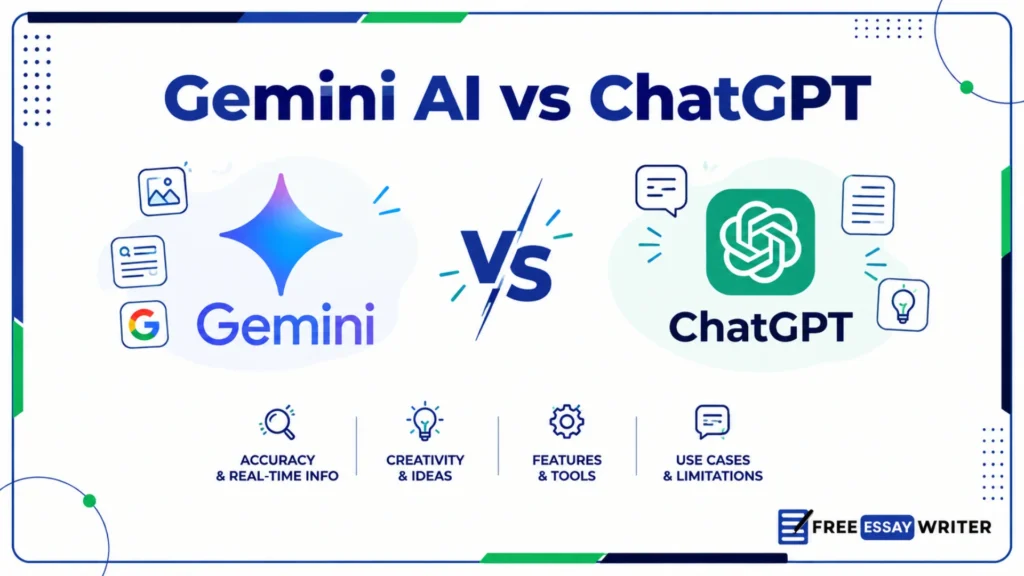
A student opens two browser tabs, pastes the same essay prompt into each, and waits. One tab runs Gemini from Google, while the other tab runs ChatGPT from OpenAI. Both tabs return fluent answers within seconds, so the real choice depends on details. This guide compares Gemini AI vs ChatGPT across writing quality, research, coding, memory, media tools, and price. It reflects the public lineup in October 2026, and both companies still release new models every few months. Prices and limits change fast, so confirm each figure on the official pages before paying.
Gemini AI fits people who live inside Google apps, while ChatGPT fits people wanting one flexible assistant. Both tools write strong essays, answer research questions, and cost about 20 dollars monthly for paid plans. The better pick depends on file types, budget, and how much fact-checking the work needs. Test both tools with the same prompt before paying for either plan.
The table below summarizes the main differences that matter to students, bloggers, and office workers.
| Feature | Gemini AI | ChatGPT |
|---|---|---|
| Maker | OpenAI | |
| Free plan | Yes, Flash model by default | Yes, Luna model reported as default |
| Entry paid plan | Google AI Plus, $4.99 | Go, $8 |
| Standard paid plan | Google AI Pro, $19.99 | Plus, $20 |
| Top-tier plans | AI Ultra, $99.99 and $199.99 | Pro, $100 and $200 |
| Best known for | Google app links, long files | Flexible writing, voice, agents |
| Image tools | Built into the Gemini app | Built into the ChatGPT app |
Price tiers match almost exactly, so the decision rests on features and workflow fit.
Gemini AI is Google’s family of multimodal models and the assistant app that carries the same name. The models accept text, images, audio, video, and PDF files in one conversation. Google rebranded the Bard chatbot as Gemini, and the product now sits inside Gmail, Docs, and Android.
Google released Gemini 3.6 Flash on July 21, 2026, and called it the new default model. The model offers a 1 million token context window in the developer API. Google ships newer Flash versions often, so the default label may already have changed.
Google’s Pro tier appeared as Gemini 3.1 Pro in mid-2026 plan listings, and it handles harder questions. Free users get a Flash model by default plus limited access to the stronger Pro model. Paid plans raise those Pro limits and unlock heavier usage across the app.
Workspace subscribers can use Gemini inside Gmail, Docs, Sheets, and Slides without copying text between tabs. Gemini also reads Google Drive files and uses Google Search results for current answers. This integration is the clearest advantage Gemini holds over ChatGPT for office and school workflows.
ChatGPT is OpenAI’s conversational assistant, and it runs on the GPT-5.6 model family in 2026. OpenAI opened general access to GPT-5.6 on July 9, 2026, in three tiers named Sol, Terra, and Luna. Sol is the flagship, Terra is the balanced middle tier, and Luna is the fastest and cheapest.
Reports on OpenAI’s August 6 announcement say Luna now serves as the default for Free and Go accounts. Plus and Pro accounts receive an updated Sol model for harder questions. Image creation sits inside the same chat, and the ChatGPT Image 2 guide covers that tool in detail.
ChatGPT also offers voice conversations, persistent memory, file analysis, and agent tools that complete multi-step tasks. Codex handles coding jobs, while ChatGPT Work handles longer agent-style office tasks. These extras turn ChatGPT into a platform instead of a single chat window.
Model names cause most of the confusion in any Gemini AI vs ChatGPT comparison today. Gemini names follow a size pattern: Flash-Lite is cheapest, Flash is balanced, and Pro is heaviest. OpenAI now splits GPT-5.6 into Luna, Terra, and Sol, from fastest and cheapest to strongest.
A matching tier comparison pairs Flash with Terra, and Pro with Sol, though no pairing is exact.
| Term | Meaning |
|---|---|
| Gemini | Google’s model family and chat app |
| Bard | Earlier name for the Gemini chatbot |
| ChatGPT | OpenAI’s chat app |
| GPT-5.6 | OpenAI’s current model generation |
| Sol, Terra, Luna | GPT-5.6 tiers from strongest to cheapest |
| Flash, Pro | Gemini speed and strength tiers |
Compare tiers of similar price and purpose, never a free model against a flagship.
Google released Gemini 3.1 Pro on February 19, 2026, according to reviewers tracking launches. OpenAI followed with GPT-5.4 on March 5 and GPT-5.5 on April 23. Reports said Google cut its AI Ultra price to 100 dollars at its May 19 I/O event.
OpenAI released the GPT-5.6 family on July 9, and Google released Gemini 3.6 Flash on July 21. This pace explains why a comparison written in March can mislead readers by autumn.
Both assistants produce clear essays, emails, and blog drafts within seconds of a good prompt. Independent reviewers often rate ChatGPT higher for instruction following and consistent tone across long drafts. Reviewers credit Gemini with stronger results on tasks tied to Google Workspace. Neither tool wins every prompt, so quality changes with the topic, the prompt, and the model version.
Use one prompt, one word limit, and one set of instructions for both tools. Score each draft on thesis clarity, structure, evidence, tone, and factual accuracy. Repeat the test with three different prompts, since one result can mislead. A blog post, a five-paragraph essay, and a product description make a balanced trio.
ChatGPT follows tone instructions such as formal, playful, or academic with steady consistency. Both tools can drift toward a generic voice in long outputs, so editing remains necessary. Pasting a short writing sample helps both tools match a personal style.
Neither tool replaces a human edit, and every draft still needs a read-through.
Both tools can search the web, summarize sources, and produce long research reports on request. Gemini includes Deep Research, and Google Search gives it direct access to current pages. ChatGPT offers its own deep research mode and web search, with citations in many answers. Both tools still invent facts, dates, and quotes at times, so every claim needs a check.
Open every cited link and confirm that the page actually says what the chatbot claims. Fake references appear in AI output often enough that unchecked bibliographies cause real grading problems. Search the title in Google Scholar or a library database before citing any source. Treat chatbot summaries as leads for reading, never as the final authority.
Do not cite any source before opening it and reading the relevant passage in full.
ChatGPT offers Codex, a dedicated coding agent that reads repositories and proposes changes. Google answers with Gemini CLI, Jules, and Antigravity for developers who prefer its tools. Benchmark scores for both families sit close together and change with each new release. A model that leads in March can trail by July, so recent tests matter more than old charts.
For spreadsheets, both tools write formulas, clean data, and explain results in plain language. Gemini adds a direct link to Google Sheets, while ChatGPT analyzes uploaded files in its own workspace.
Reasoning modes in both products have improved sharply through 2026, according to benchmark reports. Reports in spring 2026 showed Gemini 3.1 Pro leading on the GPQA Diamond science benchmark. Newer GPT-5.6 results have not yet received the same independent scoring, according to July 2026 coverage.
Students should verify math answers by working each step independently on paper or in a calculator. Both tools sometimes present a wrong result in the same calm tone as a correct one.
A context window sets how much text a model can read at once. Google’s help page lists 32K tokens without a plan and 128K on Google AI Plus. Pro and Ultra plans reach 1 million tokens inside the Gemini app.
A million tokens covers roughly 700,000 words, so paid Gemini plans handle long source packs well. OpenAI lists a 1 million token context for Sol in its API, while app limits vary. ChatGPT remembers preferences and facts across chats when the user turns memory on. Gemini offers Gems, custom assistants with saved instructions, on the free plan and every paid plan.
| Feature | Gemini AI | ChatGPT |
|---|---|---|
| Long-document reading | 1M tokens on Pro and Ultra | 1M tokens for Sol in API; app varies |
| Custom assistants | Gems | Custom GPTs |
| Workspace link | Gmail, Docs, Sheets, Slides | Connectors to outside apps |
It leads on reading capacity inside its app, while ChatGPT leans on memory and connectors.
Both apps create images from text prompts directly inside the chat window. Readers who want examples can study this breakdown of ChatGPT Image 2 features before choosing. Gemini draws on Google’s image models and adds Veo video generation on paid plans.
One July 2026 comparison favored Gemini for broad media work and ChatGPT for polished image conversations. ChatGPT voice mode earns praise for natural conversation, while Gemini Live adds camera and screen sharing. Students rarely need video tools, so image and voice quality matter more for most readers.
Both companies now sell agents that complete tasks on a user’s behalf, instead of chat replies alone. ChatGPT offers an agent mode and ChatGPT Work for longer multi-step jobs across devices. Google introduced Gemini Spark, a personal agent in beta for US subscribers on Ultra plans.
Agent tools use more compute, so check usage limits on these features before relying on them. Students rarely need agents for essays, but office workers may find them valuable.
Consumer prices match closely at each level, which makes plan choice a features decision.
| Tier | Gemini AI plan | ChatGPT plan |
|---|---|---|
| Free | $0 | $0 |
| Entry paid | Google AI Plus, $4.99 | Go, $8 |
| Standard | Google AI Pro, $19.99 | Plus, $20 |
| Top tier, lower | AI Ultra, $99.99 | Pro, $100 |
| Top tier, higher | AI Ultra, $199.99 | Pro, $200 |
Heavy users pay about 100 or 200 dollars monthly on either platform.
Google AI Pro raises Pro model limits and unlocks the 1 million token app context window. It also bundles 5 TB of Google One storage, according to a June 2026 pricing summary. The 99.99 dollar Ultra plan offers five times Pro usage, while the 199.99 plan offers twenty times.
ChatGPT Plus removes ads and adds higher limits, access to Sol, and more tools. ChatGPT Pro at 100 dollars offers five times Plus usage, and the 200 dollar tier offers twenty times. Light users rarely need anything above the 20 dollar tier on either platform.
Developers pay per token through each company’s API instead of a monthly plan. At launch, Google listed Gemini 3.6 Flash at $1.50 per million input tokens and $7.50 for output. OpenAI lists Terra at $2.00 input and $12.00 output per million tokens after the July cut.
Google AI plans bundle Google One storage, so storage subscribers pay less in practice. ChatGPT Free and Go show ads in selected countries, according to early 2026 reports. Paid Plus and Pro plans remove ads, so ad-free writing costs 20 dollars monthly.
Both free plans handle essays, summaries, and brainstorming at no cost for students. Gemini Free includes Deep Research, Gemini Live, Canvas, and Gems, with usage limits. ChatGPT Free reportedly gives unlimited text chats on Luna, while file, image, and voice limits remain. Free limits change often, so check each app’s help page for current caps.
Choose Gemini when most work already happens in Google Docs, Gmail, Drive, and Search. Pick it for long source packs, because paid plans read up to 1 million tokens. It also suits broad media work that mixes text, images, audio, video, and documents.
Choose ChatGPT when instruction following, tone control, and revision quality matter most. ChatGPT also fits writers who want persistent memory, custom GPTs, and polished voice conversations. It suits people who work across different apps instead of one ecosystem.
One July 2026 comparison called ChatGPT the better standalone product and Gemini the better integrated assistant.
Consider a student writing a 1,500-word essay on climate policy with eight source PDFs. Gemini can read all eight PDFs together and draft an outline inside Google Docs. ChatGPT can critique the thesis, tighten the argument, and rewrite weak paragraphs in a chosen tone. A workable plan uses Gemini for source reading and ChatGPT for revision, with human checks throughout.
Bloggers who draft in Google Docs gain speed from Gemini’s built-in sidebar. Teams using Microsoft apps may prefer ChatGPT, since Gemini ties most closely to Google Workspace. Developers should test Codex and Gemini’s coding tools on their own repositories.
| Use case | Better starting point | Reason |
|---|---|---|
| Long source PDFs | Gemini | Larger app context on paid plans |
| Essay revision and tone | ChatGPT | Consistent instruction following |
| Google Docs drafting | Gemini | Built-in Workspace link |
| Voice practice | ChatGPT | Praised voice conversation |
| Quick image creation | Either | Both include image tools |
No single column wins every row, which explains why many writers keep both tools open.
Both apps open in a plain chat box, so new users face almost no setup. Gemini starts from a Google account, which most students already own for school email. ChatGPT asks for its own sign-up, but the process takes only a few minutes.
Beginners should start with one tool for a week before adding the second. Short, clear prompts work best at first, and detail can grow with practice.
Workspace customers can add Gemini to existing Google plans through per-seat pricing. ChatGPT Business costs 20 to 25 dollars per user monthly, with a two-seat minimum. Enterprise plans from both companies use custom pricing and add admin controls and security reviews. Teams should match the tool to the software where employees already spend their days.
Heavy use of the Pro model can hit caps, and busy periods may drop users to Flash. The consumer app does not show which model variant produced each answer. Google also renamed and repriced plans several times in 2026, which confuses older guides.
ChatGPT Free and Go accounts carry ads in selected countries, so focused writing sessions suffer. OpenAI changed its default models several times in 2026, so older advice may name the wrong model. The jump from Plus at 20 dollars to Pro at 100 dollars looks steep for casual users.
Both companies collect chat data, and each offers settings that limit training use. Read the privacy controls before pasting private documents, client files, or unpublished work. Schools set their own rules on AI help, and policies differ by course and instructor. Do not upload confidential files to either chatbot before reviewing the privacy controls first.
Disclose AI assistance whenever a syllabus, publisher, or editor asks for that information. AI detectors produce false positives, so original writing still needs drafts and notes as proof.
Many writers split the work by strength instead of choosing one winner. Start in Gemini to read sources, extract quotes, and list the main claims. Move the outline into ChatGPT to test the argument and tighten the prose. Return to Google Docs for final formatting, citation checks, and a human read-through.
Free plans make this two-tool workflow possible for students who cannot afford subscriptions.
Good prompts name the audience, the format, the length, and the tone. A prompt like “Explain AI to first-year students in 500 words” beats “write about AI”. Both tools respond well to examples, so paste a short model paragraph when tone matters.
Ask each tool to list its assumptions, because hidden assumptions often cause wrong answers. Request sources in the prompt, then verify each source on independent websites before use. Follow-up prompts that ask for tighter structure often fix a weak first draft.
A free Flash model and a paid Sol model do not compete on equal ground. Match free plan against free plan, and paid plan against paid plan.
Articles from early 2026 still rank GPT-5.2 against Gemini 3.1 Pro, which no longer reflects current plans. Check the publication date and model name before relying on any score or ranking.
A polished paragraph can hide a wrong date, a false quote, or an invented source. Verify every name, number, and citation before submitting or publishing the final draft.
A single prompt favors whichever tool happens to match that wording by chance. Run at least three prompts from different tasks before declaring a winner.
Raw quality matters less than how smoothly a tool fits daily software. A writer living in Google Docs gains little from a tool that needs constant copying.
Free plans reveal most differences in tone, speed, and accuracy within an hour. Upgrade only after a free test shows a clear limit that blocks real work.
Choose one writing task, one research task, and one file task from current work.
Write each prompt once, then paste identical text into both tools without edits. These three prompts test writing, research, and file handling in a repeatable way:
Prompt 1: Write a 600-word blog post on remote work habits for beginners. Use a friendly tone and two headings.
Prompt 2: List five peer-reviewed sources on sleep and student grades. Include authors, years, and links.
Prompt 3: Summarize the attached PDF in 200 words and list three open questions.
Prompt 2 exposes fake citations quickly, because readers can check every link and author name. Prompt 3 shows how each tool handles uploaded files and long documents.
Rate accuracy, clarity, tone, and effort needed for editing on a five-point scale. Record the scores in a simple table so the totals stay visible. Save both responses in a document and compare them side by side.
Verify names, dates, numbers, and sources in both outputs using independent websites. Count the errors per tool, since accuracy often matters more than style.
Pick the tool with the higher total, then repeat the test after major releases. Both companies release new models every few months, so rankings expire quickly.
Run through this checklist before choosing a paid plan or publishing any AI-assisted writing:
Open both free plans today and run the three sample prompts above. Record which tool needed fewer edits and produced fewer factual errors in each task. Upgrade to a paid plan only when a free limit blocks work that matters.
Neither wins every category, because Gemini AI vs ChatGPT results depend on the task. Gemini leads on Google integration and long files, while ChatGPT leads on flexible writing and voice. Test both assistants with one shared prompt before paying for any plan.
Yes, Gemini AI offers a free plan with a Flash model by default and limited Pro access. Free users also get Deep Research, Gemini Live, Canvas, and Gems with usage caps. Paid Google AI plans start at 4.99 dollars monthly, with Pro at 19.99 dollars.
Yes, ChatGPT has a free plan, and it also offers a Go plan at 8 dollars monthly. Free and Go accounts may show ads in selected countries, according to early 2026 reports. Plus costs 20 dollars monthly and includes an ad-free experience with higher usage limits.
Both tools write solid essays, so Gemini AI vs ChatGPT depends on workflow. ChatGPT often follows tone and structure instructions more closely, according to reviewers. Gemini suits writers who draft, comment, and revise entirely inside Google Docs.
No, neither tool replaces a human editor, because both can miss errors and invent facts. Use AI for outlines, drafts, and feedback, then edit the final text by hand. A teacher, editor, or trusted reviewer should still approve any important or graded work.
Gemini AI reaches 1 million tokens inside its app on Pro and Ultra plans. ChatGPT lists 1 million tokens for Sol in the API, while app limits vary by plan. Larger windows help with long source packs but do not guarantee accuracy.
Gemini AI vs ChatGPT pricing matches closely, since Google AI Pro costs 19.99 dollars and Plus costs 20. Google’s entry plan costs 4.99 dollars, while ChatGPT Go costs 8 dollars. Top-tier plans cost roughly 100 or 200 dollars monthly on both platforms.
Yes, both Gemini AI and ChatGPT create images directly inside their chat apps. Image quality and style differ, so test the same prompt in both apps. Gemini AI also adds Veo video generation on paid plans for short clips and experiments.
Safety depends on the plan, the privacy settings, and the sensitivity of the document. Review each company’s data controls before uploading contracts, client files, or personal records. When in doubt, remove names and identifying details before sending any text to either chatbot.
Yes, rankings will likely change because both Google and OpenAI release new models every few months. Google teased Gemini 4 in July 2026, so this comparison may look different soon. Recheck prices, default models, and usage limits on official pages before every purchase decision.
The Gemini AI vs ChatGPT question has no permanent answer, because both products improve every quarter. Gemini rewards people who live inside Google apps and need to read long documents. ChatGPT rewards people who want one flexible assistant for drafting, voice practice, and agent tasks. Run the thirty-minute test from this guide, trust the results, and revisit them after major releases.
Explore more AI writing guides on Free Essay Writer.

Written by
Part of the Free Essay Writer team, sharing practical advice on writing better essays, faster, and for free.
More from this authorOctober 1, 2026 · Moeed
A student, a freelance developer, and a shop owner all open the same chat app on Monday. Each person asks…
Moeed
Read more
September 30, 2026 · Moeed
A designer asks an AI tool for a poster and receives garbled letters instead of a headline. That failure defined…
Moeed
Read more
September 30, 2026 · Moeed
A student uploads a finished essay to a class portal and waits for the instructor’s feedback. Days later, a report…
Moeed
Read more
Generate a full essay free, then polish it with the built-in toolkit.
Start writing free