September 2, 2026 · Moeed
510+ Argumentative Essay Topics in 2026
Are you looking for some strong and unique argumentative essay topics? You are at the right place. Every student at…
 Moeed
Read more
Moeed
Read more

Moeed
Content Writer
A persuasive essay is one of the most common types of essays written across the globe by students. These essays rely on strong logic, reasoning, and emotional appeals. But writing a persuasive essay is not easy. Many people often get confused about which formatting and/or topics to use, and how to present their content professionally on a piece of paper. In addition, they either overargue their point of view or neglect the opposing argument.
Or they overemphasize the counterarguments, diluting their main argument. Therefore, if you are unfamiliar with how arguments are structured, learning how to write an argumentative essay can help you understand the fundamentals of building a strong argument. In this article, we will explain what a persuasive essay is and how to write one, along with some examples and topics.
A persuasive essay is an essay used to convince readers of a point of view. It attempts to persuade the reader to adopt a certain opinion or course of action. It typically utilizes logic and reason to show that one idea is more legitimate than another. Additionally, this may also rely on emotional appeals to persuade its audience.
But do not confuse it with an argumentative essay. Although both aim to convince the reader, in an argumentative essay, both sides of the coin is discussed in detail, unlike in a persuasive essay where the only side of the issue is uncovered.
Whether you are arguing against junk food at your high school or requesting a raise from your boss. Knowing the technique to write a persuasive essay is an essential skill everyone should know.
A good persuasive essay must have the following two things:
Keep in mind that persuasive writing is all about delivering your opinion and convincing people to change their perspective about a certain thing.
The purpose of the persuasive essay is:
A good persuasive essay should use evidence and facts to support its argument in an organized manner. It should also appeal to the reader’s sense of reason and emotion through logical arguments.
Now that you understand the elements of persuasive writing, let’s look at how to write it.
To ensure that your writing is efficient and effective, make sure to follow these steps before you begin.
Follow the steps outlined below, and you’ll be writing in no time:
Use facts, statistics, quotes, or anecdotes to support your stance.
The ending of the essay should be strong, as it leaves a long-term mark on the reader.
Finally, it is important to remember that the goal is to convince your reader. You want them to understand why you believe and be persuaded to agree with you. To do this, be sure to include evidence and logical arguments that support your opinion.
Before you start writing, take a moment to understand the elements that make up a persuasive essay.
This is an appeal to the reader’s sense of ethics, or morality. Add facts and evidence from reliable sources in your essay. This will allow them to evaluate the piece objectively without bias.
This is an appeal to logic. Your essay should include facts and evidence to support your argument. This is the most important element that will convince readers that your opinion is valid.
Pathos is an appeal to emotion. Use these emotions to make your argument more effective. You can do this by including stories that are related to your topic and make the reader feel something.
The structure of your essay is as integral to its success as the ideas you are sharing. If your text lacks organization and flow, readers may not be able to follow easily.
Here is the important formatting one should keep in mind:
These are the general formatting guidelines; however, each teacher may have additional requirements.
By following a persuasive essay format, you can ensure you have an effective piece of writing.
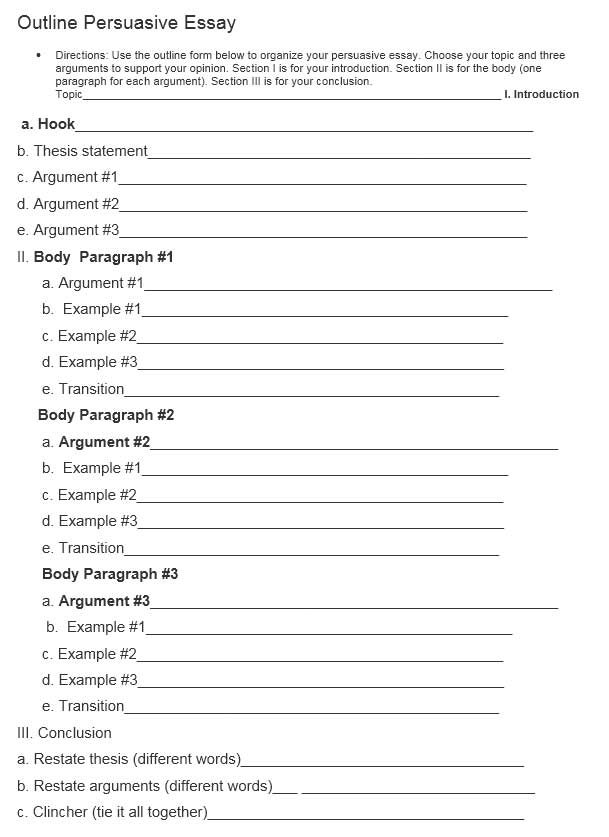
Creating a persuasive essay outline is important for an organized and effective piece of writing. Many students think that writing an outline is a waste of their time, which is wrong. You will do the work quickly when you know about the topic and the points you want to add to it.
Writing an outline is the first step in how to write an effective essay. Below, we have explained some main points that are involved in creating an outline.
Researching the topic is the first thing you must do when creating an outline for your essay. Research the main and important information about your topic and outline the points you would add to your essay.
An introductory paragraph is the first section of an essay. Here you will introduce your main topic idea and structure your introduction before writing it.
The main body is the fleshy part of the essay and includes all the main arguments. The following is the basic structure of the body paragraphs.
a. Argument Number 1
b. Argument Number 2
c. Argument Number 3
The argument paragraphs could be more than three but make sure that all of them are relevant.
The conclusion is the closing of an essay, and how to write a conclusion is one of the main questions that many students ask. Instead of adding everything, try to be brief and just mention the essence of the entire essay.
Use the below persuasive essay outline template to structure your essay.
To understand how persuasive essays work, it can be helpful to look at some essay examples.
Here are some examples of persuasive essays:
Choosing a topic for your persuasive essay can be tricky. The best way to find something interesting is to look for topics that interest you. Here are some ideas for good persuasive essay topics:
Writing a persuasive essay becomes easier when you have a clear argument, strong evidence, and a well-organized structure. From choosing a focused topic to developing your thesis, supporting your claims, and ending with a strong conclusion, each step helps make your argument more convincing.
With the right approach and useful writing tools, you can also improve the clarity and quality of your work. FreeEssayWriter.net offers helpful tools, including an Essay Writing Tool and Grammar Checker, to support you throughout the writing process and help you create polished, effective essays.

Written by
Part of the Free Essay Writer team, sharing practical advice on writing better essays, faster, and for free.
More from this authorSeptember 2, 2026 · Moeed
Are you looking for some strong and unique argumentative essay topics? You are at the right place. Every student at…
Moeed
Read more
August 10, 2026 · Moeed
Running out of ideas can make essay assignments feel longer than they should, especially with tight deadlines. Structured tools can…
Moeed
Read more
January 6, 2023 · Moeed
An argumentative essay outline is the first step to writing a good argumentative essay, so you first need to understand…
Moeed
Read more
Generate a full essay free, then polish it with the built-in toolkit.
Start writing free