October 13, 2026 · Moeed
IMO Meaning: Definition, Examples, Usage Tips & IMO vs IMHO
A friend texts “IMO the sequel beats the original,” and the three letters stall the chat. The IMO meaning looks…
 Moeed
Read more
Moeed
Read more

Moeed
Moeed is the Content Head…
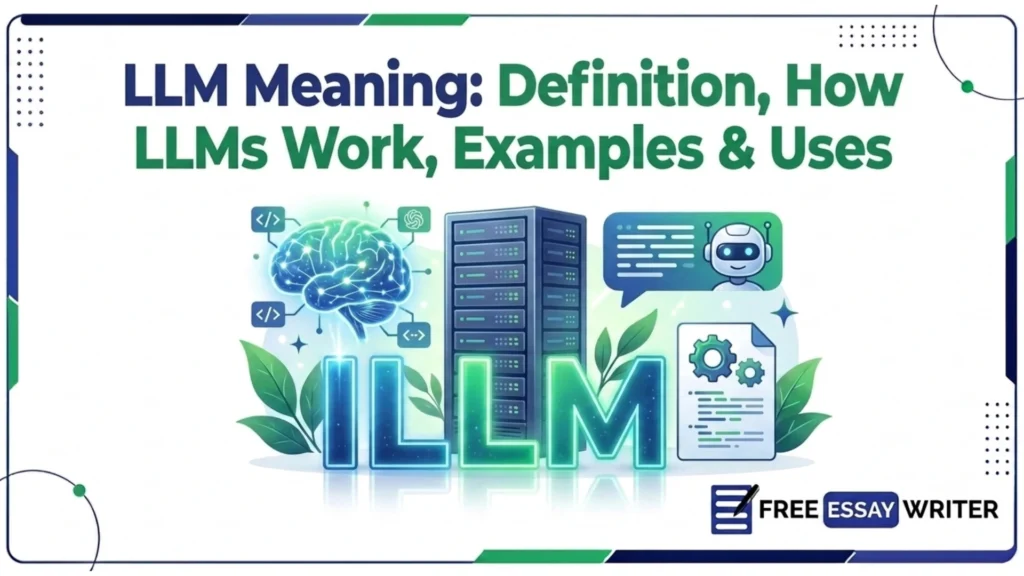
A classmate mentions an LLM during a group project, and half the group nods without knowing the term. A search for it returns two answers, one about artificial intelligence and one about law degrees. This guide explains the LLM meaning in each context so readers can use the term correctly.
Abbreviations often cause this confusion, much like the opinion shorthand that our guide to IMO meaning explains. In technology, LLM stands for large language model, the system behind ChatGPT, Claude, and Gemini. In legal education, LL.M. stands for Master of Laws, a postgraduate degree for law graduates.
The sections below explain how large language models work, what they do well, and where they fail. Later sections cover the law degree, texting use, common mistakes, and a checklist for students.
LLM usually means large language model, an AI system that reads and writes human language. It learns patterns from huge amounts of text and predicts the next word, or token, in a sequence. In law, LL.M. means Master of Laws, a degree that lawyers often earn after a first law degree. The surrounding sentence usually shows which of the two meanings a writer intends.
The letters LLM carry two established meanings, and a third appears occasionally in casual online chat. The table below lists each meaning with the field where readers most often see it.
| Abbreviation | Full form | Field | Example |
|---|---|---|---|
| LLM | Large language model | AI and technology | “The app runs on an LLM.” |
| LL.M. | Master of Laws (Legum Magister) | Law and higher education | “She earned an LL.M. in tax law.” |
| LLM (rare) | Varies by community | Texting and gaming | Check the thread for context |
Technology articles, news reports, and school discussions now use the AI meaning far more often than the legal one.
A large language model is a type of artificial intelligence that processes and generates text. It belongs to the wider field of machine learning, where software learns patterns from data instead of rules. Engineers do not write a rule for every sentence, because the model discovers grammar and facts from examples.
These models answer questions, summarize articles, translate languages, write code, and draft essays on request. Chat apps place a friendly interface on top, but the language model produces the actual writing. Students find LLMs inside chatbots, search tools, email apps, and many free writing assistants.
The word large refers to the number of parameters, which are adjustable numbers inside the model. Parameters store the patterns that the model learns during training, a little like connection strengths in a brain. Modern LLMs often hold billions of parameters, and the largest reportedly exceed a trillion. Large also describes the training data, which can include trillions of words from books, websites, and code.
A language model estimates how likely each word is to appear after the words before it. A phone keyboard runs a tiny language model when it suggests the next word in a text. An LLM performs the same basic task at enormous scale, with far more context and skill.
In simple words, an LLM is a giant autocomplete that learned language by reading enormous amounts of text.
Language models existed for decades, but early versions only counted how often word pairs appeared together. Neural network models arrived in the 2010s and learned richer patterns from larger collections of text. The 2017 transformer paper changed the field, because attention handled long passages faster and more accurately.
OpenAI released its first GPT model in 2018, and Google released BERT the same year. Each new generation grew larger, and researchers noticed that bigger models gained surprising new abilities. ChatGPT launched in November 2022 and brought LLMs to millions of everyday users within weeks.
Since then, companies have released new models every few months, adding images, audio, and web search. Today the term LLM appears in classrooms, offices, news reports, and job descriptions around the world.
Students now see the term LLM in syllabi, academic integrity policies, and assignment instructions. A policy that bans LLM use covers chat assistants, AI writing tools, and many browser extensions. A student who misreads that single term can break a rule without realizing the mistake.
Law students face a second layer, because LL.M. programs appear in career advice and graduate admissions. Knowing both meanings helps students read instructions correctly and write about either topic with confidence.
An LLM turns text into numbers, studies the relationships between them, and predicts what text comes next. The process repeats one small piece at a time until the model finishes its answer. The flow below shows the basic path from a prompt to a reply.
Prompt -> Tokens -> Embeddings -> Transformer layers -> Next-token probabilities -> Chosen token -> RepeatA token is a whole word, a word part, or a punctuation mark that the model processes. In English, a token often equals three quarters of a word, so 100 tokens hold roughly 75 words. Each token becomes a list of numbers, an embedding, that places related words near each other.
Most LLMs use the transformer architecture, which Google researchers introduced in a 2017 research paper. That paper carried the memorable title “Attention Is All You Need,” and the name stuck. Attention lets the model weigh every token against every other token in the same passage.
In a sentence about a bank beside a river, attention links bank to river, not money. This mechanism explains why LLMs track meaning across long paragraphs better than older systems.
After it processes the prompt, the model assigns a probability to every possible next token in its vocabulary. It picks one token, adds it to the text, and runs the whole calculation again. The temperature setting controls randomness, so higher values produce more varied and surprising wording. This loop explains why LLMs write fluently but sometimes state wrong facts with full confidence.
Building a large language model takes several training stages, and each stage teaches a different skill. The table summarizes the main stages that public documentation from major AI labs usually describes.
| Stage | What happens | Result |
|---|---|---|
| Pretraining | Model predicts tokens across huge text datasets | Broad language and world knowledge |
| Instruction tuning | Model studies example prompts with good answers | Follows requests and questions |
| Human feedback training | People rank answers, model learns preferences | More helpful, safer replies |
| Safety testing | Teams probe the model for harmful outputs | Fewer risky responses |
Pretraining costs the most computing time, while later stages turn raw prediction into a helpful assistant.
Pretraining runs on thousands of specialized chips for weeks or months, which explains the high cost. Companies release the finished model through apps, websites, and programming interfaces for developers. Each released model has a knowledge cutoff, the date after which its training data stops.
These key characteristics separate LLMs from older chatbots and rule-based software tools:
Large language models come in several types, and the labels describe how people access or train them. The table groups the common categories that students see in news articles and app descriptions.
| Type | What it means | Example use |
|---|---|---|
| Base model | Pretrained only, predicts text | Research and further training |
| Instruction model | Trained to follow requests | Chat assistants |
| Multimodal model | Handles text plus images or audio | Reading charts or photos |
| Open-weight model | Weights published for download | Running on private servers |
| Closed model | Access through company apps or API | Consumer chat products |
| Small language model | Fewer parameters, faster, cheaper | Phones and laptops |
Many modern assistants combine several types, such as a closed, multimodal, instruction-following model.
Several companies build well-known LLM families, and each family releases new versions every year or so. Version numbers change often, so the table lists model families instead of individual releases.
| Model family | Developer | Access |
|---|---|---|
| GPT | OpenAI | ChatGPT and API |
| Claude | Anthropic | Claude apps and API |
| Gemini | Gemini apps and Google products | |
| Llama | Meta | Open-weight downloads |
| Mistral models | Mistral AI | Open-weight and API |
Most of these companies offer free tiers with limits, so students can compare families without paying.
LLMs handle a wide range of language tasks, from casual questions to technical writing and coding. The table pairs common fields with realistic tasks that people give these models every day.
| Field | Common LLM task |
|---|---|
| Education | Explaining concepts, building quizzes |
| Writing | Outlines, drafts, grammar checks |
| Business | Emails, reports, customer support |
| Software | Writing and explaining code |
| Research | Summarizing papers, finding themes |
| Translation | Converting text between languages |
Writing support remains the most common use for students, especially outlines, feedback, and grammar fixes.
Programmers ask LLMs to explain error messages, write small functions, and convert code between languages. Translators use them for quick first drafts and check tone and idioms by hand afterward. Writers can pair an LLM with free student writing tools for paraphrasing, outlines, and structure checks.
With careful use, LLMs offer real benefits for study sessions, early drafts, and revision work:
LLMs write fluently, but fluent text and accurate text are not the same in practice. Every user should know the main weaknesses before trusting an answer for homework or research. The table matches each common problem with its usual cause and the first check to run.
| Problem | Usual cause | First check |
|---|---|---|
| Hallucinated facts | Prediction fills gaps with plausible text | Verify with a primary source |
| Fake citations | Model invents realistic references | Search each title and author |
| Outdated answers | Training cutoff | Check the date of the information |
| Bias | Patterns in training data | Compare several viewpoints |
| Privacy risk | Service stores prompts | Avoid sharing personal data |
| Generic writing | Model favors common phrasing | Add personal examples and voice |
Fake citations deserve extra attention, because teachers spot invented references quickly and treat them seriously.
A hallucination happens when the model states something false in the same confident tone as true facts. The model does not lie on purpose, because it predicts likely words without checking any database of truth. Some apps now connect LLMs to web search, which reduces this problem but does not remove it.
Bias appears because training text reflects the opinions and blind spots of the people who wrote it. Developers test models for unfair patterns, but no company claims to have removed all bias from its models.
People often use LLM and AI as synonyms, but the terms sit at different levels. AI is the broad field, while an LLM is one particular kind of AI system.
| Point | AI | LLM |
|---|---|---|
| Scope | Entire field of intelligent software | One model type within AI |
| Inputs | Text, images, sensor data, numbers | Mainly text, sometimes images |
| Examples | Self-driving systems, recommendation engines, chess programs | GPT, Claude, Gemini, Llama |
| Main task | Varies widely | Predict and generate language |
Every LLM counts as AI, but most AI systems in daily life are not language models.
A chatbot is the conversation interface, and an LLM is often the engine running behind that interface. Older chatbots followed scripted decision trees, so they failed whenever users asked an unexpected question.
| Point | Chatbot | LLM |
|---|---|---|
| What it is | Interface for conversation | Language-generating model |
| Can exist alone | Yes, with scripts | Yes, through an API |
| Flexibility | Limited if rule-based | Handles open-ended requests |
| Example | Bank support widget | Model inside ChatGPT |
Modern chat assistants combine both parts, which explains why many readers treat the terms as identical.
A search engine finds existing pages, while an LLM writes a new answer from learned patterns. That difference matters for students, because search results show sources and LLM answers often do not.
| Point | Search engine | LLM |
|---|---|---|
| Output | List of links | Written answer |
| Sources | Visible by default | Often missing unless tools add them |
| Freshness | Indexes new pages daily | Limited by training cutoff |
| Best for | Finding facts and sources | Explaining, drafting, summarizing |
Smart researchers use an LLM to explain a topic and a search engine to confirm each claim.
In law, LL.M. stands for Master of Laws, from the Latin phrase Legum Magister. The double L marks the plural of the Latin word lex, which means law. Most LL.M. programs run for one academic year and admit students who already hold a law degree. Many students pick a specialty such as tax law, international law, human rights, or business law.
In the United States, foreign-trained lawyers often take an LL.M. to study American law directly. Some states, including New York, may let certain LL.M. graduates sit for the bar exam. Rules differ by state and change over time, so applicants should check with the relevant bar authority.
| Degree | Full name | Typical level | Typical length |
|---|---|---|---|
| LL.B. | Bachelor of Laws | First law degree in many countries | 3-4 years |
| J.D. | Juris Doctor | First law degree in the US | 3 years |
| LL.M. | Master of Laws | Postgraduate specialization | About 1 year |
| S.J.D. or J.S.D. | Doctor of Juridical Science | Research doctorate | 3 or more years |
Many style guides and universities write the degree as LL.M., which helps separate it from the AI term.
Outside AI and law, LLM has no standard meaning in texting, gaming, or social media slang. Some users invent private shorthand, but those meanings rarely spread beyond one group or platform. When an unfamiliar LLM appears in a chat, the safest move is to ask the sender directly. Readers who collect abbreviations can also explore the banking term in our guide to ACH meaning.
Sara, a first-year college student, receives an essay prompt about the causes of the First World War. She asks an LLM to explain the alliance system in plain words before she reads her textbook chapter. The model gives a clear summary and names four causes that historians often discuss together.
Next, Sara asks for an outline, and the model suggests five sections with a thesis statement. She rewrites the thesis in her own words because the model’s version sounds generic and safe. When the model cites a book, Sara searches the catalog and discovers that the title does not exist.
That moment teaches her the main rule for LLM use in academic work: verify a claim before you trust it. She builds her final essay from library sources, uses the model for feedback, and discloses that help. Her teacher allows AI feedback with disclosure, so her work stays within the class policy.
The steps below help students get real value from an LLM without breaking academic integrity rules.
Read the syllabus and school handbook before opening any AI tool for a graded assignment. Policies range from full bans to open use with disclosure, and they differ between courses. Ask the instructor directly whenever the written rules leave any doubt about permitted AI use.
Ask the model to explain concepts, quiz you, or point out weak spots in your argument. Write the core ideas and final sentences yourself, because graders assess your thinking, not the model’s.
State the topic, the audience, the length, and the format you want in a single prompt. A prompt such as “explain photosynthesis to a ninth grader in 150 words” beats a vague request.
Check each fact, date, statistic, and quotation against a textbook, journal, or official source. Search every cited title in your library database, and delete any reference you cannot locate.
Never paste passwords, ID numbers, medical details, or private family information into an AI chat. Many services store conversations, and some companies may review them to improve future models.
Add a short note explaining which tool you used and what tasks it performed for the assignment. Honest disclosure protects your grade and builds trust with instructors who allow limited AI support.
Many users accept LLM output without checking it, because the writing sounds polished and confident. Polish says nothing about accuracy, so every claim still needs a check against a reliable source.
LLMs sometimes invent book titles, journal articles, and page numbers that look real at first glance. A fake reference can trigger an academic misconduct review, even when the error was accidental. Do not submit any citation that you have not personally located.
Writers sometimes mix LLM and LL.M. in the same document, which confuses readers and reviewers. Spell out the full term on first use, and keep the punctuation consistent throughout the piece.
Users often paste full documents containing names, addresses, or grades into public AI tools. Remove personal details first, or use a tool that your school or employer has approved.
Raw LLM output often sounds generic, repeats phrases, and misses the particular demands of an assignment. Teachers recognize that flat style quickly, and many schools treat undisclosed AI text as plagiarism.
An LLM without web access cannot know events after its training data ends, sometimes months earlier. Check dates on any current topic, such as laws, prices, sports results, or officeholders.
These tips help students get clearer and more useful answers from almost any large language model:
Run through this checklist before submitting any assignment that involved an LLM at any stage:
Students and job seekers can use these short questions to check their grasp of the topic. The answers also work as interview warm-ups for entry-level roles in content or technology.
| Question | Short answer |
|---|---|
| What does LLM stand for in AI? | Large language model |
| What does LL.M. stand for in law? | Master of Laws |
| What is a token? | A word or word piece the model processes |
| Which architecture do most LLMs use? | The transformer |
| What is a hallucination? | A confident but false output |
| What is a knowledge cutoff? | The date training data ends |
| Is every AI an LLM? | No, LLMs form one branch of AI |
Readers who answer five or more correctly already hold a solid grasp of the core LLM meaning.
Knowing the LLM meaning is the first step toward using AI tools wisely for school and work. The next step is practice with tools that support your own writing instead of replacing it. Browse the free writing tools for students on FreeEssayWriter for paraphrasing, word counts, and essay structure.
The LLM meaning in simple words is large language model, an AI that reads and writes text. It learns from huge amounts of writing and predicts the next word to form answers.
In ChatGPT, LLM stands for large language model, the AI system that writes each reply. OpenAI’s GPT models serve as the LLMs inside ChatGPT, while the app provides the chat interface.
LL.M. after a lawyer’s name means Master of Laws, a postgraduate degree in a legal specialty. Lawyers usually earn it after a first law degree, often in fields such as tax or international law.
No, an LLM is one type of artificial intelligence, not the whole field of AI. The LLM meaning covers language models only, while AI also includes vision, robotics, and recommendation systems.
An LLM generates text by predicting the most likely next token based on all earlier tokens. It repeats that prediction many times per second until it completes a full answer.
LLMs make mistakes because they predict plausible language instead of checking facts against a trusted database. Gaps in training data, outdated information, and vague prompts all raise the chance of errors.
Students can use LLMs for homework when their school and instructor allow it under clear rules. Many courses permit LLM help for brainstorming and feedback but require disclosure and original final writing.
An LLM is the language model, while a chatbot is the interface that lets people talk with it. Some chatbots use simple scripts, but modern AI assistants usually run on an LLM underneath.
Popular examples of LLMs include OpenAI’s GPT, Anthropic’s Claude, Google’s Gemini, and Meta’s Llama families. Each family releases newer versions over time, so version names change faster than family names.
LLM has no widely accepted meaning in texting, so the LLM meaning online almost always points to AI. When the context seems unclear, ask the sender instead of guessing what the letters mean.
The LLM meaning depends on context, but most modern readers mean large language model when they see it. These systems write fluently because they predict language, not because they know facts the way people do. That single idea explains their strength in drafting and explaining, plus their weakness with accuracy.
Law students and lawyers will still see LL.M. on résumés, applications, and university program pages. Clear punctuation and a spelled-out first mention keep both meanings separate for every reader. Use LLMs as study partners, check their claims, and keep your own voice central in your work.
Explore more writing and abbreviation guides on FreeEssayWriter.

Written by
Moeed is the Content Head at Free Essay Writer and has more than 5 years of experience in SEO and content writing. He writes clear, practical guides on essay writing, grammar and word meanings to help students write with confidence.
More from this authorOctober 13, 2026 · Moeed
A friend texts “IMO the sequel beats the original,” and the three letters stall the chat. The IMO meaning looks…
Moeed
Read more
October 13, 2026 · Moeed
A paycheck lands in a bank account overnight, and the statement lists it as an “ACH credit.” The ACH meaning…
Moeed
Read more
October 12, 2026 · Moeed
A post opens with “ICYMI” and a link, and the first word needs a quick decode. The ICYMI meaning is…
Moeed
Read more
Generate a full essay free, then polish it with the built-in toolkit.
Start writing free