October 13, 2026 · Moeed
LLM Meaning: Definition, How LLMs Work, Examples & Uses
A classmate mentions an LLM during a group project, and half the group nods without knowing the term. A search…
 Moeed
Read more
Moeed
Read more

Moeed
Moeed is the Content Head…
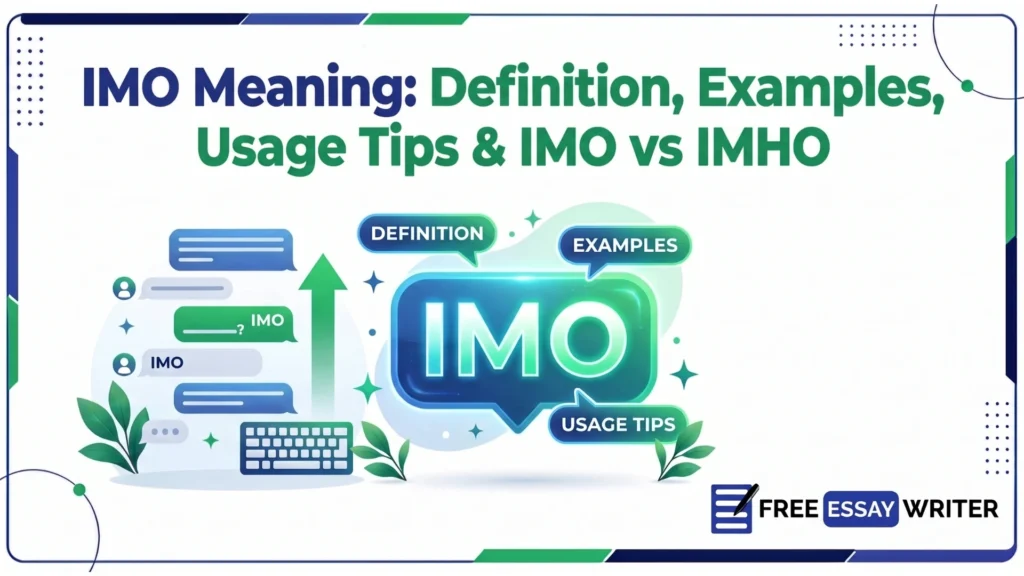
A friend texts “IMO the sequel beats the original,” and the three letters stall the chat. The IMO meaning looks simple to regular texters, yet many new readers still pause over it. IMO stands for “in my opinion,” and people add it to mark a personal view.
This guide covers the full form, the origin, real chat examples, and the IMO vs IMHO difference. It also explains when students should drop IMO from essays and formal emails. If other chat shorthand confuses readers too, our breakdown of the ICYMI meaning covers another popular acronym.
Each section uses plain examples, short tables, and clear rules that work for texting, social media, and school.
IMO means “in my opinion,” and people use it to show that a statement reflects a personal view. Texters place it at the start, middle, or end of a message, usually with a comma. The IMO meaning stays the same in uppercase or lowercase form across texts, forums, and social apps. Still, IMO belongs in casual writing, so students should swap it for full phrases in essays.
The table below sums up the core facts about IMO in one place for quick reference.
| Feature | Details |
|---|---|
| Full form | In my opinion |
| Type | Initialism (internet acronym) |
| Main purpose | Marks a statement as personal opinion |
| Common platforms | Texts, Reddit, X, Discord, and group chats |
| Variants | IMHO, IMNSHO, and imo |
| Tone | Casual, mildly softening |
| Formal writing | Avoid; use full phrases |
Overall, IMO works as a quick opinion label for casual chats, not for academic or professional documents.
In texting, IMO stands for “in my opinion,” and the letters match the first letter of each word. People read it as a label that separates their personal view from a stated fact. For example, “IMO pineapple belongs on pizza” signals a taste, not a claim anyone can prove.
Strictly speaking, IMO counts as an initialism because readers say each letter instead of a word. Most people still call it an acronym, and that casual label causes no problems in everyday conversation. In speech, people usually say the full phrase “in my opinion” instead of spelling out I-M-O.
Both IMO and imo carry the same meaning, so capitalization changes the tone, not the definition. Lowercase imo reads more relaxed and appears often in quick texts, gaming chats, and replies. Uppercase IMO looks slightly more deliberate and shows up more in forum posts and longer comments.
In simple words, IMO is a three-letter tag that says “this is my belief, not a proven fact.”
IMO grew out of early online communities where typing speed and short messages mattered to every user. Its exact first appearance is hard to pin down, so treat any precise origin date with caution.
Usenet newsgroups and bulletin board systems in the 1980s relied on short abbreviations to save typing time. Slang historians usually trace opinion tags such as IMHO and IMO back to those text-only boards. Debates in those groups ran long, so writers needed a fast way to mark personal views.
Instant messaging apps and chat rooms in the 1990s carried IMO to a much wider audience. Later, SMS character limits pushed texters to shorten every common phrase they typed each day. Today, IMO appears on Reddit, X, Discord, WhatsApp, and nearly every app with a comment box.
Younger users often type lowercase imo or tack it on the end, while older forum users favor IMHO. Both groups still read the tag the same way, so the meaning holds steady across generations.
People add IMO for three main reasons, and each one changes how the reader receives the message.
IMO tells readers that the writer is sharing a view, not reporting a verified fact. This label helps during debates about movies, sports, food, or music, where taste varies widely. Without IMO, a bold claim can read like an argument the writer expects everyone to accept.
Adding IMO before a counterpoint lowers the temperature of a heated group chat or comment thread. Compare “That plan won’t work” with “IMO that plan won’t work” to see the gentler tone. The second version leaves room for the other person to disagree without losing face.
IMO also signals openness, since it admits that other reasonable opinions exist on the topic. Writers often pair it with a question, such as “IMO the first season was better, thoughts?”
IMO fits in three main positions, and each position puts the focus on a different part.
Opening with IMO frames the whole message as an opinion before the reader reaches the main claim. A typical example reads, “IMO, the new update made the app slower.” Most texters follow IMO with a comma, although casual chats often skip it.
Mid-sentence IMO usually sits between commas and works like a quick aside or a spoken pause. For instance, “The ending, IMO, needed one more scene to explain the twist.” This placement points the opinion at one part of the sentence instead of the entire message.
Ending with IMO adds the opinion tag as an afterthought and often softens a strong claim. An example reads, “Messi is the greatest footballer ever, IMO,” which leaves room for debate. Writers place a comma before the final IMO, although lowercase texts frequently drop it.
The table below compares the three positions and the punctuation each one usually takes.
| Position | Example | Punctuation |
|---|---|---|
| Start | IMO, the book beats the movie. | Comma after IMO |
| Middle | The book, IMO, beats the movie. | Commas on both sides |
| End | The book beats the movie, IMO. | Comma before IMO |
The comma rules match those for the full phrase “in my opinion” in standard written English.
Real examples show how IMO behaves across different apps, audiences, and social settings.
Sara: Should I get the blue jacket or the black one?
Ali: IMO the black one, it matches all your clothes.
Here, Ali gives a clear pick while admitting the choice depends on personal taste. The IMO keeps the advice friendly instead of sounding like a strict fashion rule.
Comment: Season 2 was the best season of the show imo
Reply: Hard disagree, season 1 had the stronger story
Lowercase imo at the end marks a casual take that invites replies from other fans. Reddit and YouTube comment sections repeat this pattern constantly during fan debates and reviews.
Manager: Which headline should we run on the landing page?
Designer: IMO option B reads clearer on mobile screens.
Colleagues on Slack or Teams use IMO to offer suggestions without overriding the final decision maker. Workplace use stays acceptable in casual channels but looks out of place in client emails.
Player 1: Is the sniper worth unlocking first?
Player 2: imo no, the shotgun gets you more early kills
Gamers use IMO to share strategy picks that depend on play style and personal experience. Forum users often stack it with IIRC or FWIW to add extra context to a reply.
A short group chat about weekend plans shows how three letters can change the mood.
Hamza: Let's try the new burger place Saturday.
Zara: That place is overpriced and the fries are soggy.
Hamza: Okay, forget it then.
Zara states her view as fact, so Hamza reads it as a flat rejection of his idea. The chat stalls, and nobody suggests a new plan for the weekend afterward.
Hamza: Let's try the new burger place Saturday.
Zara: IMO it's a bit overpriced, but I'm open to it.
Hamza: Fair, want to try the pizza spot instead?
This time, Zara frames her doubt as an opinion and leaves the door open for discussion. Hamza responds with a new suggestion, and the group keeps planning instead of dropping the idea.
A single IMO turns a verdict into a viewpoint, and viewpoints keep conversations moving.
IMHO stands for “in my humble opinion” or “in my honest opinion,” depending on the writer. Both terms label a personal view, but IMHO adds a layer of modesty or candor. Many writers also use IMHO with irony, since the opinion that follows often sounds anything but humble.
| Feature | IMO | IMHO |
|---|---|---|
| Full form | In my opinion | In my humble or honest opinion |
| Tone | Neutral, casual | Modest or candid, sometimes ironic |
| Length | Three letters | Four letters |
| Common use | Everyday chats | Forums, debates, and careful disagreement |
Choose IMO for neutral opinions and IMHO when modesty or blunt honesty fits the message better.
IMNSHO means “in my not so humble opinion,” and people use it for playful confidence. It appears less often than IMO and usually signals a joking, self-aware boast about a strong view.
Many writers swap IMO for “I think,” and the two phrases carry nearly identical meaning in casual chats. “I think” sounds slightly more personal and reads naturally in speech, emails, and handwritten notes. IMO looks more compact on screens and signals that the writer belongs to online chat culture. For mixed audiences, “I think” offers the safer choice because every reader recognizes it instantly.
Several chat acronyms sit close to IMO, and mixing them up can change the tone of a message.
| Acronym | Full form | Main use |
|---|---|---|
| IMO | In my opinion | Marks a personal view |
| TBH | To be honest | Signals candor or a confession |
| FWIW | For what it’s worth | Offers modest input |
| AFAIK | As far as I know | Limits a claim to known facts |
| IIRC | If I recall correctly | Flags uncertain memory |
| IMHO | In my humble or honest opinion | Softer or ironic opinion |
IMO labels a belief, while AFAIK and IIRC label the limits of the writer’s knowledge or memory.
TBH sits closest to IMO, although it stresses honesty instead of personal taste. A message like “TBH, the party was boring” admits a candid reaction the writer might normally hide. Our guide to the WYF meaning breaks down another short text abbreviation that puzzles new readers.
Outside texting, IMO also names organizations and technical terms, so context decides the right reading.
| Context | IMO stands for | Where it appears |
|---|---|---|
| Texting and social media | In my opinion | Chats, comments, and forums |
| Shipping and maritime law | International Maritime Organization | News, trade, and regulation |
| Math competitions | International Mathematical Olympiad | School and contest news |
| Ship identification | IMO number (unique ship ID) | Vessel records and ports |
A news story about cargo safety usually refers to the maritime body, not a personal opinion.
The International Maritime Organization is a United Nations agency that sets global rules for shipping safety. The International Mathematical Olympiad brings top high school math students from many countries together each year. In a group chat, though, IMO nearly always carries the “in my opinion” meaning.
IMO is not inherently rude, and in most chats it makes a statement sound more polite. The tag admits that the writer might be wrong, which lowers the risk of offending anyone. Still, tone depends on the words around it, and IMO cannot rescue an insulting comment.
For example, “IMO your idea is stupid” stays rude because the insult does the damage, not the tag. Overusing IMO can also sound defensive, especially when it appears in nearly every message.
IMO keeps the same meaning in flirty or romantic texts, so no hidden message sits behind it. A text like “IMO you look great in green” shares a personal compliment, not a coded signal. Some readers overthink short texts from a crush, but IMO adds no extra romantic or hidden weight. Read the rest of the conversation for tone, since the acronym itself stays neutral in every context.
IMO suits some settings far better than others, and the audience decides whether the acronym fits. The table below matches common settings with a clear recommendation and a safer option where needed.
| Setting | Use IMO? | Safer option |
|---|---|---|
| Texts with friends | Yes | No change needed |
| Social media comments | Yes | No change needed |
| Casual work chat | Usually | I think |
| Client or manager email | No | In my view |
| Essays and reports | No | This essay argues |
| Cover letters | No | I believe |
The more formal the reader or document, the stronger the case for writing the full phrase.
Many offices now run on chat apps, so IMO appears in workplace messages more than ever before. Still, workplace use calls for more care than texting friends or posting in fan forums.
A quick IMO in an internal Slack thread reads fine, especially among teammates who already text casually. Client emails, proposals, and performance reviews call for full phrases such as “in my view.”
An IMO alone carries little weight in a business decision, so attach data or a clear reason. For example, “IMO we should delay launch, since testing found 12 open bugs” gives colleagues something concrete.
Watch how managers and senior colleagues write before using slang in a new job or team. If leaders avoid acronyms, mirror their style until the team’s norms become clear.
Students should leave IMO out of essays, research papers, and other formal assignments. Academic writing expects full words, and many instructors treat text acronyms as a sign of careless writing. Even the full phrase “in my opinion” can weaken an essay, since the thesis already shows the view.
The table below lists replacements that keep the opinion while matching an academic or professional tone.
| Formal alternative | Best for |
|---|---|
| I believe | Reflective essays and personal statements |
| This essay argues that | Argumentative essays |
| The evidence suggests | Research papers |
| From my perspective | Discussion posts |
| In my view | Formal emails and reports |
Pick the phrase that matches the assignment, and back every opinion with evidence or clear reasoning.
A casual first draft line might read, “IMO social media hurts teen sleep.” An academic version reads, “Heavy social media use appears to reduce sleep quality among teenagers.” The revision removes the acronym, uses careful hedging, and prepares the reader for supporting research.
A reply to IMO depends on whether the reader agrees, disagrees, or wants more detail.
| Situation | Sample reply |
|---|---|
| Agree | Same, I thought so too |
| Disagree politely | Fair point, but I see it differently |
| Want reasons | What makes you say that? |
| Stay neutral | Interesting take, I hadn’t considered that |
A short, respectful reply keeps the chat friendly, even when both sides hold opposite opinions.
Do not treat an IMO statement like a factual claim that needs a citation or proof. The writer already admitted it reflects personal taste, so demanding sources usually reads as hostile.
These tips help texters use IMO in a way that sounds clear, friendly, and natural:
IMO survived decades of new apps because it saves typing time without losing any meaning. Three letters replace three words, which matters on small phone keyboards and in fast group chats. The acronym also signals membership in online culture, much like insider slang in any close community. Finally, IMO fills a social need, since people want to share opinions without starting arguments.
Unfamiliar acronyms appear in chats every week, so a repeatable method saves time and avoids awkward replies.
Start by noting where the message appeared, since a shipping report and a group chat use IMO differently. The sender’s age, job, and usual writing style also hint at the most likely meaning.
Read the words around the acronym and look for opinion markers such as “better,” “worse,” or “best.” If the sentence judges a movie, meal, or player, IMO almost always means “in my opinion.”
Replace the acronym with “in my opinion” and read the sentence aloud to confirm it makes sense. If the swap sounds awkward, the writer probably meant a different term, such as the maritime organization.
A quick “what does IMO mean here?” costs nothing and prevents a confused or mistaken reply. Most people happily explain their slang, and asking also shows interest in the conversation. Polite questions also teach the asker new slang, which makes the next confusing message easier to decode.
These mistakes show up often in chats and school work, and each one has a simple fix.
Writing “IMO water boils at 100 degrees Celsius” sounds odd because science, not opinion, settles that claim. Save IMO for statements where reasonable people can disagree based on taste or judgment.
Students sometimes carry texting habits into essays, and instructors may lower grades for casual abbreviations. Proofread every assignment for chat acronyms like IMO, TBH, and LOL before submitting the final draft.
Adding IMO to every sentence makes the writer sound unsure and buries the actual point. One IMO per message, near the main claim, carries the opinion without extra clutter.
Some texters use IMHO when they mean plain IMO, which can make a neutral comment sound sarcastic. Match the acronym to the tone, and pick IMHO only when modesty or irony fits.
Some people treat IMO as a shield for harsh comments, but readers still see the insult. Rewrite harsh opinions with specific, fair reasons instead of relying on three letters for politeness.
Run through this checklist before sending a message or submitting writing that includes IMO:
These short practice questions help readers check their grasp of IMO before using it in real chats.
Compare “IMO Paris is France’s capital” with “IMO Paris has the best food in Europe.” The second sentence works, because food quality depends on taste while the capital is a fixed fact.
Look at the unpunctuated line “The game was too short IMO” and decide where the comma belongs. The correct version places a comma before IMO, so it reads “The game was too short, IMO.”
No, a history essay needs formal phrasing, so the student should write “This essay argues” instead. Strong essays support every claim with sources, which removes the need for an opinion tag.
Chat acronyms multiply every year, and the decoding steps in this guide work for each new term. Readers who want more slang breakdowns can start with our explainer on the ICYMI meaning. After that, the WYF meaning guide covers another short form that often confuses new texters. For school assignments, the free writing tools on FreeEssayWriter help turn casual drafts into polished academic prose.
IMO means “in my opinion” in text messages, chats, and social media posts. People add it to show that a statement reflects their personal view, not a proven fact.
The IMO meaning on social media stays the same: “in my opinion.” Users add it to comments, captions, and replies to frame a personal take on a topic.
IMHO means “in my humble opinion” or “in my honest opinion,” depending on the writer. It works like IMO but adds modesty, candor, or sometimes playful irony.
IMO is informal and belongs in texts, chats, forums, and casual workplace channels. Formal writing replaces it with phrases like “I believe” or “in my view.”
Students should avoid IMO in essays because academic writing expects full words and formal tone. Writers can use “I believe,” “this essay argues,” or “the evidence suggests” as formal replacements.
IMO is not rude and usually makes an opinion sound softer and more open. The surrounding words decide the tone, so IMO cannot fix an insulting comment.
Both IMO and imo carry the same meaning, so capitalization is a style choice. Uppercase looks more deliberate, while lowercase reads more relaxed in quick texts.
IMO can sit at the start, middle, or end of a sentence. Writers usually separate it with commas, as in “The film, IMO, ran too long.”
IMO means “in my opinion” and labels a personal view on a debatable topic. TBH means “to be honest” and signals candor, often before an admission or blunt reaction.
Outside texting, IMO can mean the International Maritime Organization or the International Mathematical Olympiad. Context decides the meaning, and casual chats almost always use “in my opinion.”
Here are the main points from this guide on the IMO meaning and its proper use:
The IMO meaning fits in three words, “in my opinion,” yet those letters change the tone of chats. Good IMO use separates opinion from fact, softens disagreement, and invites other people into the discussion. Keep it for casual spaces, and switch to full phrases in essays, reports, and formal emails. With those rules in hand, readers can decode IMO instantly and use it with confidence in any chat.
Explore more writing and slang guides on FreeEssayWriter.

Written by
Moeed is the Content Head at Free Essay Writer and has more than 5 years of experience in SEO and content writing. He writes clear, practical guides on essay writing, grammar and word meanings to help students write with confidence.
More from this authorOctober 13, 2026 · Moeed
A classmate mentions an LLM during a group project, and half the group nods without knowing the term. A search…
Moeed
Read more
October 13, 2026 · Moeed
A paycheck lands in a bank account overnight, and the statement lists it as an “ACH credit.” The ACH meaning…
Moeed
Read more
October 12, 2026 · Moeed
A post opens with “ICYMI” and a link, and the first word needs a quick decode. The ICYMI meaning is…
Moeed
Read more
Generate a full essay free, then polish it with the built-in toolkit.
Start writing free