October 13, 2026 · Moeed
LLM Meaning: Definition, How LLMs Work, Examples & Uses
A classmate mentions an LLM during a group project, and half the group nods without knowing the term. A search…
 Moeed
Read more
Moeed
Read more

Moeed
Moeed is the Content Head…
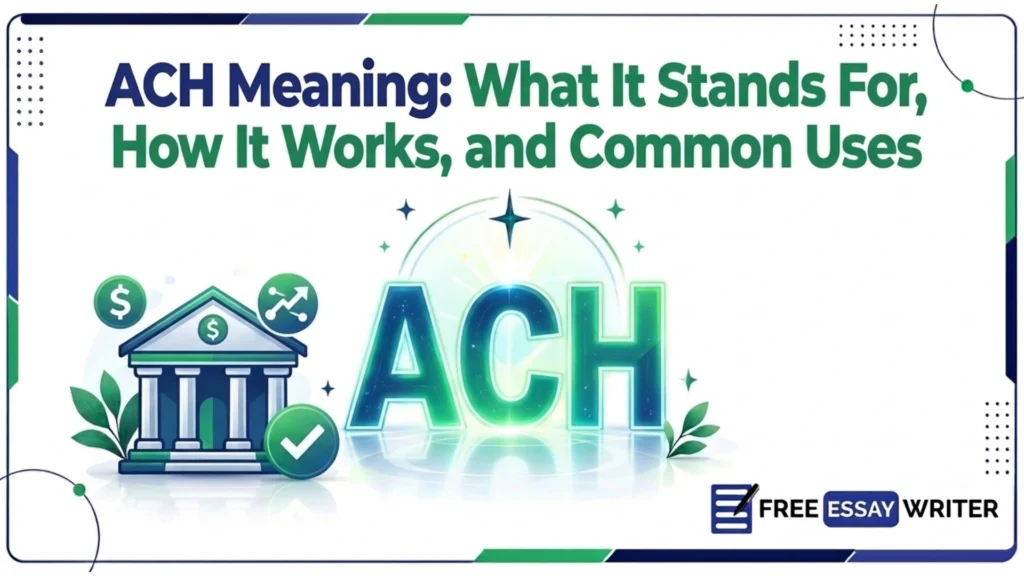
A paycheck lands in a bank account overnight, and the statement lists it as an “ACH credit.” The ACH meaning is Automated Clearing House, the electronic network behind direct deposits and bill payments. Banks use it to move money between accounts without paper checks or cash.
This guide explains the definition, the payment flow, the speed limits, the fees, and the safety rules. Other explainers on this site follow the same plain-language format. This guide offers general information, not financial advice, so check the bank’s own rules.
ACH stands for Automated Clearing House, the U.S. electronic network that moves money between bank accounts. People meet it through direct deposit, online bill pay, and recurring payments. Speed, fees, and limits vary by bank, so confirm the details before sending a payment.
The table below summarizes the core facts about ACH in one place.
| Item | Detail |
|---|---|
| Abbreviation | ACH |
| Full phrase | Automated Clearing House |
| Type | Electronic payment network |
| Rule maker | Nacha |
| Network operators | FedACH and EPN |
| Payment types | Credits (push) and debits (pull) |
| Common uses | Direct deposit, bill pay, recurring payments |
| Speed | Same day to about four business days |
| Same Day ACH cap | $1 million per payment |
ACH is a batch network, so speed depends on cutoff times and bank policies.
ACH stands for Automated Clearing House, and the name describes an automated system that clears payments. Nacha describes the network as a system for electronic transactions such as direct deposit and direct payments. The network serves consumers, businesses, and every level of government in the United States.
Nacha also lists direct deposit, direct pay, and electronic check as other names for ACH payments.
Automated means computers process the payment instructions in batches instead of clerks sorting paper. Clearing means the banks match, sort, and exchange payment instructions before final settlement. House refers to a clearinghouse, a central place where banks settle their obligations to each other.
Nacha writes and enforces the ACH Operating Rules, and it also runs education and certification programs. Reference summaries list two operators, the Federal Reserve’s FedACH and The Clearing House’s EPN. The Federal Reserve describes FedACH as a suite of low-cost, batched payment services for financial institutions.
Individual customers never connect to these operators directly, because only banks and their agents do.
Reference summaries trace the network to the 1960s and 1970s, when banks sought to automate paper check processing. Nacha formed in 1974, and a 1975 Social Security direct deposit trial drew many banks in. Today, nearly all banks and credit unions across the country participate in the network.
In simple words, ACH is the shared pipeline that lets banks pay each other for customers.
Every ACH payment follows the same path from the sender’s bank to the receiver’s bank.
| Role | Short name | Job |
|---|---|---|
| Originator | Sender | Starts the payment |
| ODFI | Originating bank | Sends the file into the network |
| ACH operator | FedACH or EPN | Sorts and routes the file |
| RDFI | Receiving bank | Posts the credit or debit |
| Receiver | Account holder | Gets or loses the funds |
Each role handles one step, so a delay can start at any point along the path.
The originator instructs its bank, the ODFI, which forwards the transaction to an ACH operator. The operator routes the transaction to the receiving bank, the RDFI, which credits or debits its customer’s account.
Originator -> ODFI -> ACH operator -> RDFI -> ReceiverIf the two banks use different operators, the first operator passes the transaction to the second one.
ACH processes payments in batches at set times, not one by one in real time. That design keeps costs low, but it explains why a transfer rarely lands instantly. Cutoff times decide whether a payment joins today’s batch or waits for the next one.
Every ACH payment is either a credit or a debit, and the difference is who starts it.
An ACH credit pushes money from the payer’s account to the payee’s account. The payer’s bank starts the transfer, so the payer controls the timing and the amount. Payroll direct deposit and a business payment to a vendor are common examples.
An ACH debit pulls money from the payer’s account after the payer grants permission. The payee’s bank starts the transfer, so the payee controls when the pull happens. Gym memberships, utility bills, and loan payments often run as ACH debits.
| Feature | ACH credit | ACH debit |
|---|---|---|
| Direction | Push | Pull |
| Who starts it | Payer | Payee |
| Authorization | Payer’s instruction | Payer’s prior permission |
| Typical use | Payroll, vendor payments | Bills, subscriptions, loans |
ACH stands out because it supports both push and pull payments on one network.
Nacha lists direct deposit, online bill pay, and scheduled recurring payments among the main uses.
Employers send salaries straight into employee bank accounts through ACH credits on payday. Government agencies use the same method for Social Security and other public payments.
Many banks and billers accept ACH payments for utilities, credit cards, and loans. Customers enter a routing number and an account number instead of mailing a check.
Mortgages, car loans, and subscriptions can draw from a bank account on a chosen day each month. Autopay saves time, but account holders still need to watch balances and statements.
Businesses use ACH for payroll, vendor invoices, and customer subscription billing at low cost. Small firms like ACH because batch pricing often costs less than card processing. Fees vary by provider, so compare written quotes before choosing a payment method.
Banks and apps also use ACH to link a checking account to a savings or brokerage account. Those transfers can take from one to four business days, depending on the institutions.
Speed depends on the payment type, the cutoff time, and the policies of both banks.
| Type | Typical timing | Notes |
|---|---|---|
| Standard ACH | Up to four business days | Batch based, lowest cost |
| Next-day ACH | Clears overnight | Posting depends on the receiving bank |
| Same Day ACH | Same business day | Needs submission before the window closes |
Timing figures come from reference summaries, so confirm exact windows with the bank.
Same Day ACH settles eligible payments within the current processing day under Nacha rules. The Nacha limit rose from $100,000 to $1 million per payment on March 18, 2022. The higher limit covers both credits and debits for businesses and consumers alike.
International payments fall outside Same Day ACH, so cross-border transfers follow different processes. Banks may charge extra for same-day service, so check the fee schedule first.
A pending status means the bank has seen the payment instruction but has not finished posting it. Banks label ACH items pending while the batch moves through the network and the receiving bank reviews it. A pending credit can still change, so wait for the posted status before spending the money.
Posted means the bank has completed the entry and updated the available balance. Exact labels and hold rules differ by bank, so check the account agreement for details.
Businesses collect ACH debits only after the customer gives a clear, signed or electronic authorization. The business submits the payment file to its bank, which acts as the ODFI. Payment processors can also submit files on the business’s behalf as agents of the bank.
Clear invoices and reminders reduce disputes, because customers recognize each debit on their statements. Businesses also track returns, since a failed debit means the invoice remains unpaid. Record keeping matters, so store each authorization for as long as the rules require.
Statements often show a short company name, a code, or a processor name beside an ACH debit. That label can differ from the brand name on the invoice, which confuses account holders. Compare the amount and date with records before disputing a debit as unauthorized.
A quick check often reveals a legitimate subscription under an unfamiliar processor name.
A receiving bank can reject an ACH payment and send it back through the network. Reference summaries list closed, frozen, or unknown accounts among the common reasons. Insufficient funds can also trigger a returned debit, and the payee may add a fee.
Banks handle most returns within about two business days, though exact windows depend on the reason. A returned payment can still cause late fees at the biller, so monitor balances before due dates.
Wire transfers and ACH payments both move money electronically, but they serve different needs.
| Feature | ACH | Wire transfer |
|---|---|---|
| Processing | Batches at set times | Individually, often faster |
| Typical cost | Low, varies by bank | Higher |
| Direction | Push and pull | Push only |
| Reversibility | Returns possible | Hard to reverse |
| Best for | Payroll, bills, subscriptions | Urgent, high-value transfers |
ACH suits routine, low-cost payments, while wires suit urgent transfers that need finality.
ACH removes paper handling, so payments avoid mail delays and lost envelopes. Nacha even lists “electronic check” as another name for ACH on its overview page.
Card payments run on card networks, while ACH payments run through bank-to-bank channels. Cards authorize at checkout in seconds, while ACH suits repeat billing at lower cost.
Instant systems such as FedNow settle payments in seconds, whereas ACH batches payments on a schedule. FedNow is a separate Federal Reserve service and availability depends on the bank.
Fees for ACH payments vary by bank, payment provider, and payment type, so no single price applies. Some consumer accounts include standard ACH transfers at no charge, but terms differ. Same-day transfers, returned payments, and business origination services often carry separate fees from the bank.
The Federal Reserve notes transparent pricing for FedACH services through published fee schedules. Read the bank’s fee schedule before scheduling frequent or same-day transfers from any account.
The network runs under Nacha rules, and the Federal Reserve offers risk tools for banks. Those tools alert banks to unusual activity and possible fraud or origination errors. Fraud still happens, because criminals can misuse stolen account numbers or fake payment requests. Do not approve an unfamiliar debit authorization without verifying the requester first.
Regulation E limits consumer liability for unauthorized electronic fund transfers under rules the CFPB publishes. The CFPB’s section 1005.6 explains the liability tiers for unauthorized electronic fund transfers. Consumers should report an unauthorized transfer within 60 days after the bank sends the statement.
Late reports can leave the consumer liable for later unauthorized transfers that timely notice would have stopped. The cited page does not name ACH, so ask the bank how the rule applies.
Follow these tips to keep ACH payments and bank details safe from fraud and errors:
Consumers and businesses gain these benefits when they choose ACH payments over paper checks:
The ACH network shows these key characteristics across banks and payment providers:
Banking staff use a short vocabulary of terms and codes when they discuss ACH payments.
| Term | Plain meaning |
|---|---|
| Routing number | Nine-digit code that identifies the bank |
| Account number | Identifier for the customer’s account |
| Originator | Person or company that starts the payment |
| ODFI | Bank that sends the file into the network |
| RDFI | Bank that receives and posts the payment |
| Return | Notice that a payment could not post |
| PPD | Code for payroll and preauthorized bills |
| WEB | Code for internet-initiated payments |
| IAT | Code for international transfers |
The three-letter codes, called Standard Entry Class codes, tell banks what kind of payment a file contains.
Short abbreviations often carry several meanings, and ACH shares that trait with text slang. Readers can compare the ICYMI meaning to see the same pattern in chat abbreviations. Context decides which expansion applies in each field, as the table below shows.
| Meaning | Field | Clue |
|---|---|---|
| Automated Clearing House | Banking, payroll | Mentions of deposits or routing numbers |
| Air changes per hour | Ventilation, building design | Mentions of airflow or room volume |
| ACh (acetylcholine) | Biology, medicine | Mentions of neurons or receptors |
| Ach (German interjection) | Everyday German speech | German text expressing surprise |
Banking likely dominates online searches for the term, but checking the surrounding words prevents mix-ups.
Collect the nine-digit routing number and the account number from the bank or a check. Use only official bank channels to look up these numbers, never a link from a stranger.
Debits need permission from the account holder, so read the authorization terms before agreeing. Keep a copy of the authorization, including the amount, the date, and the cancellation method.
Ask the bank or biller about cutoff times, processing days, and the expected posting date. Weekends and bank holidays usually delay processing, because ACH settles only on business days.
Check the account after the first transfer to confirm the amount and the date. Report any mismatch to the bank or the biller right away, before the next cycle.
Review statements monthly and cancel the authorization in writing when the service ends. Notify the bank too, because a stop-payment request can block future debits.
Consider a tenant who pays rent on the first of every month. The tenant signs an ACH authorization, and the landlord’s bank sends a debit request through the network. The tenant’s bank checks the balance, posts the debit, and returns the payment if funds are missing.
The landlord receives the money after settlement, often within one to two business days. This hypothetical case shows why timing and balances matter for every autopay payment. A weekend due date can settle on the next business day, so a buffer day helps.
Students meet ACH through tuition payments, refunds, and paychecks from campus jobs. Some schools accept ACH for tuition, and others refund credit balances by direct deposit. Students should double-check routing and account numbers, because one wrong digit can send a refund astray.
Academic papers on payments should cite Nacha, the Federal Reserve, and the CFPB instead of blogs. Writers who need help with study projects can try the tools at Free Essay Writer.
ACH batches payments and allows returns, while wires move individually and resist reversal. Sending an urgent payment by standard ACH can miss a deadline that a wire would meet.
Standard ACH transfers can take up to four business days, so plan ahead for due dates. Weekends and bank holidays add further delay to the posting date of any payment.
Routing and account numbers can authorize debits, so treat them like sensitive passwords. Do not send them through unsecured email, social media, or text messages.
An autopay debit without enough funds can bounce and trigger fees at both ends. Keep a buffer before large recurring payments and watch low-balance alerts from the bank.
Reviewing statements only once a quarter lets small unauthorized debits run for months unnoticed. Check statements monthly, because the 60-day reporting window starts when the bank sends the statement.
A canceled gym membership can still debit the account if the authorization stays active. Cancel in writing with the biller and ask the bank about a stop-payment request.
Searches for ACH can return HVAC, biology, and German-language results alongside banking pages. Add words like bank, payment, or routing number to narrow the results.
These short questions test whether the main points about ACH are clear.
ACH stands for Automated Clearing House, the electronic network that moves money between U.S. bank accounts.
A credit pushes money from the payer, while a debit pulls money from the payer’s account.
Nacha raised the limit to $1 million per payment effective March 18, 2022.
Reference summaries say standard ACH can take up to four business days.
Nacha maintains the ACH Operating Rules, and the Federal Reserve runs FedACH as one operator.
Run through this checklist before setting up or approving any ACH payment:
These official pages document the ACH facts, rules, and consumer protections cited in this guide:
The Free Essay Writer homepage offers free writing tools for students who want cleaner drafts. Practice by writing a one-paragraph summary of how an ACH payment moves from sender to receiver. Then compare the summary with the payment path section and fix any missing step.
ACH means Automated Clearing House, the U.S. electronic network that moves money between bank accounts. The ACH meaning covers direct deposit, bill pay, and recurring payments run through Nacha rules.
ACH stands for Automated Clearing House, a name that describes automated batch clearing of payments. Each word points to a different part of the process, from automation to central settlement.
Nacha writes the ACH Operating Rules, and operators such as FedACH route the payments. Banks and credit unions connect to the operators, while customers use their own banks.
Standard ACH can take up to four business days, while next-day and same-day options run faster. Cutoff times, weekends, and bank policies change the exact posting date for each ACH payment.
Same Day ACH allows up to $1 million per payment since March 18, 2022. International payments fall outside Same Day ACH, so ACH limits differ for cross-border transfers.
No, ACH batches payments and allows returns, while wires move individually and resist reversal. The ACH meaning centers on batch clearing, so urgent payments often use wires instead.
ACH runs under Nacha rules and bank risk tools, but fraud and errors still occur. Monitor statements, report unfamiliar debits quickly, and share routing numbers only with trusted parties.
A receiving bank can return an ACH payment for reasons such as a closed or frozen account. Consumers can also dispute unauthorized debits with their banks, and Regulation E sets timing rules.
Yes, a credit pushes money from the payer, and a debit pulls money from the payer’s account. The ACH meaning covers both directions, which sets ACH apart from wires.
Most ACH payments need the payee’s name, a nine-digit routing number, and an account number. Debits also need written or electronic authorization from the account holder before the first payment.
Yes, ACH can also mean air changes per hour, and ACh abbreviates acetylcholine in biology. Context decides which meaning applies, and payment-related searches almost always point to the banking network.
Some banks offer standard ACH transfers at no charge, but fees vary by provider and payment type. Same-day service and returned payments often cost extra, so read the fee schedule.
Payments fail when the account is closed, frozen, or unknown, or when funds run short. Checking the account details and balance before submitting a payment helps prevent common failures.
The ACH meaning is Automated Clearing House, the batch network behind many direct deposits and bill payments. Nacha sets the rules, banks and operators move the files, and customers control the authorizations. Speed, fees, and limits vary, so readers should confirm details with their own banks. Careful setup, monthly statement reviews, and clear authorizations make ACH a dependable payment method.
Explore more plain-language explainers on Free Essay Writer.

Written by
Moeed is the Content Head at Free Essay Writer and has more than 5 years of experience in SEO and content writing. He writes clear, practical guides on essay writing, grammar and word meanings to help students write with confidence.
More from this authorOctober 13, 2026 · Moeed
A classmate mentions an LLM during a group project, and half the group nods without knowing the term. A search…
Moeed
Read more
October 13, 2026 · Moeed
A friend texts “IMO the sequel beats the original,” and the three letters stall the chat. The IMO meaning looks…
Moeed
Read more
October 12, 2026 · Moeed
A post opens with “ICYMI” and a link, and the first word needs a quick decode. The ICYMI meaning is…
Moeed
Read more
Generate a full essay free, then polish it with the built-in toolkit.
Start writing free