October 12, 2026 · Moeed
WYF Meaning: What It Stands For, Who Uses It, and How to Reply
Someone sends a lone message reading “wyf” and the reply box stays empty. The WYF meaning depends on the sender,…
 Moeed
Read more
Moeed
Read more

Moeed
Moeed is the Content Head…
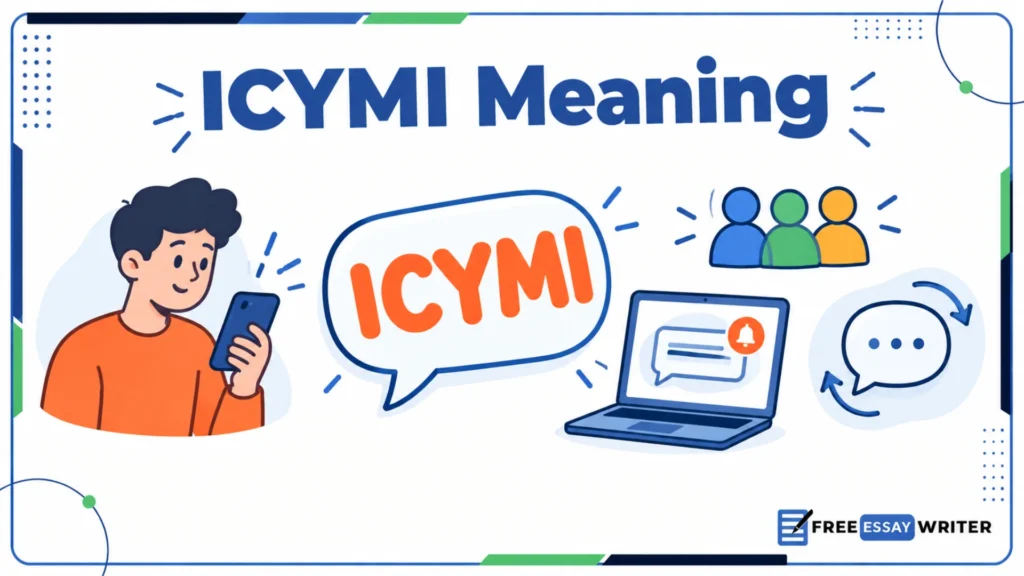
A post opens with “ICYMI” and a link, and the first word needs a quick decode. The ICYMI meaning is simple: the abbreviation stands for “in case you missed it.” Writers use it to point readers toward earlier content that deserves a second look.
This guide explains the definition, the sentence patterns, the platforms, and the common mistakes. Readers who like short abbreviations can also read the TLDR meaning guide.
ICYMI means “in case you missed it” and introduces content that readers may have overlooked. Writers place it before a link, a recap, or a repost, usually on social media and in newsletters. The abbreviation stays informal, so spell it out in formal documents and academic papers.
The table below summarizes the core facts about ICYMI in one place.
| Item | Detail |
|---|---|
| Abbreviation | ICYMI |
| Full phrase | In case you missed it |
| Part of speech | Abbreviation used as an introductory phrase |
| Main purpose | Flag content readers may have overlooked |
| Common settings | Social posts, newsletters, email, work chat |
| Tone | Informal to semi-formal |
| Usual position | Start of a post or message |
| Typical follow-up | A link, a recap, or a repost |
ICYMI works as a signpost, so it almost always sits before the content it flags.
ICYMI stands for “in case you missed it,” and each letter marks one word of that phrase. Merriam-Webster lists ICYMI as an abbreviation and shows it introducing photos, news stories, and earlier series. Dictionary.com gives a matching definition and says the term comes from digital communications.
Both entries agree on the core purpose: the abbreviation points readers toward earlier information. Dictionary.com sample sentences link to past articles, posts, or podcast episodes that remain relevant.
| Letter | Word |
|---|---|
| I | In |
| C | Case |
| Y | You |
| M | Missed |
| I | It |
The letters follow the phrase in order, so spelling it out takes five words.
The Dictionary.com page reviewed for this guide gives no pronunciation for ICYMI. Spoken use is less common than written use, and speakers likely read the letters one by one. That pattern matches FYI, though no reviewed source confirms a single standard.
Dictionary.com traces ICYMI to digital communications, and Merriam-Webster lists no first known use date. No reviewed source names an inventor, a platform, or a year for the first appearance. Treat any precise origin story as unverified unless a dated primary example backs it.
Short abbreviations suit fast, typed communication, where each character counts and readers scan quickly. That context explains why a phrase like “in case you missed it” shrank into five letters. The explanation is plausible, but it remains an inference, not a documented history.
In simple words, ICYMI is a signpost that tells readers where to find content they might have missed.
Feeds and inboxes move faster than most readers can follow, so useful content gets buried. A reader who opens an app after two days faces a long backlog. Writers cannot expect every follower to scroll back through the full backlog of posts.
ICYMI solves that problem with a short label that signals a second chance. The label also respects readers who saw the original, because it admits the repeat openly. Honest repetition usually builds more trust than silent duplicates, which can annoy loyal followers.
Strong ICYMI posts share these key characteristics, which readers recognize within seconds of scanning:
Short posts work best, because ICYMI already tells readers the content is a repeat. Aim for one or two sentences, a link, and an optional image or emoji. Long explanations defeat the purpose of the label, since the original already holds the details.
A newsletter block can list five or six items, each with a single line of description.
The abbreviation fits three common spots, and each spot changes the rhythm of the message.
Many posts open with ICYMI, followed by a comma or a colon and the pointer.
ICYMI: our new guide to citation styles is live.
ICYMI, the webinar recording is now available.
Dictionary.com’s own example uses a comma, and Merriam-Webster shows a colon version. Both punctuation marks work, so choose one and keep it consistent across a feed.
Writers sometimes insert ICYMI after a short setup, which turns it into a parenthetical aside.
Last week's report, ICYMI, covers the new filing rules.Commas on both sides keep the aside clean and easy to read.
Some writers add ICYMI after a link or a repost as a light reminder to readers. The start position still reads clearest, because readers see the purpose before the content.
Writers type ICYMI in capital letters, because the abbreviation stands for five words. Social posts sometimes use the hashtag #ICYMI, which makes a post easier to find. Periods inside the abbreviation, as in I.C.Y.M.I., appear in no reviewed dictionary entry.
ICYMI appears wherever readers face a stream of content and may skip an item.
Brands and creators use ICYMI to resurface older posts, videos, and announcements. Feeds move fast, so an earlier post can slip out of view before many followers see it. ICYMI gives that older post a second chance to reach followers who scrolled past.
Newsletters often close with an ICYMI block that lists recent stories or episodes. Email subject lines sometimes use ICYMI to signal a resend of an earlier message. Readers can skim an ICYMI block quickly and open only the items that interest them. Editors sometimes place the block near the bottom, after the main story. Others place it at the top for returning subscribers who skipped the last issue. Either spot works, provided the block stays short and carries a clearly written label.
Team channels use ICYMI to resurface decisions, documents, and meeting notes after busy days. The abbreviation saves time, but a clear sentence still helps new teammates who do not know it.
Merriam-Webster’s examples show writers using ICYMI for photo sets, returning stories, and earlier series. That pattern confirms the core job of the abbreviation: a pointer toward earlier material.
Friends use ICYMI to share a meme, a clip, or a news link from earlier. The tone stays casual in these chats, and a joke often follows the pointer.
Social posts sometimes add #ICYMI to a caption or place it at the start. The hashtag version works as a label and as a search tag at once. Captions should still include a plain sentence, because a hashtag alone gives no context.
#ICYMI Our guide to note-taking methods is worth another look.Place the hashtag at the start or end of the caption and keep the rest readable.
Email subject lines have limited space, so ICYMI should lead and the topic should follow. A clear topic after the label tells recipients what the resend contains.
ICYMI: Our study-skills guide, updated for fall
ICYMI: Three writing tools students loved this month
Avoid vague subject lines such as “ICYMI: News inside,” because they hide the real topic. Test two versions and keep the one that earns the most opens.
Education sites resurface study guides before exam season, which gives old content a timely hook. Retail brands resurface sale announcements, though they must confirm that the offer still runs. Nonprofits resurface donation stories near giving campaigns, when the original post matches the new goal.
Podcast teams resurface earlier episodes after a guest returns or a topic trends again. Each case ties the reminder to a timely reason, which strengthens the pointer.
Several chat abbreviations look similar, but each one does a different job. Other short forms, such as WYF, compress a question into three letters.
| Abbreviation | Full phrase | Main job |
|---|---|---|
| ICYMI | In case you missed it | Resurface earlier content |
| FYI | For your information | Share a useful fact |
| TLDR | Too long; didn’t read | Summarize a long text |
| IIRC | If I recall correctly | Flag an uncertain memory |
| PSA | Public service announcement | Warn or inform the public |
| TBT | Throwback Thursday | Share an old photo or memory |
ICYMI stands out because it points to existing material that readers may have missed.
FYI shares information for the first time, while ICYMI repeats information that already appeared. An FYI email passes along a new fact, and an ICYMI email resends an old one.
TLDR summarizes a long text, while ICYMI points to content without summarizing it. Writers can pair them, so an ICYMI post may end with a TLDR for busy readers.
The spelled-out phrase suits formal writing, speeches, and printed material where abbreviations may confuse readers. The abbreviation suits feeds, chats, and subject lines where space and speed matter.
Writers also use plain labels such as “Reminder,” “Repost,” or “Still relevant” instead of ICYMI. These labels carry the same job without requiring any knowledge of chat abbreviations. ICYMI remains shorter, and regular social media users likely recognize its purpose already.
| Label | Best for | Trade-off |
|---|---|---|
| ICYMI | Social feeds, newsletters | Needs abbreviation knowledge |
| Reminder | Events, deadlines | Longer, less casual |
| Repost | Reshared content | Gives no reason to revisit |
| Still relevant | Evergreen guides | Longer, needs context |
| Throwback | Nostalgic content | Suits memories, not reminders |
The best label depends on audience familiarity and on the reason for the resurfacing.
ICYMI sits in the informal-to-semi-formal range, depending on the audience and channel. Marketing teams and brand accounts use it in public posts, which suggests acceptance in business settings. Formal reports, legal letters, and academic papers still call for the full phrase. Register depends on the audience more than on the abbreviation itself, so test posts with real readers.
| Setting | ICYMI fit | Recommendation |
|---|---|---|
| Social media post | Strong | Use ICYMI |
| Team chat | Good | Use ICYMI, add context for new members |
| Marketing email | Fair | Use ICYMI in subject lines sparingly |
| Newsletter block | Good | Use ICYMI as a block label |
| Formal report | Poor | Spell out the phrase or reword |
| Academic essay | Poor | Reword the sentence entirely |
Audience knowledge, channel norms, and tone decide whether the abbreviation fits a given message.
English abbreviations travel across borders online, but not every reader knows each one. Non-native speakers may read ICYMI as a random string of letters without a spelled-out version. Writers with international audiences should spell out the phrase once in the first post.
Plain wording such as “in case you missed it” costs four extra words and removes doubt.
Formal writers have several polished replacements for the abbreviation, and each keeps the same purpose.
As a reminder, the full report is available online.
For readers who missed it, the earlier article is linked below.
Previously published: the three-part series on study habits.
These openers sound professional and work in reports, letters, and press materials.
Use ICYMI only when the content already appeared and some readers likely skipped it. Do not use ICYMI for a brand-new announcement, because nobody has missed it yet.
Open the message with ICYMI, add a colon or comma, and name the content. A short label after the abbreviation helps, such as “ICYMI: the full webinar replay.”
State what the content covers, because readers decide in seconds whether to click. A bare link after ICYMI gives readers no reason to open it. One sentence of value works better, such as a result, a deadline, or a lesson.
Casual feeds welcome emojis and jokes, while workplace channels need plain, direct wording. Keep the abbreviation, but adjust the rest of the sentence to the audience.
Wait until the original post has had time to circulate before resurfacing it. A reminder posted an hour later can look pushy, while one sent days later looks useful.
The examples below show how the same abbreviation adjusts to different settings.
ICYMI: our citation cheat sheet is back in the spotlight. Save it before finals week.This post resurfaces a useful resource and adds a reason to act.
ICYMI this week:
- The new study-skills guide
- Episode 12 of the writing podcast
The newsletter block lists each item separately and lets readers pick what matters.
ICYMI, the Q3 planning notes are pinned in the channel. Please review by Friday.The message names the document, its location, and a clear deadline for the team.
ICYMI, the school closed early today. Check the district page.Short chats allow shorter context, since friends already share most of the background knowledge.
Consider a small education site that publishes a study guide on Monday. The first post earns modest attention, because most followers miss it during a busy morning. On Thursday, the editor reposts the guide with an ICYMI label and a one-line promise.
The label tells loyal followers the content is old, while the promise explains why it matters. New followers see a recommendation, and earlier readers see a gentle reminder instead of a duplicate. This hypothetical case shows the main logic of ICYMI: it respects readers’ time while recovering missed reach.
Apply these tips to keep every ICYMI post useful, clear, and respectful toward readers:
Writers and teams gain several benefits when they use ICYMI with care:
A content calendar helps writers schedule reminders in advance instead of improvising them. Teams can tag evergreen posts and revisit them every four to six weeks. Each revisit needs a new angle, such as a fresh statistic, a student question, or a seasonal hook.
That variety keeps ICYMI posts from reading like copies of the original.
Writers can compare clicks, shares, and replies between the original post and the reminder. A rise in clicks suggests that new readers found the content through the reminder. A low unfollow rate suggests the repeat did not bother existing readers.
Track the numbers over four weeks, because one reminder rarely proves a trend.
Skip ICYMI when the content is sensitive, urgent, or tied to a recent loss or crisis. A casual abbreviation can sound careless when placed beside serious news or sensitive topics. Skip it also when the original post already reached most followers, since a reminder adds little.
Avoid ICYMI for content that readers cannot access, such as expired offers or removed pages. A dead link after ICYMI wastes reader attention and weakens trust in the sender.
ICYMI implies earlier exposure, so brand-new announcements need a different opener such as “New.” Readers who see ICYMI on a first post may doubt the writer’s accuracy.
A link with only ICYMI in front of it explains nothing about the content. Add a clear description so readers know what they will find after clicking.
Frequent ICYMI posts can train followers to ignore the label and skip reposts entirely. Reserve it for content with lasting value and a clear reason to return. Do not resurface the same item twice in one week without adding a new angle.
Contracts, reports, and academic papers expect full sentences and standard wording instead of chat shorthand. Write the full phrase “in case you missed it” or reword the sentence entirely. Do not place the abbreviation in legal or academic text, even in a casual aside.
FYI shares new information, and ICYMI resurfaces old information, so swapping them confuses readers. Check whether the content already circulated among readers before choosing either label.
Typos such as ICYMY or ICYIM can slip into fast posts and look careless to readers. Proofread the five letters against the full phrase before publishing the post.
Older readers, international readers, and newcomers may not recognize the abbreviation at first glance. Spell it out once in the first post when the audience is mixed or unfamiliar.
These short questions test whether the main rules of ICYMI are clear.
The letters stand for in, case, you, missed, and it, forming the phrase in case you missed it.
No, because the abbreviation assumes readers already had a chance to see the content.
A message that shares a new fact needs FYI, because nothing has appeared earlier.
ICYMI usually sits at the start, followed by a comma or colon and the pointer.
Writers should spell it out in formal documents, mixed audiences, and printed materials.
Academic essays follow formal conventions, so ICYMI has no place in the main text. Instructors expect complete phrases, and abbreviations like ICYMI can look careless in graded work. Quote the abbreviation only when the essay studies internet language, and cite the platform.
Writers who want help polishing informal drafts into formal prose can use the tools at Free Essay Writer.
Run through this checklist before publishing any message that starts with ICYMI:
These dictionary entries document the definition of ICYMI and anchor the claims in this guide:
The Free Essay Writer homepage offers free writing tools for students who want cleaner drafts. Practice by rewriting three old posts with ICYMI labels, then compare clicks over two weeks.
ICYMI means “in case you missed it” and flags earlier content for readers. Merriam-Webster and Dictionary.com both define the ICYMI meaning in this same way.
ICYMI stands for “in case you missed it,” with one letter for each word. The abbreviation introduces a link, a recap, or a repost of earlier content.
ICYMI belongs to informal and semi-formal writing, such as posts, chats, and newsletters. Formal documents should spell out “in case you missed it” or avoid the phrase.
ICYMI usually opens the message, followed by a comma or a colon. Writers sometimes place it mid-sentence or after a link, but the opening spot reads clearest.
No, FYI shares new information, while ICYMI points back to information that already appeared. Choosing the wrong label confuses readers about whether the content is new.
Writers capitalize ICYMI because it abbreviates a five-word phrase, and dictionary entries show it in capitals. Lowercase versions appear in casual chats, but formal posts should keep capitals.
Yes, some writers add ICYMI after a link as a reminder that the content is older. The opening position still gives readers the clearest signal about the purpose.
No reviewed source names an inventor or a first-use date for ICYMI. Dictionary.com says the term comes from digital communications, which is the extent of verified origin.
Readers can respond as they would to any post: like, comment, or click the link. A short thanks works well when the reminder helped, since the post offers value.
Yes, business emails use ICYMI in subject lines and openers when the audience knows the abbreviation. Spell out the phrase for clients, executives, or international contacts who may not recognize it.
Both punctuation marks appear in dictionary examples for ICYMI, so either one works. Pick one style and keep the ICYMI formatting consistent across every post.
The hashtag version carries the same meaning and adds a searchable tag. Posts still need a plain sentence, because ICYMI alone explains nothing about the content.
Yes, Dictionary.com’s sample sentences include podcast episodes, and writers also use ICYMI for videos. Add the title and a one-line reason for readers to listen or watch.
The ICYMI meaning stays simple while the abbreviation appears across feeds, newsletters, and chats. It stands for “in case you missed it,” and it works as a signpost to earlier content. Good use depends on context, a clear pointer, and respect for the reader’s time. Writers who match tone to the channel and spell out the phrase when needed avoid most errors.
Explore more texting slang guides on Free Essay Writer.

Written by
Moeed is the Content Head at Free Essay Writer and has more than 5 years of experience in SEO and content writing. He writes clear, practical guides on essay writing, grammar and word meanings to help students write with confidence.
More from this authorOctober 12, 2026 · Moeed
Someone sends a lone message reading “wyf” and the reply box stays empty. The WYF meaning depends on the sender,…
Moeed
Read more
October 9, 2026 · Moeed
Many people notice the same digits on a receipt, a license plate, or a clock face. A repeating pattern such…
Moeed
Read more
October 8, 2026 · Moeed
Many people notice the same digits on clocks, receipts, and license plates. A repeating pattern such as 222 often makes…
Moeed
Read more
Generate a full essay free, then polish it with the built-in toolkit.
Start writing free