October 12, 2026 · Moeed
ICYMI Meaning: What It Stands For, Examples, and How to Use It
A post opens with “ICYMI” and a link, and the first word needs a quick decode. The ICYMI meaning is…
 Moeed
Read more
Moeed
Read more

Moeed
Moeed is the Content Head…
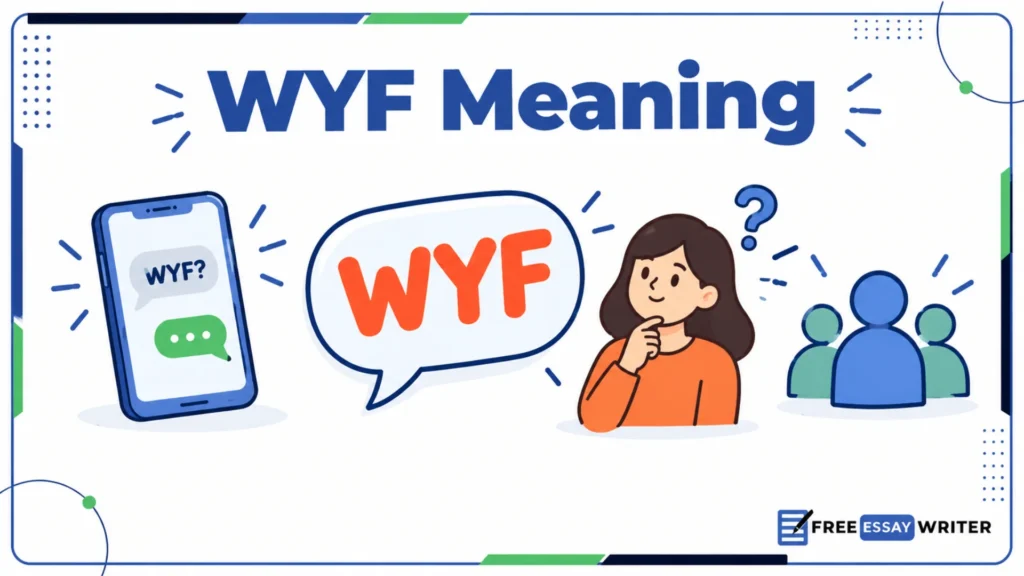
Someone sends a lone message reading “wyf” and the reply box stays empty. The WYF meaning depends on the sender, the app, and the conversation around it. Most online glossaries read it as “where you from,” but no official source settles it.
This guide separates what readers can verify from what blogs merely repeat. Similar abbreviation guides, such as SOS meaning and TLDR meaning, follow the same evidence-first method.
WYF most often means “where you from” in text slang, though no official source confirms it. Other blogs report “what’s your favorite” and “what you feeling” as alternate readings. Context, platform, and tone decide which reading fits, so ask the sender when the message stays unclear.
The table below lists the readings that recur across online slang explainers.
| Reading | Reported frequency | Typical setting |
|---|---|---|
| Where you from | Most common | Introductions, new chats |
| What’s your favorite | Common on social media | Polls, captions, comments |
| What you feeling | Reported less often | Friend check-ins |
| Who you with | Rare, single source | Flirty or slang-heavy chats |
The first reading appears in most glossaries, while the others vary by site.
Slang abbreviations rarely carry official definitions, and WYF follows that pattern closely. No standards body, regulator, or major dictionary publishes a fixed definition that this guide could verify. Instead, the meaning comes from repeated use among texters, and blogs later record those habits.
Search results reflect this gap, because similar pages repeat each other with small changes. Eight reviewed pages split clearly: seven favor “where you from,” and one favors “what you feeling.” The portions reviewed cited no dictionary entry, user survey, or dated first use. A majority of blogs is not proof, but it does signal the likeliest reading.
Readers can test any claim about slang with a simple three-step method. First, search the phrase and note which pages cite dates or first-hand examples. Second, compare those pages for agreement and for obvious copying between them. Third, test the likeliest reading against real chats before trusting it fully.
In simple words, WYF has no official meaning, only a likely one that context confirms.
Most slang guides read WYF as “where you from,” a short question about origin. Senders usually mean a hometown, a city, a country, or a neighborhood. The phrase fits a common opener on social apps, where strangers lack shared context. Some guides add that the question appears early in a new chat on Snapchat, Instagram, or dating apps.
Spoken English already uses “where you from” without the helping verb, especially in casual speech. Texters then compress the three words into three letters, the same way WYD compresses “what you doing.” That pattern makes the reading plausible, but no source proves where the abbreviation started.
Sender: hey, wyf?
Reply:  Austin, Texas. wyf?
A typical reply names a city or country and often returns the question to the sender.
Four of the eight pages reviewed report WYF as “what’s your favorite,” often attached to a category. Examples pair it with a noun, such as a movie, a song, or a restaurant. The pattern appears in sample phrases like “wyf movie” and “wyf song right now.”
One explainer treats “what you feeling” as the main reading, a casual mood check. Another page lists the same phrase among four meanings, which shows how much sources disagree. Friends who text each other daily may use it as a quick check on mood.
Only one page reported a profane variant that asks who someone is with. That claim rests on a single source, so treat it as unconfirmed. Separately, one page lists “wyfu” as a campus variant, and no other reviewed page repeats it. A different abbreviation, MYF, appears in some lists as “my fault,” so avoid mixing the two.
WYD means “what you doing,” and WYF shares two of its three letters. Readers confuse the two because D and F sit side by side on a QWERTY keyboard. That adjacency means a typo could turn WYD into WYF, so ask before assuming.
| Abbreviation | Full phrase | What it asks |
|---|---|---|
| WYD | What you doing | Current activity |
| WYF | Where you from | Origin or location |
| WYF | What’s your favorite | A preference |
| WYF | What you feeling | Current mood |
Activity questions use WYD, so a sudden WYF in a chat about plans may be a typo.
Platform, timing, and the previous message usually point toward the intended reading of a short text. The table below links common signals to the likeliest reading of the message.
| Signal | Likely reading | What to check |
|---|---|---|
| First message from a stranger | Where you from | Profile bio, mutual contacts |
| Reply to a story or poll | What’s your favorite | The prompt on the story |
| Message during weekend planning | WYD typo or mood check | Earlier messages |
| Late chat with a close friend | What you feeling | Recent events in the chat |
| Group chat after a photo | Origin or favorite | The photo caption |
No signal is certain, so a short clarifying reply beats a confident guess. The decision path below shows the order of checks that most chats need:
wyf -> check platform -> check earlier messages -> pick likeliest reading -> reply or askSnapchat chats move fast, so a bare “wyf” often arrives as a quick opener. Reported examples show group chats using it with a laughing emoji as a friendly check-in. That tone points toward a mood check instead of a location question.
Instagram mixes private messages with public stories and comments, so context splits quickly. A story poll likely asks for a favorite, while a direct message likely asks about origin. Reports suggest direct messages favor the origin reading while public posts favor the favorite reading.
WhatsApp chats sometimes connect people through a phone number with no shared social history. In that setting, an origin question makes sense as an opening line. Reply with a country or region, and keep numbers and addresses private.
TikTok comments invite short prompts, so creators may use WYF for audience favorites. Treat any viral prompt as a poll, and answer with a single pick. Tone also matters, since a flat “wyf” and a “wyf?? 😂” can carry different intent.
Text abbreviations usually grow from typing speed, repeated habit, and shared jokes among friends. Short forms like WYD, IDK, and TBH set a pattern that new abbreviations copy. Once that pattern exists, people coin new three-letter forms for any short question.
The same habit explains why one abbreviation collects several meanings across different friend groups. Each community fills the letters with words that fit its own questions. Where, what, and who all start with W, so WYF can accept several fillers. Short letter strings with no official owner stay open to reinterpretation by every community.
Some pages answer separate questions about WYF from a girl and WYF from a boy. The pages that answer both questions mostly say context matters more than gender. Linguistic logic agrees, because the abbreviation carries no gender marker in any reading. Judge the message by the platform, the conversation, and the relationship, not by the sender’s gender.
WYF itself carries no fixed tone, so intent depends on the sender and the platform. One reviewed page calls it casual slang and adds that tone can change how it lands. A stranger asking WYF on a dating app may want to learn a person’s location. That makes the question a privacy decision before it becomes a language question.
Do not share a home address, school name, workplace, or live location with a stranger. A broad answer, such as a country or a region, answers the question without exposing private details.
Scan the last few messages and the platform before choosing a reply. Check whether the sender asked a question earlier, posted a story, or shared a photo. Those clues often settle the reading without any need for a clarifying question.
For the origin reading, name a city or country and return the question. For the favorite reading, name one pick and add a short reason. For the mood reading, describe the day in two or three honest words. A reply to a stranger should stay short and friendly, with no exact place. A reply to a close friend can add detail, since trust already exists. Poll replies work best as a single pick, which keeps the thread easy to read.
wyf?        -> Austin, Texas. wyf?
wyf movie?  -> Inception, every time.
wyf? -> Tired but fine. wyf?A direct clarifying question costs one extra message and avoids a mismatched answer later. Try “wyf as in where you from?” to confirm the reading politely. Friends will answer fast, and strangers reveal intent through the way they respond.
Share only what the platform and the sender’s behavior justify, and stop when pressure appears.
Formal writing rarely accepts text abbreviations, and WYF has no place in academic essays. Readers may read WYF as a typo, and instructors may mark the line as informal. Quote slang only when the essay analyzes language, and cite the platform where it appeared. A cited example needs a date, a platform, and a clear note about the context.
Writers who need help polishing informal drafts can try the tools at Free Essay Writer.
A single blog can sound confident while repeating another blog’s unverified guess. Compare multiple pages, and look for dated, primary evidence before trusting any definition. Do not copy a definition from a page that cites no evidence.
Seven of eight reviewed pages favor that reading, but a minority reading still exists. A mood check answered with a hometown can derail a friendly chat.
WYD asks about activity, and MYF appears in some lists as “my fault.” Check the letters twice before replying, since one wrong letter changes the question.
Eager replies to a stranger sometimes include a street, a school, or a workplace. A city or country satisfies the question and protects privacy in most chats.
Abbreviations like WYF belong in casual chats and fit poorly in emails or essays. Spell out the full phrase in any school, work, or professional message. Do not put WYF in a graded essay unless the essay studies slang.
Run through this checklist before trusting any claim about a slang abbreviation such as WYF:
Researchers can stop searching when the question has a practical answer, even without an official definition. For WYF, the practical answer is to read context, pick the likeliest meaning, and ask. Hunting for a hidden official definition wastes time, because slang meanings follow usage, not rulebooks. New readings can still appear, so a one-message check always works better than certainty.
These guides on Free Essay Writer cover other abbreviations and writing questions:
WYF usually means “where you from” in text slang, according to most online explainers. The WYF meaning varies, since other pages also report “what’s your favorite” and “what you feeling.” Context and platform decide which reading fits a specific message in a given chat.
No official source that this guide found defines WYF, so every meaning comes from informal usage. Slang meanings follow how people actually text, not a rulebook or a registry.
Yes, in most explainers, WYF means “where you from” and asks about origin or location. Seven of the eight pages reviewed for this guide support that reading.
Yes, four of the eight reviewed pages list “what’s your favorite” as a WYF meaning. That reading appears mostly in captions, polls, and comments on social platforms.
No, WYD means “what you doing,” while WYF usually asks about origin or preference. D and F sit next to each other on keyboards, so typos can blur the two.
WYF carries no built-in flirtation, because the abbreviation only asks a short question. Tone, emojis, and the sender’s earlier messages decide whether the intent reads as friendly or flirty.
Match the reply to the likely reading of WYF: a place, a favorite, or a mood. Ask a short clarifying question when the message gives no useful context.
Answering WYF is safe when the reply stays broad, such as a country or region. Avoid sharing addresses, schools, workplaces, or live locations with any unknown sender.
One page claims WYF can appear as a project code in technical fields, but names no example. Treat that claim as unverified, and rely on the text slang meaning in chats.
Sources disagree about WYF because no authority defines it and each community fills the letters differently. Several pages also copy each other, which spreads one guess across the web.
Readers can browse abbreviation guides such as SOS meaning and TLDR meaning on Free Essay Writer. Each guide explains one abbreviation, its common readings, and how context changes the answer.
WYF has no official definition, but the evidence points to one likely reading. The most reported WYF meaning is “where you from,” followed by “what’s your favorite.” Readers who read context, check for typos, and ask when unsure will rarely misread it. Safe replies share a region instead of a precise address, and they keep private details private.
Explore more texting slang guides on Free Essay Writer.

Written by
Moeed is the Content Head at Free Essay Writer and has more than 5 years of experience in SEO and content writing. He writes clear, practical guides on essay writing, grammar and word meanings to help students write with confidence.
More from this authorOctober 12, 2026 · Moeed
A post opens with “ICYMI” and a link, and the first word needs a quick decode. The ICYMI meaning is…
Moeed
Read more
October 9, 2026 · Moeed
Many people notice the same digits on a receipt, a license plate, or a clock face. A repeating pattern such…
Moeed
Read more
October 8, 2026 · Moeed
Many people notice the same digits on clocks, receipts, and license plates. A repeating pattern such as 222 often makes…
Moeed
Read more
Generate a full essay free, then polish it with the built-in toolkit.
Start writing free