October 9, 2026 · Moeed
333 Angel Number Meaning: Career, Twin Flames & Signs
Many people notice the same digits on a receipt, a license plate, or a clock face. A repeating pattern such…
 Moeed
Read more
Moeed
Read more

Moeed
Moeed is the Content Head…
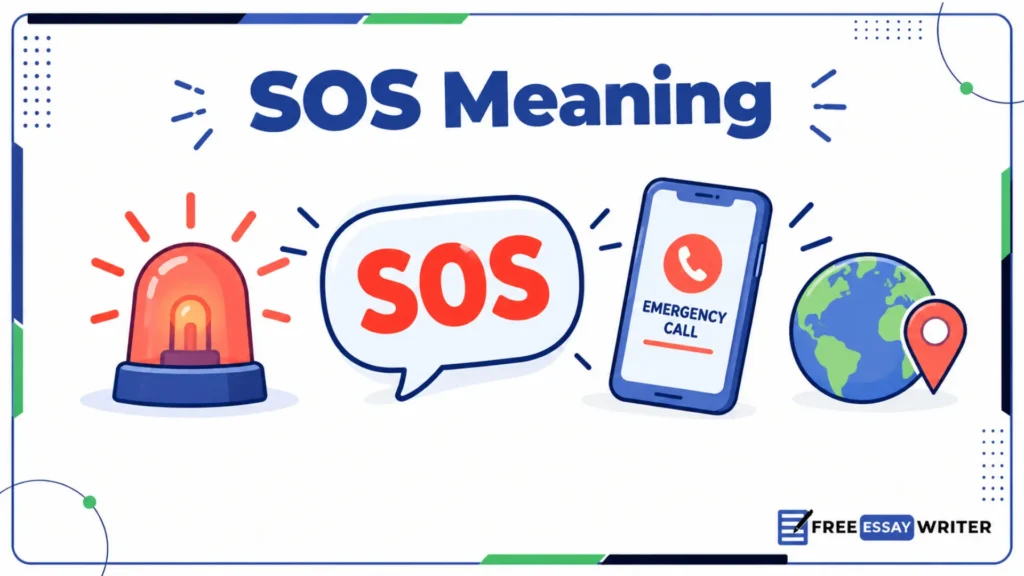
A friend texts “SOS” at midnight, and a reader wonders whether the message signals real danger. Phone screens, old movies, and pop songs all use the same three letters, so confusion is common. This guide explains the SOS meaning in plain language and covers each major use.
Shorthand like this appears in chats every day, much like the abbreviation that the TLDR meaning guide explains. SOS differs because it began as a life-saving radio signal before it became slang. The sections below cover its origin, its Morse code form, texting use, and phone features.
SOS is an international Morse code distress signal that means a person, ship, or aircraft needs urgent help. The signal consists of three dots, three dashes, and three dots sent as one unbroken sequence. The letters do not officially stand for any words, although people often say “Save Our Souls” informally.
| Item | Detail |
|---|---|
| Term | SOS |
| Type | Distress signal |
| Morse form | ··· −−− ··· |
| Official standard | 1906 Berlin Radiotelegraph Convention, in force from 1908 |
| Official expansion | None |
| Popular informal expansions | Save Our Souls, Save Our Ship |
| Spoken equivalent | Mayday |
| Modern phone feature | Emergency SOS |
The table shows that SOS works as a pattern, not as an abbreviation.
The official radio rules never assign any words to the letters SOS. Regulators chose the pattern because operators could send it fast and recognize it without error. Because S is three dots and O is three dashes, the three letters produce the signal.
Later speakers invented phrases to explain the letters, a habit called a backronym. The two best-known versions are “Save Our Souls” and “Save Our Ship”, which sound natural to modern ears. Both phrases came after the signal, so most historians treat them as folk explanations.
A backronym is a phrase that people invent after a word exists to explain its letters. The same happened with CQD, which popular stories expand as “Come Quick, Danger”. Careful writers label such expansions as popular, never official.
An acronym forms a pronounceable word from initial letters, such as NASA. An initialism reads each letter aloud, such as FBI or BBC, without forming a new word. SOS fits neither label strictly because the letters never began as initials. Radio references often call it a prosign, a Morse sequence that operators send as one unit.
Wireless telegraphy spread across ships in the early 1900s, and operators lacked one shared distress call. Meanwhile, the Marconi company used CQD, which added the letter D for distress to a general call. Confusion followed because ships from different companies and nations often used different codes and rules.
German radio regulations introduced the signal for German ships in 1905, according to most histories. Delegates at the 1906 Berlin Radiotelegraph Convention made it the international standard for distress calls. The rule took effect on July 1, 1908, and ship operators began using it worldwide.
The International Telecommunication Union, which maintains these radio rules, still publishes the modern regulations.
The RMS Titanic sent both CQD and SOS in April 1912 after striking an iceberg. Wireless operators used the older call first and the newer signal soon afterward. The disaster made SOS famous, and newspapers repeated the three letters worldwide.
Ships carried Morse equipment for decades before a new system replaced it in 1999. The Global Maritime Distress and Safety System now sends automated digital alerts that include a ship’s position. The old signal survives as a symbol, a light pattern, and a label on modern phones.
| Year | Event |
|---|---|
| 1904 | Marconi company introduces CQD |
| 1905 | German regulations introduce the SOS pattern |
| 1906 | Berlin convention names SOS the international signal |
| 1908 | SOS rule takes effect |
| 1912 | Titanic sends CQD and SOS |
| 1923 | Mayday proposed for voice radio |
| 1975 | ABBA releases a song titled “SOS” |
| 1999 | Digital maritime system replaces Morse requirement |
| 2022 | iPhone 14 adds Emergency SOS via satellite |
Each date shows how a radio pattern grew into everyday language.
Morse code builds each letter from a fixed pattern of short and long signals. The letter S uses three short signals, and the letter O uses three long signals. Sending S, O, and S without pauses produces one continuous distress pattern.
S   = · · ·
O   = − − −
S   = · · ·
SOS = · · · − − − · · ·
Operators send the pattern as one unit, so the gaps between the letters disappear.
SOS works as a pattern first, and the three letters only describe that pattern.
Regulators wanted a pattern that operators could send quickly and recognize through static. The three-three-three rhythm differs sharply from ordinary text, so listeners notice it instantly. Both letters are simple to send accurately, even for a tired operator in poor conditions. Historians usually credit that simplicity, not any hidden meaning, for the pattern’s success.
The pattern works on any medium that can produce short and long signals. Sailors flash it with a lamp, and hikers sound it on a whistle. Rescue teams also recognize large letters stamped into sand or snow as a call for help.
| Medium | Pattern | Common setting |
|---|---|---|
| Lamp or torch | 3 short, 3 long, 3 short flashes | Ships, boats, night rescue |
| Whistle | 3 short, 3 long, 3 short blasts | Hiking, water sports |
| Radio telegraph | Dots and dashes | Historic ships |
| Ground marking | Letters SOS in large lines | Beaches, snow, open fields |
Each row uses the same rhythm, so rescuers can recognize it in any form.
Do not rely on a whistle pattern alone when a phone call to emergency services is possible.\
Several distress calls exist, and each fits a different medium, era, or level of urgency. The table below compares the four calls that readers confuse most often.
| Call | Medium | Meaning | Era |
|---|---|---|---|
| SOS | Morse, light, text | General distress | 1905 onward |
| Mayday | Voice radio | Life-threatening emergency | 1920s onward |
| Pan-Pan | Voice radio | Urgent, not life-threatening | Modern |
| CQD | Morse | Early distress call | 1904 onward |
Mayday is the voice version of SOS, while Pan-Pan signals a lower level of danger.
Mayday is the spoken distress call for voice radio. According to most accounts, Frederick Stanley Mockford, a radio officer at Croydon Airport, proposed the word in 1923. He wanted a call that English and French speakers could both understand over voice radio. The word echoes the French phrase “m’aider”, which means “help me”, and rescuers repeat it three times.
Pan-Pan comes from the French word “panne”, which means a breakdown, and crews repeat it three times. Crews use it for urgent problems that do not threaten life right away, such as an engine failure.
People use SOS in messages as a playful or serious call for help. Context decides which meaning applies, so readers should check the sender, the time, and the tone.
Friends often send SOS during small crises, such as a failed recipe or a late bus. The message works like a dramatic wave across a crowded room, and replies match that mood.
Sender: SOS, my laptop died ten minutes before the essay deadline.
Reply: Send me the file name. I will check the cloud backup with you.A plain message that says “SOS” with no joke, no emoji, and no context deserves a fast reply. Call the person, or ask a direct question such as “Are you safe right now?” Contact emergency services at once if the reply suggests danger, injury, or self-harm.
| Sign | Likely meaning | Suggested response |
|---|---|---|
| Laughing emoji, small problem | Joke or mild stress | Reply with humor or advice |
| No context, late night, silence after | Possible real need | Call and ask directly |
| Location or injury details | Emergency | Contact emergency services |
| Group chat, homework | Request for help | Offer a specific task |
The tone, the timing, and the detail separate casual use from real alarm in most chats.
Treat any SOS with no joke and no context as real until the sender confirms otherwise.
SOS carries several meanings outside distress calls, and the context usually reveals which one applies.
| Field | Meaning | Example |
|---|---|---|
| US politics | Secretary of State | State election offices |
| Medicine | Si opus sit, Latin for “if necessary” | Prescription notes |
| Food orders | Sauce on side | Restaurant tickets |
| Currency | ISO code for the Somali shilling | Exchange tables |
| Charity | SOS Children’s Villages | Child welfare charity |
| Military slang | Nickname for creamed chipped beef on toast | US mess halls |
Check the setting before choosing a meaning, because abbreviations change across fields. Writers should spell out an abbreviation at first use when readers might confuse its meaning.
Modern phones include an Emergency SOS feature that calls local emergency services quickly. The exact steps vary by brand, model, and software version, so check the maker’s guide.
Apple lets owners start Emergency SOS by holding the side button and a volume button. Settings can also allow five quick presses of the side button as a shortcut. The iPhone 14 and later models add satellite messaging for emergencies when no cellular or Wi-Fi signal exists. Availability varies by country, so check Apple’s support pages for current details.
Many Android phones offer an emergency shortcut, often five quick presses of the lock button. Google Pixel phones include Emergency SOS in their safety settings, and newer models add satellite support. Samsung and other makers use different menu names, so owners should open settings and review the emergency shortcut.
Do not complete a test call, and tell the dispatcher about any accidental connection right away.
| Feature | iPhone | Android |
|---|---|---|
| Trigger | Side and volume buttons, or five presses | Often five presses of the lock button |
| Satellite option | iPhone 14 and later | Newer Pixel and some other models |
| Medical information | Medical ID | Emergency information |
Both platforms share location details with responders where local systems support it.
Callers dial 911 in the United States, 999 in the United Kingdom, and 112 across the European Union. The number 112 also works on many mobile networks outside Europe, though local rules vary.
A distress signal asks for rescue, while an alert may report a hazard or a status. Weather warnings, fire alarms, and crash notifications serve as alerts for large groups of people. SOS belongs to the first group because it requests help for a person in trouble.
Modern phones blur the line because Emergency SOS sends a request and a location together. Crash detection on some devices even starts a call automatically after a severe impact. Owners should still confirm the settings, since automatic features differ by model.
Anyone in genuine danger can use the signal, and no license or training is required. Radio operators usually need licenses for transmitters, but a flashlight or whistle needs no permit. Emergency services prefer clear voice details on a phone, so combine signals with a call whenever coverage exists. False use of the signal carries penalties in many countries and wastes limited rescue time.
Ships rely on digital alerts first, and crews keep lamps and flags as backups. Aircraft crews use voice calls and transponder codes, so Morse rarely appears in modern cockpits. Hikers carry whistles, mirrors, and phones, which makes SOS a practical backup signal in remote terrain.
Each group chooses the fastest method that reaches trained responders within the time available. Digital beacons send a position automatically, while a lamp or whistle only reaches people nearby. Mixed methods raise the odds that someone notices the call and sends help quickly.
Look for details that separate a joke from danger before choosing a reply. Check the location, the time, and the sender’s recent messages for clues about the situation. Treat any signal at sea, in the wilderness, or from an unknown device as real.
Call local emergency services whenever the signal suggests physical danger to any person or vessel. Give the dispatcher the location, the number of people, and the type of problem. Stay on the line until the dispatcher ends the call, even if the situation seems calm.
Pass along the exact words, the time, and any coordinates that the sender provided. Rescuers use small details, such as landmarks or signal times, to narrow a search area quickly.
Stay in contact with the person by text or voice, but avoid risky rescue attempts. Reassure the sender, ask short questions, and wait for trained responders to arrive.
Songs, films, and games use SOS because the three letters signal urgency instantly. ABBA released a song titled “SOS” in 1975, and several films use the signal in rescue scenes. Retellings of the Titanic story keep the Morse signal alive for each new generation of viewers.
A hiker twists an ankle on a ridge and loses phone service. She blows three short, three long, and three short whistle blasts every five minutes. A nearby group hears the pattern, marks the spot, and reaches rescue teams from a higher viewpoint.
A student sends “SOS” to a study group at 11 p.m. before an essay deadline. The group replies within minutes and shares a template, a citation format, and a proofreading checklist. The text carried no danger, yet the replies showed the signal working as a social call for help.
A boat crew loses its engine near a rocky coast in fog. The skipper calls Mayday on the marine radio and gives the vessel name and position. The Coast Guard answers, and a patrol boat reaches the crew within the hour.
A teacher plays a recorded Morse sequence and asks the class to count the dots. Students notice the steady rhythm and link it to the phone button on their devices. The lesson ends with a short writing task about clear communication under pressure.
Readers sometimes dismiss the message because friends use it casually every day. A short check-in call costs only seconds, and it can prevent serious harm in rare cases.
Many websites state the phrase as an official definition, which misleads readers about the origin. Radio regulations never defined the letters that way, so careful writers call it a popular backronym.
Mayday belongs to voice radio, while SOS belongs to Morse, light, and written signals. Mixing them up confuses beginners but rarely changes how rescuers respond to a real call.
Many owners never review the emergency shortcut on their phone until a crisis arrives. Review the settings, add medical details, and list emergency contacts this week.
Pocket presses and children’s play often cause accidental calls to busy dispatchers. Choose a deliberate gesture when the phone offers that option, and stay on the line after any mistake.
Formal essays should introduce the abbreviation with a short explanation at first mention. Readers in different fields interpret SOS differently, so clear context prevents avoidable errors.
Myth one claims that SOS always means Save Our Souls in every official document. Regulators never defined the letters that way, so the phrase remains a popular backronym. Myth two claims that the Titanic sent the first SOS call in history. Earlier ships reportedly used the signal in 1909, and the Titanic made it famous.
Myth three claims that SOS only works through a radio or a Morse key. Lamps, whistles, ground letters, and phone buttons all carry the same call for help.
Writers should separate the signal, the spoken call, and the phone feature in every explanation. Each term belongs to a different medium, and mixing them confuses readers. Cite a regulator such as the International Telecommunication Union for historical dates. Label backronyms clearly so readers know the phrase is popular, not official. Avoid dramatic claims about rescues unless a named source confirms the story.
Modern rescue systems still honor the signal even though most alerts travel by digital beacon. Aviation and maritime crews learn SOS and Mayday during basic safety training. Everyday users meet the term on phone screens, so the SOS meaning stays part of daily language. Knowledge of the signal also helps hikers, boaters, and drivers in remote areas.
Children meet SOS on phone screens before they meet it in history lessons. Adults should explain the button, the number, and the rule against false alarms. Practice calls on a toy phone build confidence without tying up dispatchers.
Teachers can connect the topic to history, science, and media literacy in a single class session. A short lesson on Morse code shows how patterns carry meaning across distance. Students can also compare SOS with modern emoji shorthand used in group chats today.
Writers capitalize SOS in every context because the signal is a fixed pattern. Avoid periods between the letters, since S.O.S. appears mostly in older texts. Use the phrase “SOS calls” when a sentence discusses several signals from different senders. Quote the phrase “Save Our Souls” only when describing popular belief about the origin.
Spoken use follows the letters, so speakers say each letter aloud in ordinary conversation. Radio operators avoid the phrase when no emergency exists, because listeners may react at once. Teachers and writers can still use the term freely when they explain its history.
Test one: a reader hears three short whistle blasts, three long blasts, and three short blasts. The sequence matches the SOS meaning and signals a call for help.
Test two: a friend texts “SOS” with a laughing emoji after burning dinner. The context points to a joke, so a playful reply fits the situation well.
Test three: a stranger flashes the pattern from a stalled boat at night. The situation suggests danger, so the observer should call the coast guard or local emergency services.
The SOS meaning is a call for urgent help from a person, a ship, or an aircraft. SOS is a Morse code distress signal made of three dots, three dashes, and three dots.
No official regulation says the SOS meaning includes the words Save Our Souls. The phrase is a popular backronym that people created after the signal became famous. The signal itself works as a Morse pattern and never started as an abbreviation of words.
Germany introduced SOS in 1905, and the 1906 Berlin Radiotelegraph Convention made it international. The rule took effect in 1908, so the SOS meaning became standard for ships worldwide.
In a text, SOS usually means someone needs help, either as a joke or in earnest. The sender’s tone and details show whether the SOS meaning is playful or serious.
SOS is a Morse, light, or written distress signal, while Mayday is the spoken version on voice radio. Both calls report immediate danger, and rescuers treat each as a request for urgent help.
Send three short signals, three long signals, and three short signals without pausing between letters. A flashlight, a whistle, or a tapping sound can carry the SOS meaning to nearby rescuers.
Emergency SOS lets a phone call local emergency services through a button shortcut. On an iPhone, holding the side button with a volume button starts the feature.
Many countries penalize false distress calls because they waste rescue resources and delay real help. Penalties vary by location and situation, so readers should check local law for details.
Yes, SOS also means Secretary of State, si opus sit in medicine, and sauce on side in restaurants. The setting reveals which SOS meaning applies, so writers should define the abbreviation at first use.
The older CQD call remained common in 1912, while SOS was the newer international standard. Operators tried both signals to reach any ship or station that was listening. The disaster helped make the SOS meaning familiar to the public around the world.
Writers who explain abbreviations clearly keep readers engaged and earn lasting trust over time. The same habit improves essays, emails, and online posts for any audience. The tools at Free Essay Writer help students draft, edit, and structure clear explanations in minutes. Readers who want another abbreviation explained can read the TLDR meaning guide next.
The SOS meaning begins with a radio pattern and ends with a button on modern phones. The letters never stood for words in official rules, yet the signal still carries a universal message. Knowing the history, the Morse form, and the modern uses helps readers respond calmly.
Explore more writing and language guides on Free Essay Writer.

Written by
Moeed is the Content Head at Free Essay Writer and has more than 5 years of experience in SEO and content writing. He writes clear, practical guides on essay writing, grammar and word meanings to help students write with confidence.
More from this authorOctober 9, 2026 · Moeed
Many people notice the same digits on a receipt, a license plate, or a clock face. A repeating pattern such…
Moeed
Read more
October 8, 2026 · Moeed
Many people notice the same digits on clocks, receipts, and license plates. A repeating pattern such as 222 often makes…
Moeed
Read more
October 8, 2026 · Moeed
Many people glance at a clock and see 11:11 at the exact moment a thought crosses their mind. The 1111…
Moeed
Read more
Generate a full essay free, then polish it with the built-in toolkit.
Start writing free