October 9, 2026 · Moeed
333 Angel Number Meaning: Career, Twin Flames & Signs
Many people notice the same digits on a receipt, a license plate, or a clock face. A repeating pattern such…
 Moeed
Read more
Moeed
Read more

Moeed
Moeed is the Content Head…
A reader scrolls through a long forum thread and spots three letters near the bottom. Those letters promise a quick shortcut through the dense wall of text above them.
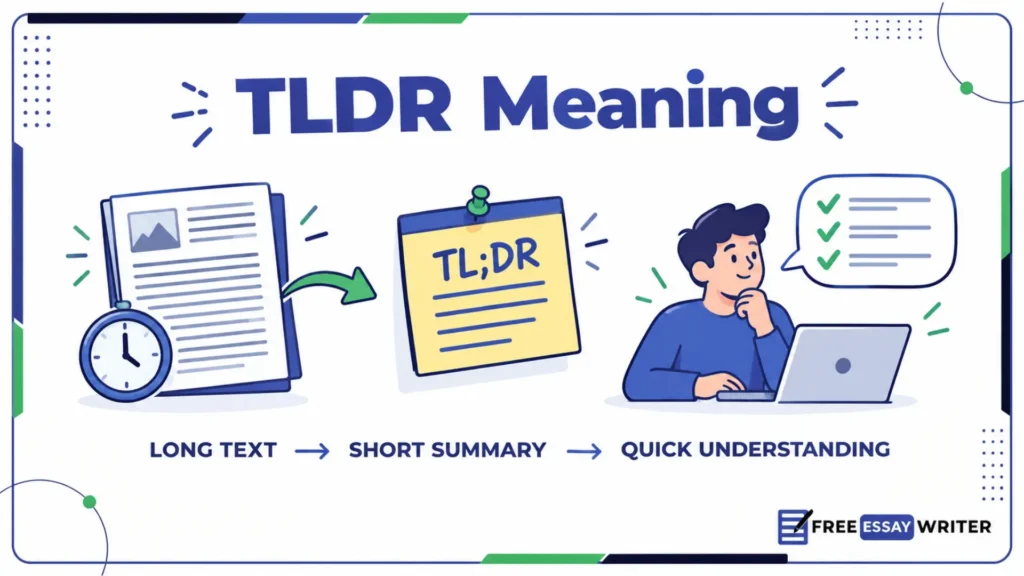
The TLDR meaning is “too long; didn’t read,” and writers use it to flag a summary. Similar internet shorthand, such as the SOS meaning, also packs a full message into three or four letters.
This guide explains the meaning, the history, the correct format, and the best ways to write one.
TLDR means “too long; didn’t read” and introduces a short summary of a longer text. Writers place it at the top or bottom of posts, emails, and reports. Readers use it to decide whether the full text deserves their time. The label sometimes carries a joking tone, so context decides whether it sounds helpful or dismissive.
In simple words, a TLDR is the shortest honest answer to the question: what is this text about?
The table below lists the core facts about the term in one place.
| Item | Detail |
|---|---|
| Full form | Too long; didn’t read |
| Common spellings | TLDR, TL;DR, tl;dr, tldr |
| Part of speech | Noun, interjection, sometimes a verb |
| First appeared | Early internet forums and Usenet groups |
| Main purpose | Give a short summary of a long text |
| Typical placement | Top or bottom of a post, email, or report |
| Tone | Casual, sometimes joking |
Overall, the term works as a label, a request, and a quick reaction depending on the sentence.
The abbreviation TLDR stands for the phrase too long; didn’t read in everyday online English. The first half, “too long,” judges the text and finds that it exceeds the reader’s patience. The second half, “didn’t read,” admits the reader skipped the text entirely. Together, the two halves form a confession that doubles as a request for a shorter version.
The semicolon in TL;DR mirrors the punctuation of programming languages, where a semicolon ends a statement. Early internet users often wrote code, so the punctuation habit spread easily among them. Most writers now drop the semicolon and type TLDR in plain capitals. Both spellings carry the same meaning, so readers recognize either one without trouble.
Writers type the term as TLDR, TL;DR, tl;dr, or tldr, and each form means the same. Lowercase forms look casual and suit chat messages, comment threads, and quick social posts. Uppercase forms with the semicolon look tidier and suit blog posts, newsletters, and documents. Pick one spelling for a whole article and keep that choice consistent in every section.
Internet users coined the abbreviation in early online communities, including Usenet groups and discussion forums. Posters in those spaces wrote long messages, and replies often complained about the length. A short complaint such as “too long, didn’t read” became the standard reply. Exact dates remain unclear, because early forum posts rarely survive in searchable archives.
At first, readers aimed the phrase at authors as criticism of rambling posts. Authors soon flipped the idea and added their own summaries to head off the complaint. That change turned the term from a dismissal into a courtesy for busy readers. Reddit communities later helped make the habit routine by placing summaries at the end of long posts.
Major dictionaries now list the abbreviation, which shows how far the slang has traveled. Newsrooms, software teams, and schools also use the label in everyday writing. Readers who want the latest wording should check a current dictionary entry.
Online readers face constant choices, and long pages compete with every other tab. Nielsen Norman Group research reports that web users usually scan pages instead of reading every word. Scanning readers look for headings, bullet points, bold phrases, and opening lines. A TLDR gives those readers an opening line that answers the question quickly.
Mobile screens increase the pressure, since a long paragraph fills the whole display. Writers who respect that behavior structure texts for both scanners and deep readers. The TLDR serves the scanner, while the full text serves the reader who wants depth. Neither group loses out when the summary stays accurate and the full text stays complete.
People use the term in three main ways, and each way changes the sentence structure.
Writers type TLDR followed by a colon and a short summary of the post. This label may open a post, close it, or sit in a bold box. Readers who want only the main point read that line and move on.
A reader can also send the term as a request, as in “TLDR?” after a long message. The request asks the author to condense the message into one or two sentences. Tone matters here, because the question can sound polite or sound impatient.
Sometimes people type “tldr” alone to mock a message they find too wordy. Friends exchange this kind of teasing freely, but strangers may read it as rude. Do not use the joking form in professional channels, customer chats, or formal correspondence.
Informal writers sometimes treat the term as a verb, as in “tldr this report for me.” That usage means “summarize this,” and it appears mostly in chats between coworkers.
TLDW stands for “too long; didn’t watch” and applies to videos, streams, and recorded meetings. Writers who share video links often add a TLDW line with the key moments. The pattern mirrors the TLDR meaning, with the same promise of a shortcut.
The same label appears in five common places, and each place sets its own rules.
| Setting | Typical use | Sample line |
|---|---|---|
| Forum post | Summary at the end of a long post | TLDR: Laptop is fast, hinge is weak |
| Work email | Opening line with decision and deadline | TLDR: Approve budget by Thursday |
| Team chat | Recap of a long thread | TLDR: Launch moves to May 12 |
| Text message | Quick request for a shorter version | tldr? |
| Social media | Short hook above or below a thread | TLDR: Sale ends Friday |
Across every setting, the TLDR meaning stays the same while the placement and tone change.
Busy managers often read only the first two lines of an email. A TLDR line at the top gives them the decision, the deadline, and the owner. The rest of the email holds the background for anyone who needs details.
Plain-language guidelines from government agencies support this pattern of leading with the main point. Teams that write status updates often use a fixed format with the TLDR on line one. Meanwhile, managers who receive those updates can scan ten messages in a few minutes.
Developers often place a TLDR at the top of a README file or pull request. The summary tells reviewers what changed and why before they open the code. Support teams add the same line to long tickets so new agents can respond fast. A community project called tldr-pages offers short command examples as a simpler alternative to long manual pages. This usage shows how the TLDR meaning extends from prose to technical help.
Bloggers use a TLDR box to serve scanners and to support search visibility. A concise answer near the top also suits answer engines that look for direct statements. Place the box after the introduction, and keep the wording distinct from the opening paragraph. Repeating the same sentence twice wastes space and makes the page look padded.
Video creators follow the same logic when they pin a summary comment or add chapters. Newsletter writers often open with a two-line recap before the main story. Each format adjusts the label, but the reader-first goal stays the same across platforms.
Each platform shapes how writers place, phrase, and format a TLDR for its readers.
Forum posters usually add the summary at the end, after the full story. Moderators sometimes request it on posts that run longer than one screen. Posters often write the label in capitals and follow it with a colon and one sentence.
Chat tools favor short, lowercase replies, so tldr appears as a quick question. Team leads often pin a TLDR message at the top of a long channel update. Threads with a clear TLDR save new members from scrolling through every earlier message.
Professional networks reward polish, so writers label the summary Key Takeaway or Summary instead. The TLDR meaning still applies, but the casual label stays out of formal posts.
Creators pin a comment with timestamps and a one-line TLDW for long videos. Viewers use that line to jump straight to the section they want.
A clear TLDR box helps the TLDR stand out from the body text. Sites commonly use a shaded box, a bold label, or a blockquote. Any of these formats works, provided the label stays visible on mobile screens. Keep the box short, with a bold label followed by the summary text. Screen reader users also need a text label, so avoid using an icon alone. Contrast between the box and the page background keeps the summary readable.
| Term | Typical length | Tone | Where it appears |
|---|---|---|---|
| TLDR | 1-3 sentences | Casual | Posts, chats, emails |
| Summary | One paragraph or more | Neutral | Articles, notes, study guides |
| Abstract | 150-250 words | Formal | Academic papers |
| Executive summary | One to two pages | Formal | Business reports |
The main difference lies in formality and length, not in the goal of saving reader time.
A TLDR sits closest to casual speech and rarely exceeds three sentences. An abstract follows strict academic conventions, and journals often cap it at 150 to 250 words. An executive summary serves decision makers and usually fills one or two pages in a business report. A standard summary falls between those formats and fits notes, articles, and study guides.
Match the format to the audience: friends get a TLDR, professors get an abstract. Business readers expect an executive summary at the front of any longer report.
Internet slang packs meaning into few letters, and readers often mix up similar terms.
| Abbreviation | Meaning | Purpose |
|---|---|---|
| TLDR | Too long; didn’t read | Summarize a long text |
| ICYMI | In case you missed it | Recap earlier content |
| FYI | For your information | Share a fact without asking for action |
| TBH | To be honest | Signal a candid opinion |
| SOS | International distress signal | Call for urgent help |
Of these terms, only TLDR promises a shortcut through a long text for the reader. Readers can compare the TLDR meaning with the SOS meaning, which signals an emergency.
The answer depends on who writes the term and who reads it.
An author who adds a summary shows respect for the reader’s time. Online communities often welcome this habit, and moderators sometimes ask for it on lengthy posts.
A reader who replies “tldr” to a heartfelt message sends a cold signal. The writer may conclude that the reader values speed over the writer’s effort. Context, relationship, and platform all change how the abbreviation lands with its audience.
Short messages of one or two paragraphs do not need a TLDR. A summary of a summary only adds clutter and delays the real message. Do not attach a TLDR to personal, emotional, or legal messages that deserve full attention. Narrative writing, such as fiction or memoir, loses its pacing when a summary spoils the story. Ask whether the reader gains speed or loses meaning before adding the label.
Readers rate a TLDR as useful when it shares these key characteristics:
Writers can apply these tips to every TLDR before they publish a post or send a message:
Writers who add a TLDR gain these benefits across posts, emails, and reports:
A reliable process turns any long text into a short, honest summary.
Start by naming the specific reader who will see the TLDR before anything else. A teammate needs deadlines and owners, while a customer needs outcomes and next steps. The audience decides which facts survive the cut and which facts stay in the full text.
Ask what single message the reader must carry away after reading the text. Highlight the sentence in the original that states the conclusion, decision, or request. Long texts often bury that sentence in the final paragraph, so scan the ending first. That sentence usually holds the main point of the whole piece of writing.
Write the first sentence as a direct statement of the conclusion or the request. Use the second sentence for the most important reason or the deadline. Add a third sentence only when the reader needs a next step. Keep the whole draft to one to three sentences at most, and cut anything extra.
Delete filler words, hedges, and repeated ideas until each word carries weight. Compare the draft against the original and confirm that no fact has changed. Accuracy matters more than brevity, because a misleading summary damages trust fast.
Place the TLDR where readers will see it before they commit to the full text. Label it clearly with TLDR, TL;DR, or Summary, and separate it with bold text or a box. Email writers should put it in the first two lines, while bloggers can place it after the title.
Writers can reuse simple patterns to draft a TLDR in under a minute.
Decision: TLDR: We chose [option] because [reason]. Next step: [action] by [date].
Update: TLDR: [Project] is [status]. The blocker is [issue]. Help needed from [owner].
Review: TLDR: [Product] is good for [use], weak at [limit]. Verdict: [buy or skip].
The decision pattern fits meetings, the update pattern fits status reports, and the review pattern fits forums. Fill each bracket with a concrete fact, never a vague placeholder phrase.
Examples show the difference between a weak TLDR and a strong one.
A user posts a 900-word review of a laptop after three months of daily use.
Weak TLDR: Good laptop with problems, but it works.
Strong TLDR: The laptop runs fast and lasts nine hours per charge, but the hinge loosened after three months.
The weak version hides the useful facts, while the strong version names the speed, battery, and hinge problem.
A project lead writes a long email about a vendor contract and opens with one line.
TLDR: Approve the revised budget by Thursday noon, or the vendor contract lapses on Friday.This line gives the action, the deadline, and the consequence in one sentence.
A product manager closes a forty-message thread with a recap that lists three decisions.
TLDR: Launch moves to May 12. Design finishes Monday. Engineering needs two more testers.Short sentences work well in chats, where readers scan on phones between meetings.
Students often meet the TLDR habit in online study groups and class discussion boards. Formal essays do not use the label, because instructors expect a thesis statement and an introduction. Still, the skill behind a TLDR transfers directly to thesis writing and revision.
A writer who can state an argument in two sentences usually writes a clearer thesis. Students can test any draft by writing a one-line TLDR of each body paragraph. Any paragraph that resists a one-line summary probably needs a sharper focus. Students who want drafting help can try the writing tools at Free Essay Writer.
A TLDR that runs past three sentences defeats its own purpose for busy readers. Trim the draft until a reader can finish it in ten seconds.
Careless writers sneak a fresh claim into the TLDR that the post never supports. Readers who skip the full text trust a claim that has no supporting evidence. Never add a fact to the summary that the full text does not contain.
A casual “tldr” in a client email looks careless and may harm the relationship. Use the word Summary or Key Point when the audience expects formal language.
A summary in the middle of a long post misses the readers who need it most. Put it at the top, or at the end when the community expects it there.
Mixing TLDR, TL;DR, and tldr in one document looks sloppy to attentive readers. Choose one form and apply it in every heading, label, and caption.
Reducing sensitive news, such as layoffs or health updates, to a TLDR can sound cold. Write a full, careful message instead and offer a short summary only as a courtesy.
Run this checklist before sending or publishing any text with a TLDR:
A short quiz helps readers confirm that they can read and write the term correctly.
The semicolon mirrors programming syntax and adds a playful, technical flavor to the label. It does not change the meaning, so TLDR and TL;DR stay interchangeable.
Place it in the first two lines, because busy managers often stop reading after that point. The details follow below for any reader who needs the full background.
A research paper uses an abstract, not a TLDR, because journals expect formal conventions. The abstract follows the journal’s rules for length and structure, which authors check carefully.
Readers can check the Merriam-Webster Dictionary for current entries on the abbreviation. The Oxford English Dictionary tracks word histories and the first recorded uses of terms. PlainLanguage.gov publishes federal guidance on clear writing, including advice on leading with the main point. The Nielsen Norman Group publishes research on how people scan and read web pages.
The TLDR meaning is “too long; didn’t read,” a label for a short summary. Writers add it to long posts so readers can grasp the main point quickly. Readers also send the term as a polite request for a shorter version of the text.
Both punctuation styles appear online, and both carry the same TLDR meaning. The semicolon version mirrors programming syntax, while the comma version reads like plain English.
Most people spell out the letters one by one: T, L, D, R. Few speakers treat the TLDR meaning as a single spoken word, so spelling it out is standard.
The TLDR meaning belongs to informal English, so it suits chats, forums, and casual posts. Formal documents use labels such as Summary, Abstract, or Executive Summary instead.
Place the TLDR near the top, directly under the title or the opening paragraph. Certain forums prefer it at the end, so check local custom first.
A TLDR should run one to three sentences, or about 20 to 60 words. Longer summaries belong under labels such as Summary or Executive Summary, not under TLDR.
The reply can sound rude because it signals that the reader skipped the message. Ask politely for a short version instead, such as a request for a quick TLDR line.
A TLDR is a casual, brief summary, while a full summary runs longer and sounds neutral. The TLDR meaning focuses on speed, whereas a summary focuses on completeness.
Academic papers do not use TLDR, because the TLDR meaning signals casual language. Authors write an abstract instead, which follows journal rules for length and structure.
Readers like a TLDR because it saves time and shows the main point at once. The TLDR meaning also promises respect for busy schedules, which builds goodwill.
The TLDR meaning looks simple, but the habit behind it carries real value for writers. A short, honest summary saves readers time and shows respect for their attention. Writers who practice the label learn to find the main point before they publish.
Readers who know the TLDR meaning also recognize when a summary helps and when it falls short. Use the label with care, match the tone to the audience, and keep every summary accurate.
Explore more writing guides on Free Essay Writer.

Written by
Moeed is the Content Head at Free Essay Writer and has more than 5 years of experience in SEO and content writing. He writes clear, practical guides on essay writing, grammar and word meanings to help students write with confidence.
More from this authorOctober 9, 2026 · Moeed
Many people notice the same digits on a receipt, a license plate, or a clock face. A repeating pattern such…
Moeed
Read more
October 8, 2026 · Moeed
Many people notice the same digits on clocks, receipts, and license plates. A repeating pattern such as 222 often makes…
Moeed
Read more
October 8, 2026 · Moeed
Many people glance at a clock and see 11:11 at the exact moment a thought crosses their mind. The 1111…
Moeed
Read more
Generate a full essay free, then polish it with the built-in toolkit.
Start writing free